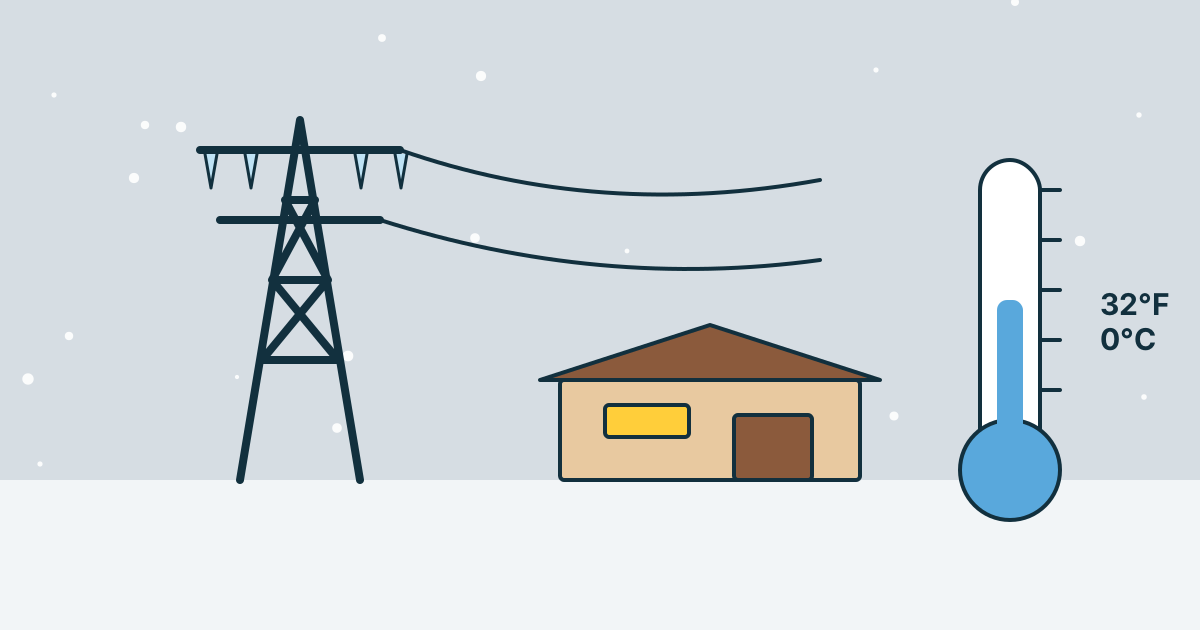
Hard freezes don’t come to most of Texas every winter, which is exactly why they catch people out. Homes, pipes and cars are built for heat, and many households don’t keep winter gear. When a freeze also puts strain on the power grid, outages and cold can arrive together. This page gathers the Texas-specific alerts and official advice so you can prepare in an afternoon.
This is general information, and it isn’t about who runs the grid or why. Call 911 in an emergency.
1. Sign up for grid notices from ERCOT
ERCOT, the grid operator for most of Texas, runs the Texas Advisory and Notification System (TXANS). It’s ERCOT’s early notice ahead of periods of higher demand. You can get it three ways, according to the TXANS page:
- Email: sign up through the TXANS email form on that page.
- The ERCOT mobile app, for iOS and Android.
- Social media: ERCOT posts on X, Facebook and LinkedIn.
What the notices mean, in ERCOT’s words:
- Weather Watch: an earlier notice, about 3 to 5 days ahead, of forecast significant weather and high demand. Grid conditions are normal when it’s issued. This is your cue to get ready.
- Voluntary Conservation Notice: a request to cut energy use during peak demand, if it’s safe to do so.
- Conservation Appeal: a stronger request, issued when reserves are low and there’s a potential for emergency operations.
ERCOT notes that TXANS notices don’t replace Energy Emergency Alerts. Your utility or electric provider handles outage reports and restoration for your address, so save their outage page and number too.
2. Make sure you’ll get weather warnings
The National Weather Service says Wireless Emergency Alerts need no sign-up and are free from wireless carriers. NWS sends them for warnings such as snow squalls and extreme wind, among others. Many Texas cities and counties also run their own opt-in alert systems. Check your county emergency management website and sign up.
3. If someone at home has medical or access needs
The State of Texas Emergency Assistance Registry (STEAR) is a free registry that gives local emergency planners and responders more information about needs in their community. TDEM recommends it for people with disabilities, people who are medically fragile, and people with access or functional needs, such as limited mobility or needing transportation or personal care help.
- Register online on the STEAR website, or dial 2-1-1.
- TDEM is clear that registering does not guarantee a specific service in an emergency. Keep your own plan too.
If anyone uses powered medical equipment, see my medical device power plan and power station sizing guide.
4. Heat safely: carbon monoxide comes first
Carbon monoxide warning. Generators, camp stoves, grills, and gas, kerosene or propane heaters give off carbon monoxide, which you can’t see or smell and which can kill within minutes. Never use them indoors, or in a garage, even with the door open. CDC says a generator must be at least 20 feet (6 m) from any window, door or vent.
Official guidance for Texas winter storms:
- Texas Ready says to have emergency heating equipment approved for indoor use, with the right fuel, and that gas, kerosene or propane heaters should not be used indoors because of the CO risk.
- The State’s winter page repeats Ready.gov: only use generators and grills outdoors and away from windows, and never heat your home with a gas stovetop or oven.
- CDC recommends a battery-operated CO detector, and keeping space heaters at least 3 feet (about 1 m) from anything that can burn.
My guide to staying warm when the power is out covers one warm room, layers and heater safety step by step.
5. Protect the pipes
Pipes in exterior walls, attics and crawlspaces freeze first. My cold-weather pipes guide covers insulating, dripping taps, opening cabinet doors and finding your main shutoff. The State’s winter page also links to a search for a licensed Texas plumber if you need one after a freeze.
Learn where your main water shutoff is now. My utility shutoffs guide shows what to look for.
6. Water and food for a few days
Freezes can affect water systems as well as power. CDC suggests storing at least 1 gallon (3.8 L) of water per person per day for 3 days. Fill containers before the freeze arrives. Keep food that needs no cooking, since many Texas kitchens have electric stoves.
- My 72-hour list is a good minimum.
- See food that lasts without a fridge for ideas.
7. Roads and the car
Icy roads are the other big winter risk. The State’s winter page links to DriveTexas.org for road conditions. Before you drive, check it, and keep a kit in the car. NHTSA lists blankets, water, non-perishable food, a flashlight, a first aid kit, and a phone charger. My winter car kit has the full list, including how to avoid carbon monoxide if you’re stuck.
8. Know where to go if it gets too cold
The State’s winter page links to a statewide warming center map. CDC says that if it’s too cold, go to a friend’s home or a community shelter. Plan the trip before roads ice over, and check on older neighbours, which CDC also recommends.
Build the rest of your plan
- Work out water, food and supplies for your household in the plan builder.
- Print ready-made lists, including the winter storm checklist.
- Plan meals without a stove on my food page and with no-cook recipes.
Questions people ask
How do I get ERCOT grid alerts?
ERCOT's TXANS page says you can sign up for email notifications, download the ERCOT mobile app, or follow ERCOT on social media. TXANS sends Weather Watches, Voluntary Conservation Notices and Conservation Appeals.
What is an ERCOT Weather Watch?
ERCOT describes it as an early notice, about 3 to 5 days ahead, of forecast significant weather and high demand. Grid conditions are normal when one is issued.
What is the STEAR registry in Texas?
STEAR is a free registry run with the Texas Division of Emergency Management. It gives local emergency planners information about people with disabilities, medical needs or access and functional needs. You can register online or by calling 2-1-1. TDEM says registering does not guarantee a specific service.
Can I use a propane or kerosene heater indoors in Texas?
Texas Ready says gas, kerosene or propane heaters should not be used indoors because of the risk of carbon monoxide poisoning. It says to have emergency heating equipment approved for indoor use.
Where can I find a warming center in Texas?
The State's winter weather page links to a statewide warming center map. Your city or county emergency management office will also post local locations.
Where to buy
Some links earn me a commission at no cost to you. How this works
Battery-operated carbon monoxide alarm
Kidde KN-COB-B-LP Nighthawk Carbon Monoxide Alarm, Battery Operated
Kidde lists it as UL Listed with an electrochemical sensor, and it runs on 3 AA batteries so it keeps working in a power outage.
Check prices and optionsat Amazon.comCanadian link coming soon
Battery-operated carbon monoxide alarm
Kidde C3010 Worry-Free Carbon Monoxide Alarm, 10-Year Sealed Battery
Kidde lists its Canadian C3010-CA as CSA Listed with an electrochemical sensor and a sealed lithium battery, so it keeps working in an outage; check the listing shows the CSA mark before buying.
US link coming soonCheck prices and optionsat Amazon.ca
Flashlight, battery or hand-crank
Black Diamond Spot 400 Headlamp
A AAA-powered dimmable headlamp that keeps both hands free and uses common batteries.
Check prices and optionsat Amazon.comCheck prices and optionsat Amazon.ca
Flashlight, battery or hand-crank
Petzl TIKKINA Headlamp, 300 Lumens
Petzl lists 300 lumens max and 100 hours at 7 lumens on three AAA batteries, at 92 g.
Check prices and optionsat Amazon.comCheck prices and optionsat Amazon.ca
Spare batteries for your flashlights and radio
Energizer Ultimate Lithium AA Batteries, 4 Pack
Energizer states AA Ultimate Lithium cells last up to 25 years in storage and work from -40°F to 140°F (-40°C to 60°C), which suits stored kits.
Check prices and optionsat Amazon.comCheck prices and optionsat Amazon.ca
Phone power bank
Anker Power Bank, 20,000mAh, Built-In USB-C Cable
A 20,000 mAh pack holds several phone charges and has its own cable, so one less thing to find in the dark.
Check prices and optionsat Amazon.comCheck prices and optionsat Amazon.ca
Water storage container, 7 gal / 26 L
Reliance Aqua-Tainer 7 Gallon Rigid Water Container
A rigid 7 gal (26 L) container sold for drinking water storage, so one jug covers several person-days.
Check prices and optionsat Amazon.comCheck prices and optionsat Amazon.ca
Battery or hand-crank radio, with NOAA Weather Radio
Midland ER310 Emergency Crank Weather AM/FM Radio
Runs from multiple power sources including a hand crank, and receives NOAA weather channels with alert.
Check prices and optionsat Amazon.comCheck prices and optionsat Amazon.ca
Battery or hand-crank radio, with NOAA Weather Radio
Kaito KA500 5-Way Powered Emergency AM/FM/SW Weather Alert Radio
Has solar, hand-crank and other power options plus a flashlight and reading lamp.
Check prices and optionsat Amazon.comCheck prices and optionsat Amazon.ca
Where these numbers come from (8 sources)
- ERCOT: Texas Advisory and Notification System (TXANS) https://www.ercot.com/txans
- TDEM: State of Texas Emergency Assistance Registry (STEAR) https://www.tdem.texas.gov/response/state-of-texas-emergency-assistance-registry
- Texas Ready: Winter storms https://texasready.gov/be-informed/natural-disasters/winter-storms.html
- Texas.gov: Winter weather resources https://open.texas.gov/winter
- National Weather Service: Wireless Emergency Alerts https://www.weather.gov/wrn/wea
- CDC: Stay Safe During and After a Winter Storm https://www.cdc.gov/winter-weather/safety/stay-safe-during-after-a-winter-storm-safety.html
- CDC: What to Do to Protect Yourself During a Power Outage https://www.cdc.gov/natural-disasters/response/what-to-do-protect-yourself-during-a-power-outage.html
- NHTSA: Winter Driving Tips https://www.nhtsa.gov/winter-driving-tips