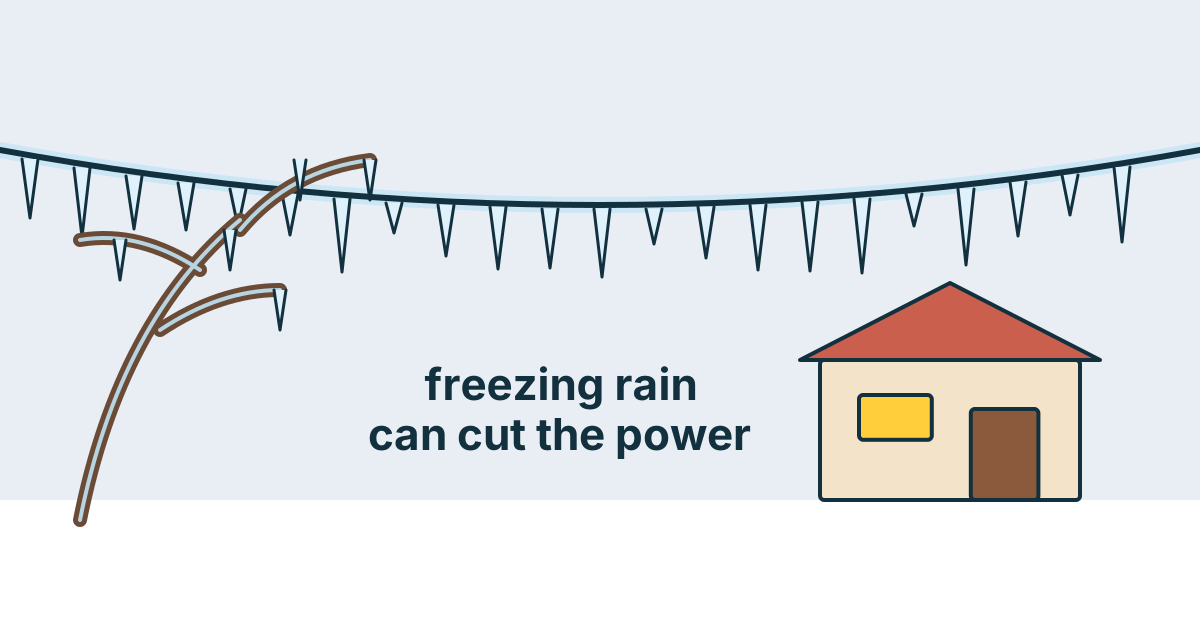
Freezing rain is one of the main causes of power outages in Ontario, the Province says. Ice weighs down branches and lines, and it makes roads and sidewalks slippery at the same time. Here’s how to set up alerts now and what to do when the ice comes.
This is general information. Follow your local officials and utility. Call 911 in an emergency.
1. Set up your alerts
Three alert sources cover most of what you need.
- Your utility’s outage alerts. If Hydro One is your utility, it offers outage alerts by text and email. You can sign up through myAccount, by texting REGISTER to 92887 (WATTS) and following the prompts, or in the Hydro One app under Outage Map, then Menu, then Get Outage Alerts. If your power comes from a local utility instead, check its website for a similar service.
- Weather warnings. Environment and Climate Change Canada’s free WeatherCAN app can send push notifications for severe weather, air quality and extreme temperatures.
- Alert Ready. Canada’s national emergency alerting system sends urgent alerts to TV, radio and compatible LTE-connected phones.
Ontario also suggests knowing how your own community shares updates in an emergency. Check your municipality’s website for a local alert sign-up.
2. Stock a 3-day kit, at least
Ontario says to make sure your household’s emergency kit is stocked to last at least 3 days. It also asks you to think about essentials an outage could affect, such as medication that needs to stay cold.
- Water: Canada.ca suggests about 4 L (about 1 US gallon) per person per day
- Food that needs no cooking or fridge
- Flashlights and spare batteries
- A battery or crank radio
- Charged phones and power banks
- Warm layers and a blanket or sleeping bag for each person
- Battery-operated smoke and carbon monoxide alarms, which Ontario recommends
- Medications, and a plan for any that need the fridge
My 72-hour list is a printable version, and the plan builder works out longer stays.
If you have a backup generator, Ontario says to follow the manufacturer’s instructions and make sure it’s professionally installed.
Medicine and medical devices
Ontario asks you to think ahead about essentials an outage could affect, such as refrigerated medication. If you take insulin or another medicine that needs the fridge, ask your pharmacist how long it can be kept out and how to keep it cool. My medication planning guide has questions to bring.
If someone at home uses powered medical equipment, talk to your supplier about a backup, and let your utility know. My medical device power plan and power station sizing guide can help.
3. When the ice arrives
Stay away from downed lines
Ontario says to keep yourself, children and pets at least 10 metres (about 33 feet) away from any downed power line. Give ice-laden trees and lines a wide berth when you go outside.
Heat and carbon monoxide
Carbon monoxide warning. Barbecues, camp stoves and generators give off carbon monoxide, which you can’t see or smell and which can kill within minutes. Ontario says not to use charcoal or gas barbecues, camping stoves or home generators indoors, because their exhaust can be fatal.
Ontario’s heating rules for an outage:
- Don’t use a gas stove or oven to heat your home. It could lead to carbon monoxide poisoning.
- Only use portable space heaters designed for indoor use.
- Turn your heating and cooling systems down to the minimum, to prevent damage when power returns.
Health Canada says that if your CO alarm sounds, leave right away, get to fresh air, and call 911 or the fire department from outside. Don’t go back in until a professional has fixed the problem.
My guide to staying warm when the power is out covers one warm room and layers.
Food
Ontario says to keep fridge and freezer doors closed while the power is out. My fridge food safety guide helps you decide what’s safe afterwards.
Know when the power’s back
Ontario suggests leaving one light switched on so you’ll know when power is restored.
4. When the power comes back
Ontario says to wait 10 to 15 minutes before slowly turning appliances back on, so the system has a chance to stabilise. Then check the fridge and freezer, and reset clocks and thermostats.
5. Check on people nearby
Canada.ca suggests checking on older relatives and neighbours before a winter storm, to make sure they have enough supplies, and helping during the storm if you can do it safely. On icy days, a phone call is safer than a walk across the street. My guide to neighbour networks has a simple way to organise it.
6. If you have to drive
It’s safest to stay off icy roads. If you must go, check road conditions first and keep a car kit. Canada.ca’s car kit includes a blanket, water in plastic bottles, food, a small shovel and scraper, a wind-up flashlight, and sand or non-clumping cat litter. See my winter car emergency kit for what to do if you get stuck.
Build the rest of your plan
- Get amounts for your household and number of days in the plan builder.
- Print ready-made lists, including the winter storm checklist.
- Plan no-cook meals with my food page and recipes.
Questions people ask
How do I sign up for Hydro One outage alerts?
Hydro One offers outage alerts by text and email. Sign up through myAccount, text REGISTER to 92887 (WATTS) and follow the prompts, or use the Hydro One app: Outage Map, then Menu, then Get Outage Alerts.
How far should I stay from a downed power line in Ontario?
Ontario says to keep yourself, children and pets at least 10 metres (about 33 feet) away from any downed power line.
How long should my emergency kit last in Ontario?
Ontario says to make sure your household's kit is stocked to last at least 3 days.
Can I use a gas stove to heat my home during an outage?
No. Ontario says not to use a gas stove or oven as a heat source because it could lead to carbon monoxide poisoning, and to use only portable space heaters designed for indoor use.
What should I do when the power comes back?
Ontario says to wait 10 to 15 minutes before slowly turning appliances back on, to give the system a chance to stabilise.
Where to buy
Some links earn me a commission at no cost to you. How this works
Battery-operated carbon monoxide alarm
Kidde KN-COB-B-LP Nighthawk Carbon Monoxide Alarm, Battery Operated
Kidde lists it as UL Listed with an electrochemical sensor, and it runs on 3 AA batteries so it keeps working in a power outage.
Check prices and optionsat Amazon.comCanadian link coming soon
Battery-operated carbon monoxide alarm
Kidde C3010 Worry-Free Carbon Monoxide Alarm, 10-Year Sealed Battery
Kidde lists its Canadian C3010-CA as CSA Listed with an electrochemical sensor and a sealed lithium battery, so it keeps working in an outage; check the listing shows the CSA mark before buying.
US link coming soonCheck prices and optionsat Amazon.ca
Flashlight, battery or hand-crank
Black Diamond Spot 400 Headlamp
A AAA-powered dimmable headlamp that keeps both hands free and uses common batteries.
Check prices and optionsat Amazon.comCheck prices and optionsat Amazon.ca
Flashlight, battery or hand-crank
Petzl TIKKINA Headlamp, 300 Lumens
Petzl lists 300 lumens max and 100 hours at 7 lumens on three AAA batteries, at 92 g.
Check prices and optionsat Amazon.comCheck prices and optionsat Amazon.ca
Spare batteries for your flashlights and radio
Energizer Ultimate Lithium AA Batteries, 4 Pack
Energizer states AA Ultimate Lithium cells last up to 25 years in storage and work from -40°F to 140°F (-40°C to 60°C), which suits stored kits.
Check prices and optionsat Amazon.comCheck prices and optionsat Amazon.ca
Battery or hand-crank radio, with NOAA Weather Radio
Midland ER310 Emergency Crank Weather AM/FM Radio
Runs from multiple power sources including a hand crank, and receives NOAA weather channels with alert.
Check prices and optionsat Amazon.comCheck prices and optionsat Amazon.ca
Battery or hand-crank radio, with NOAA Weather Radio
Kaito KA500 5-Way Powered Emergency AM/FM/SW Weather Alert Radio
Has solar, hand-crank and other power options plus a flashlight and reading lamp.
Check prices and optionsat Amazon.comCheck prices and optionsat Amazon.ca
Phone power bank
Anker Power Bank, 20,000mAh, Built-In USB-C Cable
A 20,000 mAh pack holds several phone charges and has its own cable, so one less thing to find in the dark.
Check prices and optionsat Amazon.comCheck prices and optionsat Amazon.ca
Water storage container, 7 gal / 26 L
Reliance Aqua-Tainer 7 Gallon Rigid Water Container
A rigid 7 gal (26 L) container sold for drinking water storage, so one jug covers several person-days.
Check prices and optionsat Amazon.comCheck prices and optionsat Amazon.ca
Where these numbers come from (8 sources)
- Ontario: Power outages and blackouts https://www.ontario.ca/page/power-outages-and-blackouts
- Hydro One: Outage alerts https://www.hydroone.com/request-a-service/outage-alerts
- Alert Ready https://www.alertready.ca/
- Environment and Climate Change Canada: WeatherCAN app https://www.canada.ca/en/environment-climate-change/services/weather-general-tools-resources/weathercan.html
- Canada.ca: Winter storms, how to prepare https://www.canada.ca/en/services/policing/emergencies/preparedness/get-prepared/hazards-emergencies/winter-storms/how-prepare.html
- Health Canada: Keep carbon monoxide out of your home https://www.canada.ca/en/health-canada/services/air-quality/indoor-air-contaminants/keep-carbon-monoxide-out-your-home.html
- Canada.ca: Emergency kits https://www.canada.ca/en/services/policing/emergencies/preparedness/get-prepared/emergency-kits.html
- Canada.ca: Emergency car kit https://www.canada.ca/en/services/policing/emergencies/preparedness/get-prepared/emergency-kits/car-kit.html