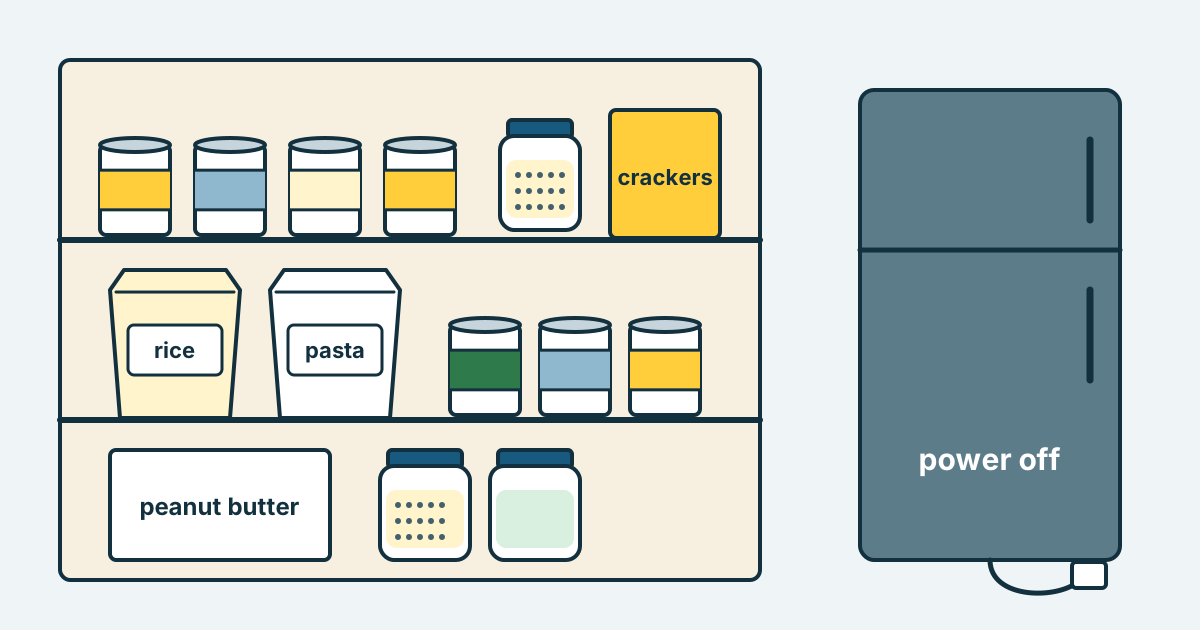
When the power goes out, the food question comes in two parts. First, what in your fridge can you still eat? Second, what could you keep in the cupboard so that next time it matters less? This post covers both, using the FoodSafety.gov outage chart, Health Canada, USDA FSIS and CDC. There is a short keep-or-throw-out quiz at the end.
The two numbers that decide everything
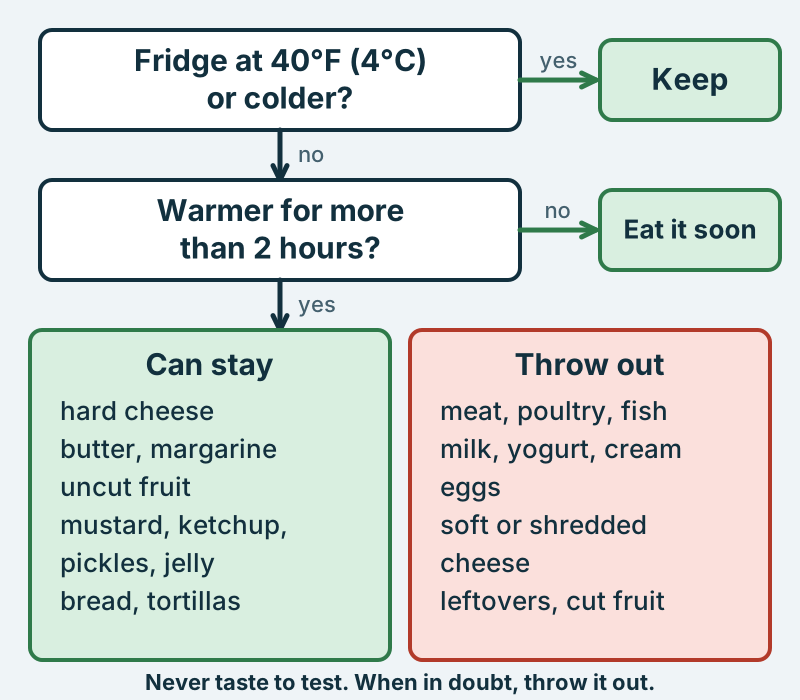
40°F (4°C). That is the safe line for a fridge. Above it, bacteria grow faster.
2 hours. FoodSafety.gov’s chart sorts fridge food by whether it has been at 40°F (4°C) or above for more than 2 hours. Health Canada’s rule for food at room temperature is the same: 2 or more hours and it goes.
A closed fridge stays cold for about 4 hours, and a full freezer for about 48 hours (24 if half full), according to CDC and Health Canada. That is why the most important thing in an outage is to keep the doors shut. A cheap fridge thermometer turns guesswork into a reading.
Fridge food that can stay
The FoodSafety.gov chart lists these as keep, even after more than 2 hours above 40°F (4°C):
- Hard cheeses: cheddar, Colby, Swiss, Parmesan, provolone, Romano
- Butter and margarine
- Fresh fruit that has not been cut
- Jelly, relish, taco sauce, mustard, ketchup, olives and pickles
- Bread, rolls, cakes, muffins, quick breads and tortillas
Fridge food that goes
And these as discard after more than 2 hours above 40°F (4°C):
- Raw or cooked meat, poultry, fish and seafood
- Milk, cream, sour cream, buttermilk, yogurt and soy milk
- Fresh eggs, hard-cooked eggs and egg dishes
- Soft cheeses such as mozzarella
- Cut fresh fruit
The chart covers many more foods. My fridge and freezer guide has a fuller table, including what to do with freezer food that still has ice crystals.
Never taste food to find out. Health Canada points out that food contaminated with bacteria does not always smell bad or look spoiled. Throw out anything with an unusual colour or smell, anything that touched floodwater, and anything in a leaking, swollen or punctured container.
Food that never needed a fridge
The easiest outage is one where most of your meals were never cold to begin with. USDA FSIS gives these storage times for food kept in a cool, dry place:
| Food | Keeps for |
|---|---|
| Low-acid cans: meat, poultry, stews, beans, corn, peas | 2 to 5 years |
| High-acid cans: tomatoes, most fruit, juice, pickles | 12 to 18 months |
| Tuna and seafood in pouches | 18 months |
| Rice and dried pasta | 2 years |
| Commercially packaged jerky | 12 months |
FSIS says temperatures below 85°F (29°C) are best, and that heat over 100°F (38°C) harms canned goods. Keep food away from the stove, the space under the sink, and damp garages or basements.
For outage meals, I lean on things that need no cooking:
- Canned beans, chicken, tuna or salmon
- Peanut butter or another nut or seed butter
- Crackers, dry cereal and granola
- Canned fruit and vegetables
- Shelf-stable milk or juice boxes
Health Canada suggests foods that keep well, such as canned food and energy bars, and reminds us to plan around allergies, celiac disease and food intolerances. Do not forget a manual can opener. My post on pantry staples that keep for a year goes further, and what to stock by calories helps you work out how much.
Once a can is open
An open can is fridge food again. Without a fridge, Health Canada’s rule for food at room temperature applies: throw it out after 2 hours. In hot weather the limit is shorter, and my fridge guide lists the 1-hour rule above 90°F (32°C). Small cans sized for one meal mean less waste when nothing can be chilled.
Cooking when the stove is off
Many shelf-stable foods are fine cold. If you want something hot, see cooking without power.
Carbon monoxide warning. Generators, camp stoves, barbecues, charcoal, and kerosene or propane burners give off carbon monoxide, which you cannot see or smell and which can kill within minutes. Never use them indoors, or in a garage, basement, shed, tent or covered porch, even with doors and windows open. Outdoors, keep them at least 20 feet (6 m) from doors, windows and vents.
The Red Cross also says not to use outdoor stoves indoors for heating or cooking.
Medicine in the fridge
Some medicines need refrigeration. CDC says that when the power is out for a day or more, refrigerated medicine should be thrown away unless the label says otherwise. Call your pharmacist about replacing it, and see my medication planning page for what to sort out before the next outage.
Plan the next one now
- Build a no-fridge menu with 14 days of no-power pantry meals.
- Use the plan builder to size your food stock to your household.
- Keep it fresh with pantry rotation.
Quick quiz
Keep it or throw it out?
Based on the FoodSafety.gov chart for food above 40°F (4°C) for more than 2 hours, unless the question says otherwise.
Power out 3 hours, fridge door kept shut, thermometer reads 38°F (3°C). The milk?
A closed fridge keeps food safe for about 4 hours, and 40°F (4°C) or below is the safe line.
Block of cheddar, fridge warm for more than 2 hours.
Hard cheeses such as cheddar, Swiss and Parmesan are on the keep list.
Shredded mozzarella, fridge warm for more than 2 hours.
Soft and shredded cheeses go.
Butter, fridge warm for more than 2 hours.
Butter and margarine are on the keep list.
Leftover cooked chicken, fridge warm for more than 2 hours.
Raw or cooked meat, poultry and seafood all go.
Mustard, ketchup and pickles, fridge warm for more than 2 hours.
These condiments are on the keep list.
Cut melon, fridge warm for more than 2 hours.
Cut fruit goes. Whole, uncut fruit can stay.
Something smells fine but you are not sure. Taste a little to check?
Never taste food to test it. Health Canada notes that contaminated food does not always smell or look spoiled.
Questions people ask
What is the 2-hour rule for fridge food in a power outage?
FoodSafety.gov says to throw out perishable fridge food that has been at 40°F (4°C) or above for more than 2 hours. Health Canada says to throw away food that has been at room temperature for 2 or more hours.
Can I keep butter and hard cheese after a power outage?
Yes. The FoodSafety.gov chart lists butter, margarine and hard cheeses such as cheddar, Swiss and Parmesan as safe to keep even after more than 2 hours above 40°F (4°C).
Are eggs safe after the power has been out?
Not if they have been above 40°F (4°C) for more than 2 hours. FoodSafety.gov lists fresh shell eggs, hard-cooked eggs and egg dishes as discard.
What foods need no fridge at all?
Canned meat, fish, beans and vegetables, canned fruit, rice, dried pasta, crackers, cereal, peanut butter and other shelf-stable foods. USDA FSIS gives 2 to 5 years for low-acid cans and 12 to 18 months for high-acid cans stored cool and dry.
Can I tell if food is safe by smelling it?
No. Health Canada notes that food contaminated with bacteria does not always smell bad or look spoiled. Never taste food to test it. When in doubt, throw it out.
Where to buy
Some links earn me a commission at no cost to you. How this works
Canned beans, tuna, chicken or stew
Canned chunk chicken breast, multi-pack
Fully cooked and ready to eat from the can; USDA FSIS lists canned meat and poultry at 2 to 5 years.
Check prices and optionsat Amazon.comCheck prices and optionsat Amazon.ca
Peanut butter or another nut or seed butter
Peanut butter, large jars, multi-pack
Ready-to-eat protein that needs no cooking or fridge before opening; check for peanut allergies in your household first.
Check prices and optionsat Amazon.comCheck prices and optionsat Amazon.ca
Manual can opener
OXO Good Grips Lock & Go Can Opener
A manual opener that works without power and has locking arms that hold the can while you turn.
Check prices and optionsat Amazon.comCheck prices and optionsat Amazon.ca
Where these numbers come from (5 sources)
- FoodSafety.gov: Food Safety During a Power Outage (chart) https://www.foodsafety.gov/food-safety-charts/food-safety-during-power-outage
- Health Canada: Food and drinking water safety in an emergency https://www.canada.ca/en/health-canada/services/food-drinking-water-safe-emergency.html
- USDA FSIS: Shelf-Stable Food Safety https://www.fsis.usda.gov/food-safety/safe-food-handling-and-preparation/food-safety-basics/shelf-stable-food
- CDC: What to Do to Protect Yourself During a Power Outage https://www.cdc.gov/natural-disasters/response/what-to-do-protect-yourself-during-a-power-outage.html
- American Red Cross: Power Outage https://www.redcross.org/get-help/how-to-prepare-for-emergencies/types-of-emergencies/power-outage.html