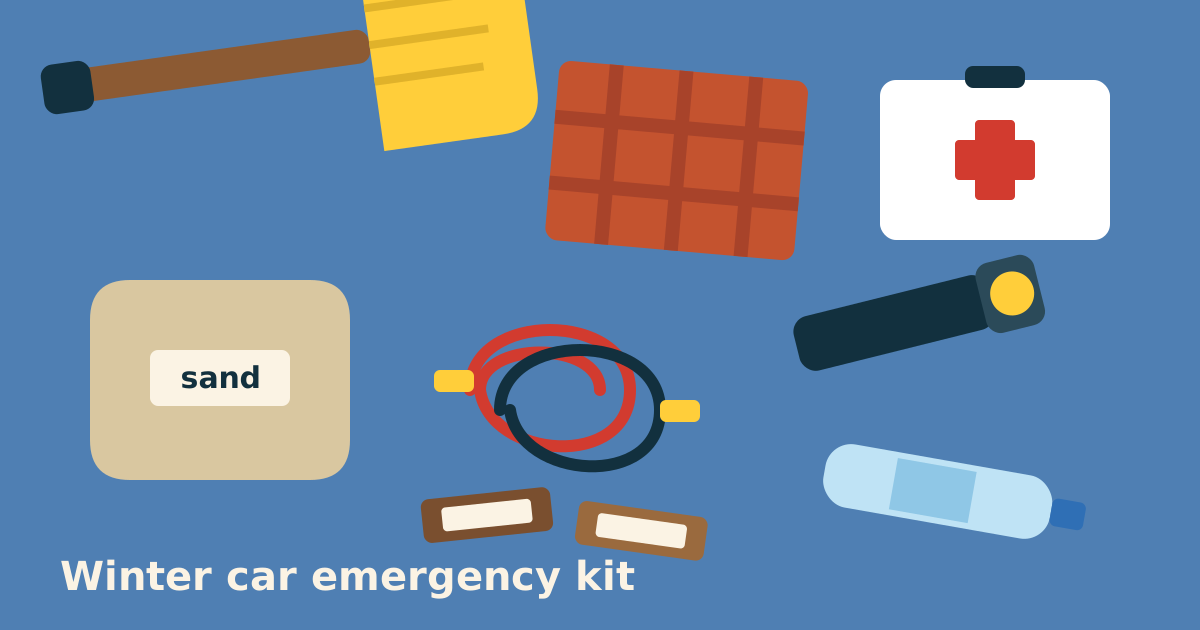
A car is a small shelter if it has the right things in it. Winter breakdowns, a closed highway or a ditch on a quiet road can leave you waiting for hours. The kit below comes from the lists that NHTSA and Canada.ca publish, with notes on how to use it safely. It fits in a plastic tote or a duffel bag in the trunk.
This is general information. If you’re in danger, call 911.
The kit, item by item
NHTSA groups its winter list into six parts. Canada.ca’s car kit list overlaps it and adds a few things. Here they are together.
Snow and traction
- A snow shovel, broom or snowbrush, and an ice scraper. Both lists include them.
- Sand, salt or non-clumping cat litter for traction if you get stuck.
Safety and repair
- Jumper cables. NHTSA notes that when the temperature drops, so does battery power.
- A flashlight. Canada.ca suggests a wind-up flashlight, so dead batteries aren’t a problem.
- Warning devices, such as road flares or a warning light.
- A tow rope, a fire extinguisher, and antifreeze or windshield washer fluid. Canada.ca lists these to keep in the trunk.
- A whistle to attract attention.
Warmth and comfort
- Blankets. A sleeping bag works too.
- Extra clothing and shoes: a hat, mittens, warm socks and winter boots. Michigan State Police also suggests hand warmer packets and a Mylar space blanket.
Food and water
- Non-perishable food, such as energy bars, nuts, dried fruit or granola bars.
- Water in plastic bottles. Canada.ca says plastic, so it won’t break if it freezes, and to change it every six months.
Health
- A first aid kit. Canada.ca suggests one with a seatbelt cutter, and NHTSA mentions a tourniquet.
- Any medicines you need, in case you’re stuck for hours.
Communication and paperwork
- A phone and a car charger. A small power bank is a good backup.
- Road maps, in case there’s no signal.
- A copy of your emergency plan and personal documents.
Canada.ca also lists a candle in a deep can with matches. If you carry one, keep it upright in the can, away from fabric, and only light it while you’re awake. Never leave a flame burning while you sleep.
Before you drive in winter
A kit helps if something goes wrong. These steps make that less likely.
- Check the weather and roads before you go. In BC, DriveBC shows real-time road conditions, closures and highway webcams. Most US states and Canadian provinces have a similar road-conditions site or a 511 service.
- Keep the tank close to full. NHTSA says to keep your gas tank close to full whenever possible. If you’re stuck, that fuel is also your heat.
- Check your tires. NHTSA says to inflate to the pressure your vehicle maker recommends, not the number on the tire, which is the maximum the tire can hold. Check them cold, after at least three hours parked, and keep at least 2/32 inch of tread. Transport Canada notes that below 7°C (about 45°F), all-season and summer tires begin to lose traction.
- Get the battery checked. NHTSA suggests having a mechanic test the battery and charging system before winter.
- Tell someone your route and when you expect to arrive.
If you get stuck
Both NHTSA and Canada.ca say the same first thing: stay with your vehicle. Michigan State Police adds that staying put is usually safest unless a safe place is within sight. A car is easier for rescuers to find than a person on foot, and walking in a storm wears you out fast.
- Call for help. Call 911 or a roadside service.
- Make yourself visible. NHTSA suggests bright markers on the antenna or windows and keeping the dome light on.
- Don’t overexert yourself. Shovelling in heavy snow is hard work in the cold. Take breaks.
- Layer up and stay dry. Put on the extra clothing before you get cold, and change out of anything wet.
- Eat and drink a little at a time.
Carbon monoxide: the exhaust pipe
Carbon monoxide warning. A running engine makes carbon monoxide, which you can’t see or smell and which can kill within minutes. If snow blocks the exhaust pipe, the gas can build up inside the car.
- Keep the tailpipe clear. Canada.ca says to keep the tail pipe clear of snow and ice. Michigan State Police says to check it periodically.
- Run the engine only in short bursts. Michigan State Police says to run the vehicle for only 5 to 10 minutes each hour, with the windows open slightly for ventilation. NHTSA says to run the car only sporadically, just long enough to stay warm.
- Never run a car in a closed garage, even to warm it up.
If anyone feels dizzy, sleepy, sick or confused, turn the engine off, open the windows and get fresh air.
Pack it once, check it twice a year
A good time to check the kit is when you change your clocks or switch to winter tires. Swap out water every six months, as Canada.ca suggests, replace food before its date, and recharge or replace batteries. If you take medicine, rotate it so it doesn’t expire in the car, and keep it away from freezing if the label says so.
For a kit you can grab if you need to leave home, see my go-bag checklist. If you’re deciding whether to drive at all in a storm, my post on staying in or leaving may help.
Build the rest of your plan
- Get supply amounts for your household at home in the plan builder.
- See ready-made lists, including the winter storm checklist.
- Find car-friendly snacks on my food page and no-cook ideas such as trail mix in recipes.
Questions people ask
What should be in a winter car emergency kit?
NHTSA lists a snow shovel, broom and ice scraper; sand or kitty litter for traction; jumper cables, a flashlight and warning devices; a first aid kit and any medicines you need; blankets, bottled water and non-perishable food; and a phone with a car charger. Canada.ca adds a whistle, road maps, extra clothing and a tow rope.
Should I stay in my car if I'm stuck in snow?
NHTSA and Canada.ca both say to stay with your vehicle. Michigan State Police says staying put is usually safest unless a safe place is within sight. Call 911 or a roadside service, and make the car easy to see.
How often can I run the engine to stay warm?
Michigan State Police says to run the vehicle for only 5 to 10 minutes each hour, open the windows slightly for fresh air, and make sure the exhaust pipe is clear of snow, ice or dirt. Check the pipe again from time to time.
Why plastic water bottles in the car?
Canada.ca suggests water in plastic bottles so they won't break if they freeze, and says to change them every six months.
Do I need winter tires?
Transport Canada notes that below 7°C (about 45°F), all-season and summer tires begin to lose traction. Rules on winter tires differ by province and state, so check your local transportation ministry or department.
Where to buy
Some links earn me a commission at no cost to you. How this works
SOL 90% Heat Reflective Heavy Duty Emergency Blanket
A compact reflective blanket that the maker rates at 90% heat reflection, useful as a low-cost layer in a home without heat.
Check prices and optionsat Amazon.comCheck prices and optionsat Amazon.ca
First aid kit with bandages, antiseptic wipes and gloves
First Aid Only 299 Piece All-Purpose First Aid Kit
A soft-sided kit with a broad mix of common supplies for home use; check contents and replace used items.
Check prices and optionsat Amazon.comCheck prices and optionsat Amazon.ca
First aid kit with bandages, antiseptic wipes and gloves
Adventure Medical Kits Mountain Series Hiker Medical Kit
Sized by the maker for 2 people for 2 days and includes a guide book for when you can't get information online.
Check prices and optionsat Amazon.comCheck prices and optionsat Amazon.ca
Flashlight, battery or hand-crank
Black Diamond Spot 400 Headlamp
A AAA-powered dimmable headlamp that keeps both hands free and uses common batteries.
Check prices and optionsat Amazon.comCheck prices and optionsat Amazon.ca
Flashlight, battery or hand-crank
Petzl TIKKINA Headlamp, 300 Lumens
Petzl lists 300 lumens max and 100 hours at 7 lumens on three AAA batteries, at 92 g.
Check prices and optionsat Amazon.comCheck prices and optionsat Amazon.ca
Spare batteries for your flashlights and radio
Energizer Ultimate Lithium AA Batteries, 4 Pack
Energizer states AA Ultimate Lithium cells last up to 25 years in storage and work from -40°F to 140°F (-40°C to 60°C), which suits stored kits.
Check prices and optionsat Amazon.comCheck prices and optionsat Amazon.ca
Phone power bank
Anker Power Bank, 20,000mAh, Built-In USB-C Cable
A 20,000 mAh pack holds several phone charges and has its own cable, so one less thing to find in the dark.
Check prices and optionsat Amazon.comCheck prices and optionsat Amazon.ca
Where these numbers come from (6 sources)
- NHTSA: Winter Driving Tips https://www.nhtsa.gov/winter-driving-tips
- Canada.ca: Emergency car kit https://www.canada.ca/en/services/policing/emergencies/preparedness/get-prepared/emergency-kits/car-kit.html
- Canada.ca: Winter storms, how to prepare https://www.canada.ca/en/services/policing/emergencies/preparedness/get-prepared/hazards-emergencies/winter-storms/how-prepare.html
- Michigan State Police: Know how to handle winter driving emergencies https://www.michigan.gov/msp/divisions/ohsp/safety-programs/winter-driving/know-how-to-handle-winter-driving-emergencies
- Transport Canada: Winter driving https://tc.canada.ca/en/road-transportation/stay-safe-when-driving/winter-driving
- DriveBC https://www.drivebc.ca/