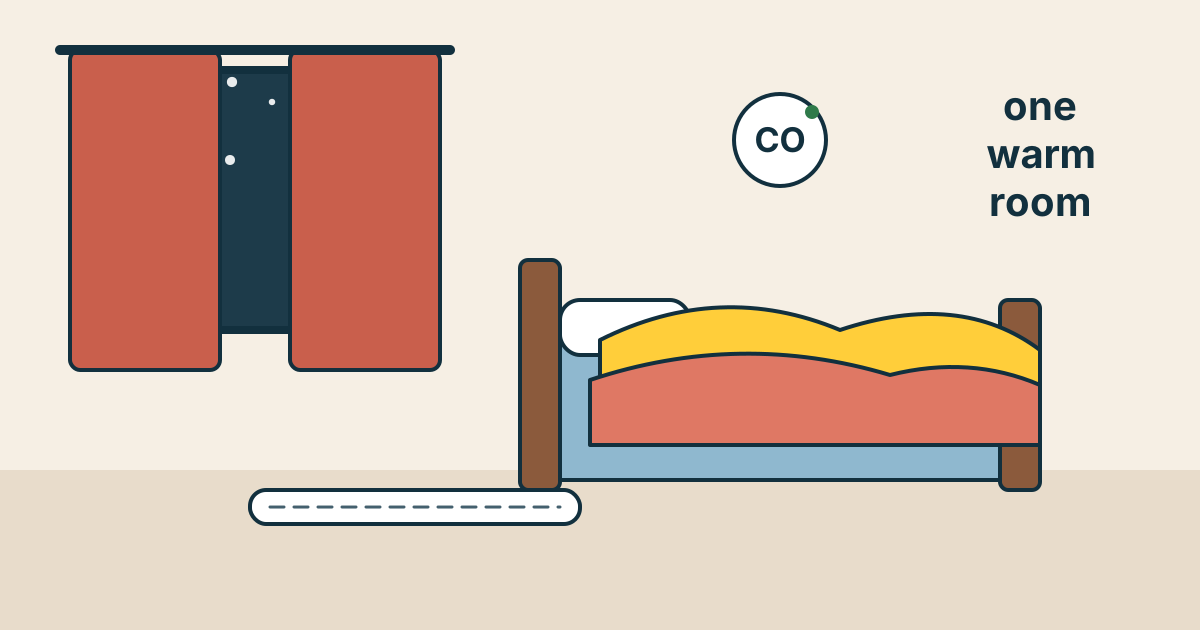
When the power goes out in winter, the house cools slowly at first, then faster. The safest heat in an outage is the heat you already have: your body’s warmth, kept in by layers, blankets and a closed room. Everything that burns fuel comes with a carbon monoxide or fire risk, so I’ll start there and then get to the practical steps.
This is general information from official sources in the US and Canada. Follow your local officials, and call 911 in an emergency.
Safety first: carbon monoxide
Carbon monoxide warning. Generators, camp stoves, barbecues, charcoal, and kerosene or propane burners give off carbon monoxide, a gas you can’t see or smell that can kill within minutes. Never use them indoors, or in a garage, basement, shed, tent or covered porch, even with doors and windows open. CDC says a generator must be at least 20 feet (6 m) from any window, door or vent.
The official rules for heat in an outage are short:
- Never heat your home with the stove or oven. CDC says turning on the stove for heat is not safe. Ontario says not to use a gas stove or oven as a heat source because it could lead to carbon monoxide poisoning.
- No fuel-burning heaters indoors unless they’re properly vented. CDC says to use fireplaces, wood stoves or other combustion heaters only if they are properly vented to the outside. Texas Ready says gas, kerosene or propane heaters should not be used indoors because of the carbon monoxide risk.
- Only space heaters made for indoor use. That’s Ontario’s wording, and it applies to any heater you bring inside.
- Have a working CO alarm. CDC recommends a battery-operated CO detector. Health Canada says the most important place for one is in hallways, outside sleeping areas. In Canada, look for a Canadian certification mark on both the alarm and the box.
Health Canada says that if the alarm sounds, leave your home immediately and move to fresh air. Don’t try to find the source. Once outside, call 911 or your local fire department, and go back in only after a professional has fixed the problem.
Fire safety with any heat source
The US Fire Administration says to keep anything that can burn at least 3 feet (about 1 m) from all heat sources, including fireplaces, wood stoves, radiators and candles. CDC gives the same distance for space heaters. USFA also says:
- Turn space heaters off when you leave the room or go to bed.
- Don’t use extension cords on appliances.
- Have heating equipment and chimneys cleaned and inspected each year by a professional.
Canada.ca adds a reminder to clean your chimney and flues and make sure a wood stove or fireplace is well maintained and working. If you heat with wood, do that check before winter, not during a storm. My home fire safety guide covers smoke alarms and escape plans.
Pick one warm room
CDC’s advice is to close off unneeded rooms, stuff towels or rags in cracks under doors, and avoid opening doors or windows when you don’t need to. In practice, that means picking one room and keeping it as warm as you can.
- Choose a room with few outside walls and windows. An inside bedroom often works.
- Close the doors to the rest of the house and roll a towel along the bottom of the door.
- Cover windows at night. Draw heavy curtains, or hang a blanket over the window.
- Bring everyone in, including pets. Several people in one small room keep it warmer.
- Insulate from the floor. Sleep off a cold floor if you can, on a mattress or with blankets underneath you.
My apartment winter guide has a floor plan of a warm room and a quick planner.
Dress in layers
CDC recommends dressing in layers: an inner layer that wicks moisture, an insulating layer that traps heat, and an outer layer against wind and water. Indoors, that might be a thermal base layer, a fleece or wool sweater, and a coat if it gets cold enough.
Small things help a lot:
- Hats and socks. Wear a hat indoors, and keep spare dry socks. Change out of anything damp right away.
- Blankets and sleeping bags. CDC’s outage page lists extra blankets, sleeping bags and warm winter coats as ways to keep warm.
- Warm drinks and regular meals. If you have a safe way to heat water, a hot drink helps. My hot cocoa recipe uses shelf-stable powders. Never use a camp stove indoors. See cooking without power for safe options.
Watch for the cold getting to people
Older adults, babies and anyone who is ill can get cold faster. CDC says to check on older friends and neighbours often to make sure their homes are heated properly. Canada.ca suggests checking on older relatives and neighbours before a storm, to make sure they have enough supplies.
Learn the signs of hypothermia and frostbite before you need them. They’re on my winter storm checklist, along with what to do.
Protect the house, too
A cold house can mean frozen pipes. My cold-weather pipes guide covers what to do before and during a freeze. Ontario also suggests turning heating systems down to the minimum during an outage to prevent damage when power comes back, and waiting 10 to 15 minutes before slowly turning appliances back on.
Know when to go
If you can’t keep a room warm enough, leave. CDC says that if conditions are too hot or too cold, seek shelter with friends or at a community shelter. Listen to local radio or check your city or county website for warming centres, and plan how you’d get there safely before roads ice over.
If someone in your home uses powered medical equipment, plan this step early. My medical device power plan and power station sizing guide can help.
A short warmth kit
Most of this you may already own. Gather it in one place before winter:
- A blanket or sleeping bag for each person
- Hats, gloves, warm socks and a base layer for each person
- A battery-operated carbon monoxide alarm and spare batteries
- Flashlights or headlamps instead of candles, which CDC suggests to lower the fire risk
- Towels for door gaps, and spare blankets for windows
- Water and food that needs no cooking
Build the rest of your plan
- Get a full list for your household and number of days in the plan builder.
- Browse ready-made lists, including the winter storm list.
- See what to eat without a working stove on my food page and in no-cook recipes.
Questions people ask
How can I heat a room without electricity safely?
Start with what doesn't burn anything: close off unused rooms, block draughts, layer clothing and blankets, and keep everyone in one room. If you use a fireplace, wood stove or other fuel-burning heater, CDC says to use it only if it is properly vented to the outside, and keep a battery-operated carbon monoxide alarm working.
Can I use my gas oven or stove to heat the house?
No. CDC says turning on the stove for heat is not safe, and Ontario says not to use a gas stove or oven as a heat source because it could lead to carbon monoxide poisoning.
Is it safe to use a propane or kerosene heater indoors?
Texas Ready says gas, kerosene or propane heaters should not be used indoors because of the risk of carbon monoxide poisoning. CDC says to use combustion heaters only if they are properly vented to the outside. Ontario says to use only portable space heaters designed for indoor use.
How far should a space heater be from things that can burn?
At least 3 feet (about 1 m) from drapes, furniture, bedding and anything else that can burn, according to CDC and the US Fire Administration. USFA also says to turn space heaters off when you leave the room or go to bed.
What are the signs of carbon monoxide poisoning?
Health Canada lists flu-like symptoms at low levels, such as tiredness, headaches and shortness of breath, and dizziness, chest pain, poor vision and trouble thinking at higher levels. If the alarm sounds or anyone feels this way, leave right away, get to fresh air and call 911.
Where to buy
Some links earn me a commission at no cost to you. How this works
Battery-operated carbon monoxide alarm
Kidde KN-COB-B-LP Nighthawk Carbon Monoxide Alarm, Battery Operated
Kidde lists it as UL Listed with an electrochemical sensor, and it runs on 3 AA batteries so it keeps working in a power outage.
Check prices and optionsat Amazon.comCanadian link coming soon
Battery-operated carbon monoxide alarm
Kidde C3010 Worry-Free Carbon Monoxide Alarm, 10-Year Sealed Battery
Kidde lists its Canadian C3010-CA as CSA Listed with an electrochemical sensor and a sealed lithium battery, so it keeps working in an outage; check the listing shows the CSA mark before buying.
US link coming soonCheck prices and optionsat Amazon.ca
SOL 90% Heat Reflective Heavy Duty Emergency Blanket
A compact reflective blanket that the maker rates at 90% heat reflection, useful as a low-cost layer in a home without heat.
Check prices and optionsat Amazon.comCheck prices and optionsat Amazon.ca
Flashlight, battery or hand-crank
Black Diamond Spot 400 Headlamp
A AAA-powered dimmable headlamp that keeps both hands free and uses common batteries.
Check prices and optionsat Amazon.comCheck prices and optionsat Amazon.ca
Spare batteries for your flashlights and radio
Energizer Ultimate Lithium AA Batteries, 4 Pack
Energizer states AA Ultimate Lithium cells last up to 25 years in storage and work from -40°F to 140°F (-40°C to 60°C), which suits stored kits.
Check prices and optionsat Amazon.comCheck prices and optionsat Amazon.ca
Where these numbers come from (7 sources)
- CDC: Stay Safe During and After a Winter Storm https://www.cdc.gov/winter-weather/safety/stay-safe-during-after-a-winter-storm-safety.html
- CDC: What to Do to Protect Yourself During a Power Outage https://www.cdc.gov/natural-disasters/response/what-to-do-protect-yourself-during-a-power-outage.html
- US Fire Administration: Heating fire safety https://www.usfa.fema.gov/prevention/home-fires/prevent-fires/heating/
- Health Canada: Keep carbon monoxide out of your home https://www.canada.ca/en/health-canada/services/air-quality/indoor-air-contaminants/keep-carbon-monoxide-out-your-home.html
- Canada.ca: Winter storms, how to prepare https://www.canada.ca/en/services/policing/emergencies/preparedness/get-prepared/hazards-emergencies/winter-storms/how-prepare.html
- Ontario: Power outages and blackouts https://www.ontario.ca/page/power-outages-and-blackouts
- Texas Ready: Winter storms https://texasready.gov/be-informed/natural-disasters/winter-storms.html