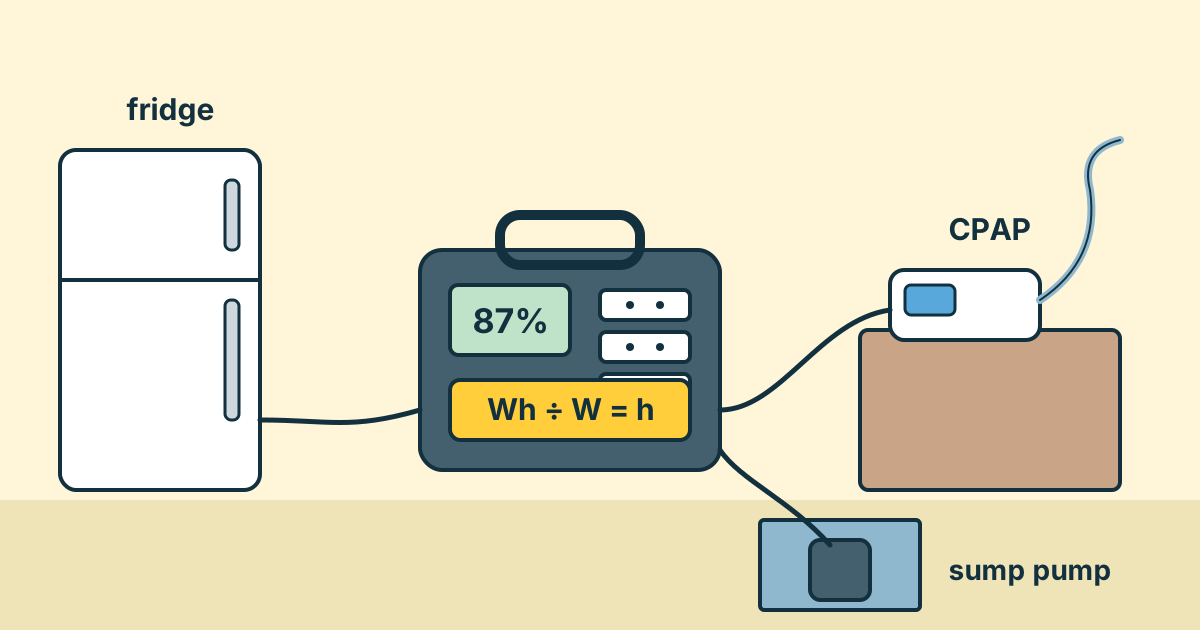
A portable power station is a big battery with outlets. The first question is usually not which brand, but how big. The answer comes from two numbers on the label of whatever you want to run, and a bit of multiplication. Here is that math for the three devices people ask about most: a fridge, a CPAP, and a sump pump. After that comes a table of six models, using only the specs their makers publish, so you can see which ones fit your numbers.
This is general information. If someone in your home relies on a powered medical device, talk to your equipment supplier and your doctor before you rely on any battery. My medical device power plan covers the other steps, like telling your utility.
The two numbers that matter
Every station lists two ratings, and you need both.
- Capacity, in watt-hours (Wh). This is how much energy is stored. It decides how long things run.
- Output, in watts (W). This is how much power the station can deliver at once. It decides what can run at all. Many makers also list a higher surge figure for the brief jolt some motors need to start.
The basic sum is: hours of runtime = usable watt-hours ÷ watts drawn.
Real runtime is lower than the label suggests, because the station loses some energy turning battery power into household AC. Makers don’t give one standard figure for this. My own planning assumption, not a manufacturer number, is to count on only about 80% of the rated watt-hours. I use that below so the examples lean toward too big rather than too small.
CPAP: check your own label first
CPAP machines vary a lot, so the most useful number is the one printed on your device or in its manual. Ask your equipment supplier if you can’t find it, and ask whether a DC adapter is available for your model, since running on DC can avoid some conversion loss.
As a worked example, ResMed’s user guide for the AirSense 11 lists a typical power consumption of 56.1 W and a peak of 73.2 W. The guide gives one figure, not separate ones with and without the humidifier or a heated tube, so your real draw depends on your settings.
For an 8-hour night:
- Typical: 56.1 W × 8 h = 449 Wh. With the 80% margin: 449 ÷ 0.8 = about 560 Wh.
- Peak: 73.2 W × 8 h = 586 Wh. With the margin: 586 ÷ 0.8 = about 730 Wh.
So for one night at the peak figure, a station of roughly 750 Wh or more fits. For two or three nights between charges, multiply. Output is rarely the limit here: any of the stations below can deliver 73 W.
Fridge: start with the yellow label
A fridge cycles on and off, so its watts alone don’t tell you how much energy it uses in a day. The better number is on its energy label. In the US the EnergyGuide label shows estimated yearly energy use in kWh. The FTC notes this is an estimate based on typical use. In Canada the EnerGuide label shows the same kind of figure.
Here’s the math using an example label of 600 kWh a year. That number is only to show the steps, so use the one on your own fridge.
- Daily energy: 600 kWh ÷ 365 = 1.64 kWh, or 1,644 Wh a day.
- With the 80% margin: 1,644 ÷ 0.8 = about 2,055 Wh a day.
Older fridges use more. ENERGY STAR says an old refrigerator uses, on average, about 20% more energy than one that has earned its label.
Two more checks:
- Running watts. Look for the rating plate inside the fridge. It usually lists volts and amps. Volts × amps gives a rough maximum in watts, and the station’s continuous output should be above it.
- Start-up surge. The compressor draws more for a moment when it kicks on. Fridge makers rarely publish this, so a station with a surge rating well above the running watts gives you room. If you’re unsure, ask the fridge maker.
You may not need to run the fridge all day. CDC says a fridge keeps food safe for up to 4 hours without power if you keep the door shut. My fridge food safety guide explains when to throw food out.
Sump pump: the hardest one to cover
A sump pump uses a lot of power while it runs, and it runs most when the weather is worst. As an example, Zoeller’s catalog sheet for its Model 53 lists a 3/10 hp motor at 115 or 230 V and 4.8 to 9.7 amps. For a 115 V home, plan on the higher figure:
- Running watts: 115 V × 9.7 A = about 1,116 W.
- Start-up draw is higher than that and is not on the sheet. Ask the pump maker before you rely on any station.
Now the energy. Say the pump runs a total of 10 minutes in every hour during a storm. That number is only to show the math. Then:
- 1,116 W × (10 ÷ 60) h = 186 Wh per hour.
- Over 24 hours: 186 × 24 = about 4,460 Wh, or about 5,580 Wh with the 80% margin.
That’s more than any single station in the table below holds. A station can bridge a short outage or a light rain, but for long storms people usually look at a battery backup sold for sump pumps, or a generator.
Carbon monoxide warning. A fuel-burning generator gives off carbon monoxide, which you can’t see or smell and which can kill within minutes. Never run it indoors, or in a garage, basement, shed or covered porch, even with doors open. CDC says to keep it at least 20 feet (6 m) from any window, door or vent, and to use a battery-powered or battery-backup CO alarm inside. My generator safety guide has the rest.
Six stations and their published specs
These figures come only from each maker’s own product page as I read them on November 9, 2026. Specs change, so check the page before you buy. Where a page listed two different figures, I’ve noted it. This is not a ranking. It’s a way to match a model to your numbers.
Capacity, output and weight
| Model | Capacity | AC output | Surge | Weight |
|---|---|---|---|---|
| BLUETTI AC70 | 768 Wh | 1,000 W | 1,500 W | 22.5 lb (10.2 kg) |
| EcoFlow DELTA 3 Plus | 1,024 Wh | 1,800 W | 3,600 W | 27.6 lb (12.5 kg) |
| Anker SOLIX C1000X | 1,056 Wh | 1,800 W | 2,400 W | 28.44 lb (12.9 kg) |
| BLUETTI AC180 | 1,152 Wh | 1,800 W | 2,700 W* | 35.3 lb (16 kg)** |
| Goal Zero Yeti 1500X | 1,516 Wh | 2,000 W | 3,500 W | 45.64 lb (20.7 kg) |
| Jackery Explorer 2000 v2 | 2,042 Wh | 2,200 W | 4,400 W | about 39.5 lb (17.9 kg) |
* BLUETTI lists the AC180’s 2,700 W figure with its Power Lifting mode. ** The AC180 page also lists 37 lb (17 kg).
Outputs and battery
| Model | Outputs | Battery | Cycle rating |
|---|---|---|---|
| BLUETTI AC70 | 2 AC, 2 USB-C, 2 USB-A, 1 car | LiFePO4 | 3,000+ to 80% |
| EcoFlow DELTA 3 Plus | 6 AC, 2 USB-C, 2 USB-A, 1 car, 2 DC5521 | LFP | 4,000 to 80%+ |
| Anker SOLIX C1000X | 6 AC, 2 USB-C, 2 USB-A, 1 car | LiFePO4 | 3,000 to 80%+ |
| BLUETTI AC180 | 4 AC, 1 USB-C, 4 USB-A, 1 car, wireless pad | LiFePO4 | 3,500+ to 80% |
| Goal Zero Yeti 1500X | 2 AC, 2 USB-C, 2 USB-A, 1 car, 2 × 6 mm, 2 high-power 12 V | Li-ion NMC | 500 to 80% |
| Jackery Explorer 2000 v2 | 3 AC, 2 USB-C, 1 USB-A, 1 car | LiFePO4 | 4,000 to 70%+ |
A few other published details that matter for medical use: EcoFlow lists a UPS switchover time of under 10 ms for the DELTA 3 Plus. Anker and Jackery list under 20 ms for the C1000X and Explorer 2000 v2, and BLUETTI lists 20 ms for the AC70. The AC180 page doesn’t state one.
Which one fits your numbers
Using the examples above, not a judgement on any brand:
- One CPAP night at the peak figure (about 730 Wh): the 768 Wh AC70 just covers it, so a bigger station gives you more slack. For two nights (about 1,460 Wh), you’re looking at the 1,516 Wh or 2,042 Wh models.
- One day of the example fridge (about 2,055 Wh): only the 2,042 Wh model comes close, and it’s still just under. A smaller station can cover the fridge for part of the day if you plug it in for a few hours at a time.
- A sump pump through a long storm: no model here covers the example on its own. Check the pump’s start-up draw against the surge column first.
Weight matters too. If you’ll carry the station up from a basement, the gap between 22.5 lb (10.2 kg) and 45.64 lb (20.7 kg) is real.
Keep it charged
A power station only helps if it’s full when the power goes out. Top it up whenever a storm is forecast, and check the charge every few months. My guide to keeping phones charged for a week covers smaller batteries, and backup power basics compares stations, solar and generators.
Build the rest of your plan
- Work out water, food and supplies for your household in the plan builder.
- Pick a ready-made list from the lists page, such as the 14-day power outage list.
- Plan meals that need no fridge with my food guides and no-cook recipes.
Questions people ask
How many watt-hours do I need to run a CPAP overnight?
Multiply your machine's power draw by the hours you sleep. ResMed lists typical consumption of 56.1 W and peak of 73.2 W for the AirSense 11, so 8 hours is about 450 to 590 Wh before conversion losses. Check your own device label and ask your equipment supplier, because humidifiers, heated tubes and settings change the draw.
Can a portable power station run a full-size fridge?
Often yes, for a while. Find the yearly kWh on your fridge's EnergyGuide or EnerGuide label, divide by 365 to get a daily figure, and compare it with the station's watt-hours. The station's continuous output must also cover the fridge's running watts, and its surge rating must cover the start-up draw.
Will a power station keep my sump pump running in a storm?
Only for a limited time. A 1/3 hp class pump can draw over 1,000 W while running, so a 1,000 Wh station might cover about an hour of pumping in total. How long that lasts depends on how often the pump cycles. Ask the pump maker about start-up draw and consider a backup made for sump pumps.
What does LiFePO4 or LFP mean on a power station?
It is the battery chemistry: lithium iron phosphate. Makers usually rate these packs for thousands of charge cycles. Goal Zero's Yeti 1500X uses a different lithium chemistry (NMC) and is rated for 500 cycles to 80% capacity.
Is it safe to use a power station indoors?
A battery power station has no engine, so it gives off no exhaust. Follow the maker's manual on ventilation, charging and keeping it dry. A fuel-burning generator is different: it must stay outdoors, at least 20 feet (6 m) from doors, windows and vents.
Where to buy
Some links earn me a commission at no cost to you. How this works
Jackery Explorer 1000 v2 Portable Power Station, 1070Wh
A 1070 Wh LiFePO4 unit with 1500 W AC output, sized for running small appliances through an outage with no fumes indoors.
Check prices and optionsat Amazon.comCheck prices and optionsat Amazon.ca
EcoFlow DELTA 2 Portable Power Station, 1024Wh
A 1024 Wh LiFePO4 unit with 1800 W AC output that can be expanded with an extra battery if a household needs more.
Check prices and optionsat Amazon.comCheck prices and optionsat Amazon.ca
EcoFlow RIVER 2 Portable Power Station, 256Wh
A smaller 256 Wh LiFePO4 unit for phones, lights and a modem, at lower weight and capacity than a 1000 Wh station.
Check prices and optionsat Amazon.comCheck prices and optionsat Amazon.ca
BLUETTI AC180 Portable Power Station, 1152Wh
A 1152 Wh LiFePO4 unit with 1800 W AC output for households that want a mid-size station with more AC capacity.
Check prices and optionsat Amazon.comCheck prices and optionsat Amazon.ca
Goal Zero Yeti 500X Portable Power Station, 497Wh
A 497 Wh unit in the middle of the range, for lights, phones and small devices when a 1000 Wh station is more than needed.
Check prices and optionsat Amazon.comCanadian link coming soon
EcoFlow DELTA 3 Plus Portable Power Station, 1024Wh
EcoFlow lists 1024 Wh of LFP storage, 1800 W continuous AC output across 6 outlets, and a UPS switchover time under 10 ms.
Check prices and optionsat Amazon.comCheck prices and optionsat Amazon.ca
Jackery Explorer 2000 v2 Portable Power Station, 2042Wh
Jackery lists 2042 Wh of LiFePO4 storage and 2200 W rated AC output, with a UPS switchover under 20 ms.
Check prices and optionsat Amazon.comCheck prices and optionsat Amazon.ca
BLUETTI AC70 Portable Power Station, 768Wh
BLUETTI lists 768 Wh of LiFePO4 storage and 1000 W rated AC output at about 22.5 lb (10.2 kg).
Check prices and optionsat Amazon.comCheck prices and optionsat Amazon.ca
Battery-operated carbon monoxide alarm
Kidde KN-COB-B-LP Nighthawk Carbon Monoxide Alarm, Battery Operated
Kidde lists it as UL Listed with an electrochemical sensor, and it runs on 3 AA batteries so it keeps working in a power outage.
Check prices and optionsat Amazon.comCanadian link coming soon
Battery-operated carbon monoxide alarm
Kidde C3010 Worry-Free Carbon Monoxide Alarm, 10-Year Sealed Battery
Kidde lists its Canadian C3010-CA as CSA Listed with an electrochemical sensor and a sealed lithium battery, so it keeps working in an outage; check the listing shows the CSA mark before buying.
US link coming soonCheck prices and optionsat Amazon.ca
Flashlight, battery or hand-crank
Black Diamond Spot 400 Headlamp
A AAA-powered dimmable headlamp that keeps both hands free and uses common batteries.
Check prices and optionsat Amazon.comCheck prices and optionsat Amazon.ca
Phone power bank
Anker Power Bank, 20,000mAh, Built-In USB-C Cable
A 20,000 mAh pack holds several phone charges and has its own cable, so one less thing to find in the dark.
Check prices and optionsat Amazon.comCheck prices and optionsat Amazon.ca
Where these numbers come from (12 sources)
- ResMed: AirSense 11 User Guide, technical specifications (PDF) https://document.resmed.com/documents/products/machine/airsense-11/user-guide/398272_airsense11-uk-eu_user-guide_eur_mul.pdf
- Zoeller: Model 53 catalog sheet (PDF, via distributor) https://www.cooneybrothers.com/userfiles/ad/documents/Zoeller_53_0001_Catalog.pdf
- FTC: How to Use the EnergyGuide Label https://consumer.ftc.gov/articles/how-use-energyguide-label-shop-home-appliances
- ENERGY STAR: Refrigerators https://www.energystar.gov/products/refrigerators
- EcoFlow: DELTA 3 Plus https://us.ecoflow.com/products/delta-3-plus-portable-power-station
- Jackery: Explorer 2000 v2 https://jackery.com/products/jackery-explorer-2000-v2-portable-power-station
- BLUETTI: AC180 https://www.bluettipower.com/products/ac180
- BLUETTI: AC70 https://www.bluettipower.com/products/ac70
- Goal Zero: Yeti 1500X https://www.goalzero.com/products/goal-zero-yeti-1500x-portable-power-station
- Anker SOLIX: C1000X https://www.ankersolix.com/products/a1761111
- CDC: What to Do to Protect Yourself During a Power Outage https://www.cdc.gov/natural-disasters/response/what-to-do-protect-yourself-during-a-power-outage.html
- PreparedBC: Get prepared for a power outage https://www2.gov.bc.ca/gov/content/safety/emergency-management/preparedbc/know-your-hazards/power-outages