Planner
What $50 covers first
This uses the same order as the plan builder. Tick what you already have and the next item moves up. Costs are my rough estimates, not prices from any store.
| Item | Have it | About |
|---|---|---|
| Water storage container, 7 gal / 26 L | $18.00 | |
| Ready-to-feed infant formula, if your baby uses formula | $12.00 | |
| 4 × Canned beans, tuna, chicken or stew | $7.00 | |
| Crackers, cereal or granola | $4.00 | |
| Your dog's usual food | $3.00 | |
| Your cat's usual food | $2.00 | |
| Flashlight, battery or hand-crank | $8.00 | |
| Spare batteries for your flashlights and radio | $8.00 | |
| Whistle | $3.00 | |
| First aid kit with bandages, antiseptic wipes and gloves | $20.00 | |
| Battery-operated carbon monoxide alarm | $25.00 |
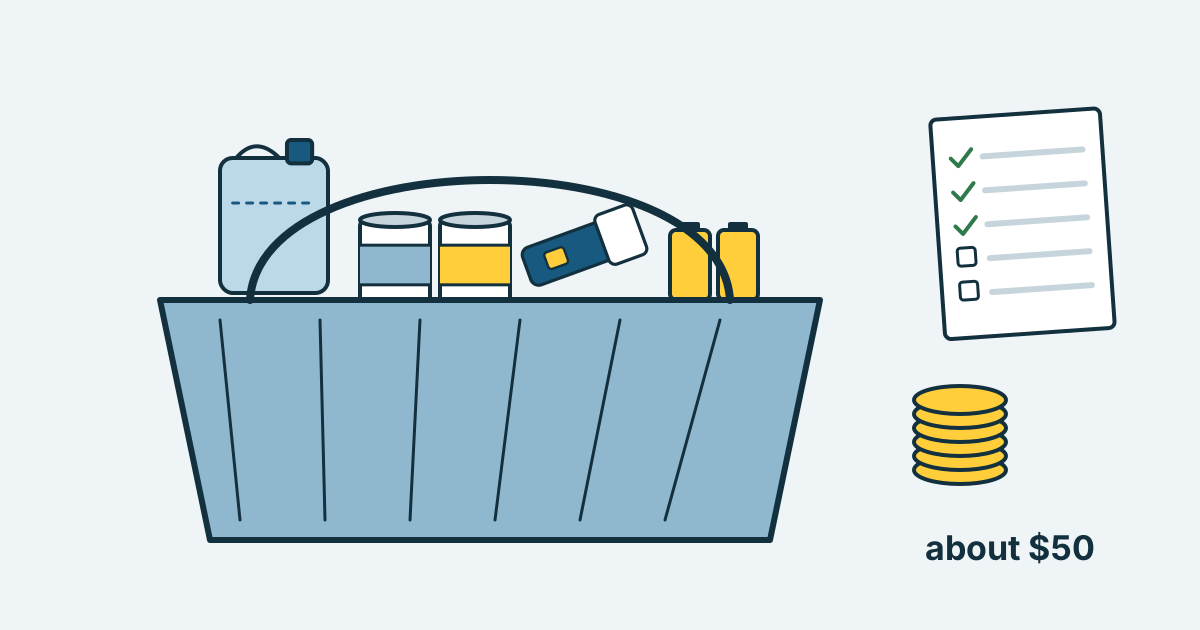
Being ready for an emergency does not start with a big shopping trip. It starts with a list, a look through your cupboards and a small amount of money spent in the right order. This post is about that first $50. The planner above shows what fits, using the same priority order as my plan builder. The prices are my rough estimates, not quotes from any store, so treat them as a guide.
Start with what you already have
Before spending anything, the Canadian Red Cross suggests taking stock of what you have at home. PreparedBC makes the same point, and lists things many homes already own:
- Phone chargers, cords and battery packs, from the junk drawer
- Basic first aid supplies such as bandages, gauze, tape and wipes
- Warm seasonal clothing
I would add any flashlights, blankets and a manual can opener you already have.
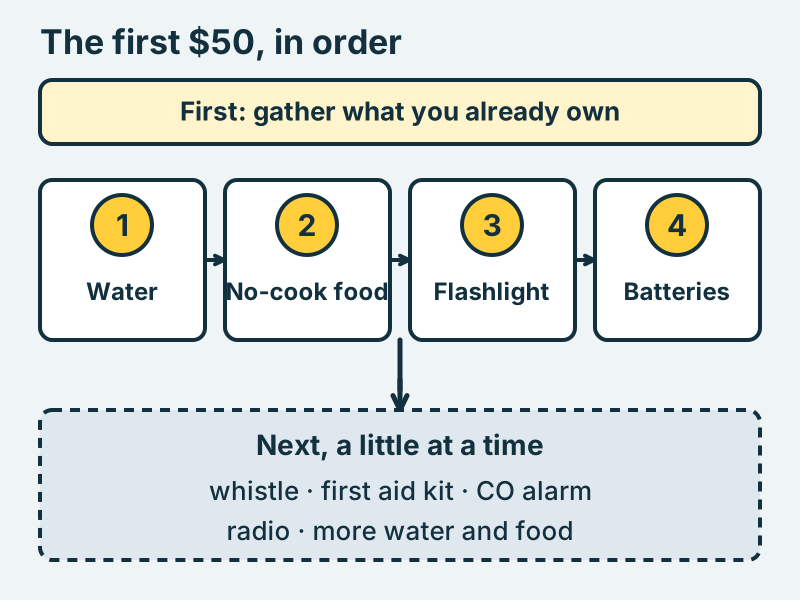
Gather them in one box or bin and you have the start of a kit for nothing. Tick those items as “have it” in the planner above, and the money moves to the next thing on the list.
Step 1: water
PreparedBC says to start with essentials like food and water. Water comes first in my plan builder too, because you cannot go without it for long and tap water can stop or become unsafe in an emergency.
CDC asks for at least 1 US gallon (3.8 L) per person per day for at least 3 days. Canada.ca’s figure is about 4 L. For one person, three days is 3 gallons or 12 L. A single 7 gal (26 L) food-grade container covers that and more. If money is very tight, clean and refill bottles you already have, following CDC’s cleaning steps in my water storage guide.
Step 2: food that needs no cooking
Next, a few days of food you can eat cold: canned beans, tuna or chicken, crackers or cereal, peanut butter if no one is allergic. The Canadian Red Cross suggests choosing long-lasting foods and avoiding those that need refrigeration once opened. Buy what your household already eats, so nothing goes to waste. My post on pantry staples that keep for a year lists the long-keepers.
Step 3: light and batteries
A flashlight for each person and a pack of spare batteries. PreparedBC puts flashlights at roughly $5 to $30. A headlamp keeps your hands free. Canada.ca suggests flashlights instead of candles to lower the risk of fire.
Step 4: the rest, a little at a time
After water, food and light, my priority list moves on to a whistle, a basic first aid kit, and a battery carbon monoxide alarm. PreparedBC puts a basic first aid kit at $15 to $25 and a radio at $20 to $50. Those may not fit in the first $50, and that is fine.
Spreading the cost
The Canadian Red Cross has some practical habits for building a kit without a big outlay:
- Keep your kit list in your wallet or phone. Then you can pick things up when you see them on sale.
- Add a couple of items each shopping trip. A calendar helps you spread purchases across months.
- Ask family and friends if they have spare items you are missing.
PreparedBC adds:
- Watch grocery flyers for specials on emergency supplies.
- Buy non-perishables in bulk, possibly with neighbours.
- Try thrift stores, garage sales and dollar stores for gear that does not need to be new.
- Consider rechargeable batteries.
Nobody needs to go into debt to prepare. A kit built over six months is just as useful as one bought in an afternoon.
Free things that matter as much as supplies
Some of the most useful preparation costs nothing:
- Make a plan. PreparedBC says a household emergency plan can be done in a weekend or a couple of evenings, and offers a free fill-in-the-blanks version.
- Write down important numbers on paper.
- Copy important documents. See protecting documents.
- Learn where your utility shut-offs are. See shutting off utilities.
- Meet your neighbours. See building a neighbour network.
If you have pets or a baby
Tick the boxes in the planner above to see how pet food or infant supplies change the first $50. For a baby, ready-to-feed formula moves near the top of the list. My post on prepping with pets covers animals in more detail.
Rotate, so nothing is wasted
Food and water bought for emergencies should be used and replaced, not forgotten. The Canadian Red Cross suggests checking dates regularly and eating older items before they expire. Canada.ca suggests replacing items that expire, such as food, water and batteries, at least once a year.
Where to go next
- The 72-hour checklist is the natural first target.
- The plan builder works out amounts for your household, with the same first-$50 list.
- How much water for two weeks helps you plan the next step up.
Questions people ask
What should I buy first for an emergency kit on a budget?
Start with water and food. PreparedBC suggests starting with essentials like food and water, then adding other items over time as your budget allows.
How can I build an emergency kit without spending much?
Check what you already own first, keep a shopping list with you, and add a couple of items each shopping trip. The Canadian Red Cross also suggests asking family and friends for spare items, and PreparedBC points to thrift stores, garage sales and dollar stores.
How much water should a starter kit have?
CDC asks for at least 1 US gallon (3.8 L) per person per day for 3 days. Canada.ca's figure is about 4 L per person per day.
Do I need to buy a ready-made emergency kit?
No. Many kit items are things you already have, such as flashlights, chargers, warm clothes and basic first aid supplies. A homemade kit built over time works, as long as it covers water, food, light, first aid and your household's specific needs.
Should I go into debt to prepare for emergencies?
No. Spread purchases out over time. The Canadian Red Cross suggests buying a couple of items each shopping trip to spread out the cost.
Where to buy
Some links earn me a commission at no cost to you. How this works
Water storage container, 7 gal / 26 L
Reliance Aqua-Tainer 7 Gallon Rigid Water Container
A rigid 7 gal (26 L) container sold for drinking water storage, so one jug covers several person-days.
Check prices and optionsat Amazon.comCheck prices and optionsat Amazon.ca
Canned beans, tuna, chicken or stew
Canned chunk chicken breast, multi-pack
Fully cooked and ready to eat from the can; USDA FSIS lists canned meat and poultry at 2 to 5 years.
Check prices and optionsat Amazon.comCheck prices and optionsat Amazon.ca
Flashlight, battery or hand-crank
Black Diamond Spot 400 Headlamp
A AAA-powered dimmable headlamp that keeps both hands free and uses common batteries.
Check prices and optionsat Amazon.comCheck prices and optionsat Amazon.ca
Spare batteries for your flashlights and radio
Energizer Ultimate Lithium AA Batteries, 4 Pack
Energizer states AA Ultimate Lithium cells last up to 25 years in storage and work from -40°F to 140°F (-40°C to 60°C), which suits stored kits.
Check prices and optionsat Amazon.comCheck prices and optionsat Amazon.ca
First aid kit with bandages, antiseptic wipes and gloves
First Aid Only 299 Piece All-Purpose First Aid Kit
A soft-sided kit with a broad mix of common supplies for home use; check contents and replace used items.
Check prices and optionsat Amazon.comCheck prices and optionsat Amazon.ca
First aid kit with bandages, antiseptic wipes and gloves
Adventure Medical Kits Mountain Series Hiker Medical Kit
Sized by the maker for 2 people for 2 days and includes a guide book for when you can't get information online.
Check prices and optionsat Amazon.comCheck prices and optionsat Amazon.ca
Manual can opener
OXO Good Grips Lock & Go Can Opener
A manual opener that works without power and has locking arms that hold the can while you turn.
Check prices and optionsat Amazon.comCheck prices and optionsat Amazon.ca
Where these numbers come from (5 sources)
- Province of BC (PreparedBC): Emergency kit on a budget https://www2.gov.bc.ca/gov/content/safety/emergency-management/preparedbc/build-an-emergency-kit-and-grab-and-go-bag/on-a-budget
- Canadian Red Cross: Disaster prep on a budget https://www.redcross.ca/blog/2020/1/disaster-prep-on-a-budget
- CDC: How to Create an Emergency Water Supply https://www.cdc.gov/water-emergency/about/how-to-create-and-store-an-emergency-water-supply.html
- Canada.ca: Emergency kits https://www.canada.ca/en/services/policing/emergencies/preparedness/get-prepared/emergency-kits.html
- Canada.ca: Power outages, how to prepare https://www.canada.ca/en/services/policing/emergencies/preparedness/get-prepared/hazards-emergencies/power-outages/how-prepare.html