Calculator
Water for your pets
Uses 1 US gallon (3.8 L) per person per day, the CDC figure.Uses 4 L (about 1 US gallon) per person per day, the Canada.ca and PreparedBC figure. Pets use the Canada.ca averages: 4 L a day for a dog and 1 L for a cat.
Pets cannot pack their own bag, and they cannot tell you they are thirsty in a way you will notice in a busy emergency. The good news is that a pet plan is mostly a short list and a few phone numbers. Canada.ca puts it simply: the best way to protect your pet or service animal in an emergency is to bring them with you. Everything below is about making that possible, whether you stay home or have to leave.
The calculator above works out water for your animals. It uses Canada.ca’s averages and switches between gallons and litres with the US and Canada toggle at the top of the page.
Water for animals
Canada.ca gives averages of about 4 L (about 1 US gallon) a day for a dog and 1 L (about 1 quart) a day for a cat. PreparedBC offers a weight-based rule: about 30 mL per kg of body weight per day, or roughly half a fluid ounce per pound. For a 30 kg (66 lb) dog, that works out to about 0.9 L a day. The two methods give quite different answers, so I plan on the larger one, which leaves room for spills and cleaning bowls.
CDC lists pets among the reasons to store more water than the basic 1 gallon (3.8 L) per person per day. Store pet water in the same clean, food-grade containers as your own. My post on how much water for two weeks has a calculator for the whole household, people and pets together.
Food
Canada.ca says to keep food and water for pets for at least 72 hours. If your household plan covers a week or two, cover your animals for the same time. A few practical points:
- Keep their usual food, the one they already eat.
- Rotate it. Use the oldest bag or can first and replace it, the same way you would rotate your own pantry.
- Store it sealed and dry, off the floor.
- Pack a can opener if the food is canned. Canada.ca includes bowls and a can opener in its pet kit.
The pet kit
Canada.ca’s list for pets and service animals:
- A crate or carrier
- A leash or harness
- Bowls and a can opener
- Medications, dosage and your veterinarian’s contact information
- Newspaper, paper towels, plastic bags, litter and a litter box
- A first aid kit for pets
- A blanket and toys
- Your animal’s file (more on that below)
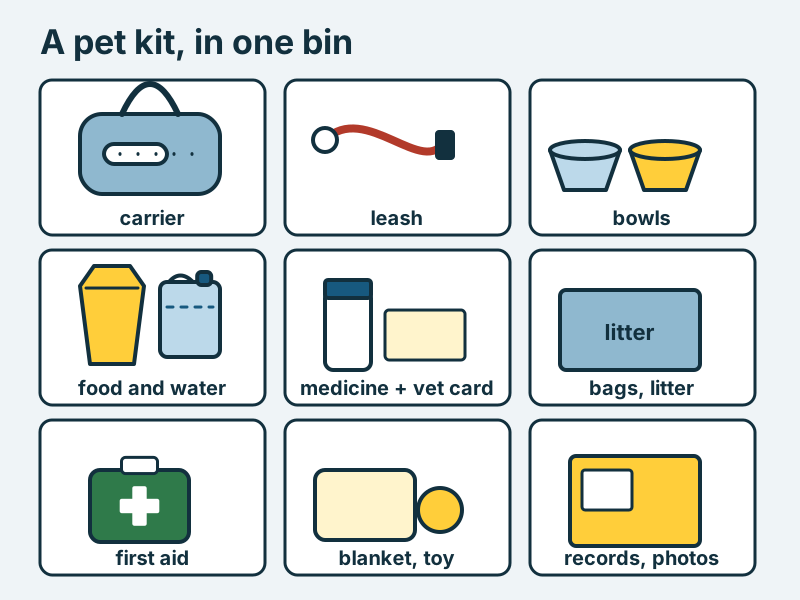
Keep it all in one bin next to the carrier. In a hurry, you want one thing to grab, not ten.
ID and records
Canada.ca says pets and service animals should wear identification at all times, and suggests considering a microchip. Keep the chip registration up to date with your current phone number.
Canada.ca also suggests keeping a file for each animal with:
- Recent photos, which help prove ownership if you are separated
- Emergency contacts
- Medical and vaccination records
- Copies of licences, and training centre information for service animals
A paper copy in the kit and a photo of each page on your phone covers both cases. My guide to protecting documents has storage ideas.
Sheltering at home with pets
If officials tell you to shelter in place, bring pets inside early. CDC’s shelter-in-place advice for chemical emergencies starts with coming indoors with your pets before you close up the house. It helps to know where each animal likes to hide.
During wildfire smoke, keep pets indoors and in your cleaner-air room with water. See making a clean-air room. In a winter outage, they need warm bedding and unfrozen water too.
Carbon monoxide warning. Generators, camp stoves, barbecues, charcoal, and kerosene or propane burners give off carbon monoxide, which you cannot see or smell and which can kill within minutes. Never use them indoors, or in a garage, basement, shed, tent or covered porch, even with doors and windows open. Outdoors, keep them at least 20 feet (6 m) from doors, windows and vents.
If you have to leave
This is where a little planning makes the biggest difference. Canada.ca notes that most evacuation shelters will only accept service animals. So before you need it, find out:
- Which hotels or motels along likely routes accept animals
- Boarding centres and animal clinics that could take them
- Friends or family outside your area who would host you and your pets
Canada.ca also suggests practising your household emergency plan with your pets included, and Ready.gov suggests getting pets used to their carriers and to car travel so an evacuation goes more smoothly.
When you go, take your pets with you. Ready.gov’s advice is never to leave pets behind. See my post on sheltering in place versus leaving, and the go-bag checklist for what to change when pets are coming too.
Medications
If your pet takes medication, keep a written note of the name and dosage as prescribed, and your vet’s phone number, in the kit. Ask your vet how to store it and what to do if you cannot get a refill during an emergency. Do not change doses on your own.
Next steps
- Add your pets in the plan builder and it will include their water and food in your list.
- Check the 72-hour checklist and add the pet items.
- Watch the FEMA video below for a short overview.
Video: Preparing Makes Sense for Pet Owners
From the official FEMA YouTube channel.
Playing it loads the video from YouTube (youtube-nocookie.com), which may set cookies. Nothing loads until you press play. You can also watch it on YouTube.
Questions people ask
How much water does a dog need in an emergency?
Canada.ca suggests about 4 L (about 1 US gallon) a day for an average dog. PreparedBC gives a weight-based rule of about 30 mL per kg of body weight per day, so a large dog may need more.
How much water does a cat need in an emergency?
Canada.ca suggests about 1 L (about 1 quart) a day for an average cat.
How many days of pet food should I keep?
Canada.ca says to keep food and water for pets for at least 72 hours. If you keep two weeks of supplies for your household, it makes sense to keep the same for your animals.
Will an evacuation shelter take my pet?
Often not. Canada.ca notes that most evacuation shelters only accept service animals. Plan ahead with pet-friendly hotels, boarding centres, animal clinics, or friends and family outside your area.
What records should I keep for my pet?
Canada.ca suggests a file with recent photos, emergency contacts, medical and vaccination records, medications and dosage as prescribed by your vet, your vet's contact details, and copies of licences.
Where to buy
Some links earn me a commission at no cost to you. How this works
Water storage container, 7 gal / 26 L
Reliance Aqua-Tainer 7 Gallon Rigid Water Container
A rigid 7 gal (26 L) container sold for drinking water storage, so one jug covers several person-days.
Check prices and optionsat Amazon.comCheck prices and optionsat Amazon.ca
Where these numbers come from (6 sources)
- Canada.ca: Pets and service animals in emergencies https://www.canada.ca/en/services/policing/emergencies/preparedness/get-prepared/emergency-planning-resources/animals.html
- PreparedBC: Build an emergency kit and grab-and-go bag https://www2.gov.bc.ca/gov/content/safety/emergency-management/preparedbc/build-an-emergency-kit-and-grab-and-go-bag
- CDC: How to Create an Emergency Water Supply https://www.cdc.gov/water-emergency/about/how-to-create-and-store-an-emergency-water-supply.html
- Canada.ca: Emergency kits https://www.canada.ca/en/services/policing/emergencies/preparedness/get-prepared/emergency-kits.html
- Ready.gov: Pet preparedness toolkit https://www.ready.gov/pet-toolkit
- CDC: Stay Put and Seal Off Your Space in a Chemical Emergency https://www.cdc.gov/chemical-emergencies/response/shelter-in-place.html