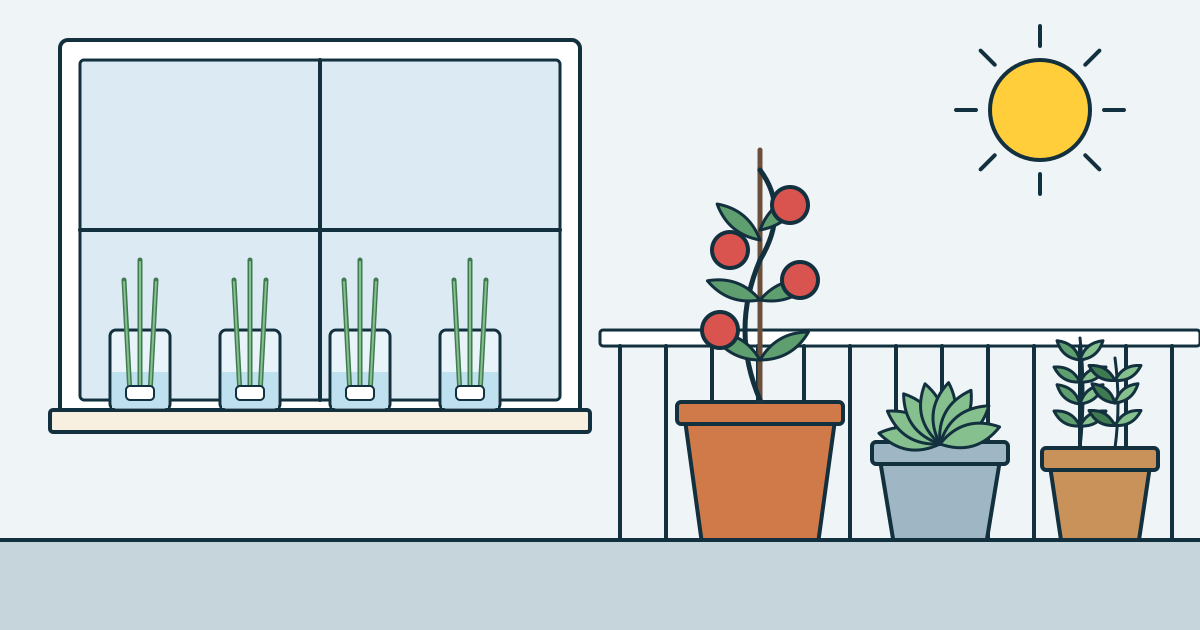
You do not need a yard to grow some of your own food. A sunny balcony, a patio, a front step or a bright windowsill can grow herbs, salad greens, green onions and even a tomato or two. It will not replace a pantry, but it puts fresh food within reach and teaches you the basics before you try anything bigger.
This guide sticks to what Oregon State University (OSU) Extension says about container vegetables. I have not grown these myself, so I point to the source for each figure.
Step 1: Measure your light
Light decides what you can grow, so check it before you buy anything. Over one sunny day, note when direct sun reaches the spot and when it leaves.
- 6 to 8 hours of direct sun: OSU says this is what fruiting crops need, such as tomatoes, peppers and green beans.
- Less than that: OSU says leafy and root crops like lettuce, beets, cabbage and mustard greens tolerate some shade. A north- or east-facing balcony is a greens balcony.
- A windowsill only: stick to herbs, green onions and microgreens. If the window is dim in winter, a small grow light helps. For microgreens, Utah State University Extension suggests keeping a grow light on a timer, 18 hours on and 6 hours off.
Step 2: Pick pots by root size
OSU gives two useful sizes:
| Crop | Container |
|---|---|
| Herbs, parsley, green onions | 10-inch (25 cm) pot |
| Tomatoes, peppers, eggplant | 5-gallon (about 19 L) container |
Almost anything can be a container if it drains well. OSU suggests drilling drainage holes in the sides about ½ inch (1 cm) up from the bottom, and raising the pot on bricks or wooden slats so it is not sitting on concrete or in standing water.
On a balcony, also think about weight. Wet potting mix is heavy, so check your lease or building rules before setting out a row of large pots, and keep anything that could blow off well away from the railing edge.
Step 3: Fill with potting mix, not garden soil
OSU says to use a high-quality potting mix or composted soil from a garden centre, because it is lightweight and drains well. Garden soil and topsoil can be too heavy and hold too much moisture in a pot.
Step 4: Choose crops that like pots
OSU lists lettuce, herbs, tomatoes, peppers, eggplant, carrots, beans, squash, radishes, kale, chard and spinach as good container crops. It also suggests dwarf or miniature varieties for tight spaces, such as ‘Thumbelina’ carrots, and says vining crops like beans and squash can be grown in large pots or trained up a trellis.
For a first balcony, I would start with:
- Leaf lettuce or mixed greens, which you can cut and let regrow.
- Kale or chard, which keep producing for months.
- Green onions, which you can even start from the root ends of store-bought ones. Iowa State Extension’s instructions are in my post on regrowing vegetables from kitchen scraps.
- One tomato in a 5-gallon container, if you have the sun.
- Herbs you actually cook with.
If you want seed you can save and sow again next year, buy open-pollinated varieties. Seed saving for beginners explains why.
Step 5: Water and feed more than you expect
Containers dry out much faster than garden beds. OSU says daily watering is often needed, especially on a sunny patio. Water when the top of the soil feels dry, and keep going until water runs out of the drainage holes, but do not leave the soil waterlogged.
Because frequent watering washes nutrients out, potted vegetables need regular feeding. OSU suggests a water-soluble all-purpose fertilizer at half the label strength every three to four days, or a dry fertilizer about every three weeks. Organic options it lists include compost, aged manure, blood meal, greensand and rock phosphate. Follow the label on whatever you buy.
Step 6: Time it to your frost dates
Pots are easy to move, which is a real advantage. You can set tender plants out after your last spring frost and pull them inside or under cover when an early fall frost is forecast.
To find your average dates:
- United States: NOAA’s Climate.gov last spring freeze map shows the average date for nearby weather stations.
- Canada: Search Environment and Climate Change Canada’s Canadian Climate Normals for your nearest station.
An average date is not a promise. NC State Extension explains that frost probabilities come in levels: a 50% date means frost after it still happens in about half of years, and it suggests a more cautious date for frost-sensitive crops like tomatoes and peppers. With pots, the simplest fix is to watch the forecast and bring them in.
A windowsill garden through winter
When the balcony season ends, a bright windowsill can keep going with green onions, a pot of herbs and trays of microgreens. Microgreens are ready in one to two weeks for many crops, according to Utah State’s table. My post on sprouts and microgreens on the counter covers how to grow them and the food safety rules for sprouts.
Where this fits
A few pots will not feed a household through a long disruption, and they are not meant to. They add fresh greens to a pantry of rice, beans, oats and cans. For that core, start with the plan builder and the food section, then find ways to use what you grow in the recipes, like a handful of chopped greens stirred into pantry lentil soup.
Questions people ask
How big a pot does a tomato need?
Oregon State University Extension says larger, deeper-rooted plants such as tomatoes, peppers and eggplant need 5-gallon (about 19 L) containers. Herbs, parsley and green onions do fine in 10-inch (25 cm) pots.
Can I use soil from the garden in pots?
Oregon State advises against it. Garden soil and topsoil can be too heavy and hold too much water in a container. Use a good-quality potting mix or composted potting soil instead.
How much sun does a balcony garden need?
Fruiting crops such as tomatoes, peppers and green beans need 6 to 8 hours of direct sun a day, according to Oregon State. Lettuce, beets, cabbage and mustard greens tolerate some shade, so a balcony with less sun suits leafy crops better.
How often should I water container vegetables?
Often. Oregon State says daily watering is often needed on a sunny patio. Water when the top of the soil feels dry, and keep going until water runs out of the drainage holes, without leaving the pot sitting in water.
Where to buy
Some links earn me a commission at no cost to you. How this works
Fabric grow bags, 5 gal (19 L), multi-pack
Oregon State Extension gives 5-gallon containers for tomatoes, peppers and eggplant, in any container that drains well.
Check prices and optionsat Amazon.comCheck prices and optionsat Amazon.ca
Potting mix, large bag
Oregon State Extension advises potting mix rather than garden soil in containers because it is light and drains well.
Check prices and optionsat Amazon.comCheck prices and optionsat Amazon.ca
True Leaf Market Organic Heirloom Variety - 16 Pack
True Leaf Market states all 16 varieties, including beet, carrot, kale, lettuce, snap pea and tomato, are non-GMO, open-pollinated and heirloom.
Check prices and optionsat True Leaf MarketCanadian link coming soon
West Coast Seeds Vegetable seeds
A seed company based in Delta, BC; if you plan to save seed, choose varieties that are not marked F1.
US link coming soonCheck prices and optionsat West Coast Seeds
LED grow light for seedlings and microgreens
For a dim window; Utah State Extension suggests a timer set to 18 hours on and 6 hours off for microgreens.
Check prices and optionsat Amazon.comCheck prices and optionsat West Coast Seeds
Where these numbers come from (6 sources)
- Oregon State University Extension: Container gardening, grow vegetables even without yard space https://extension.oregonstate.edu/news/container-gardening-grow-vegetables-even-without-yard-space
- Utah State University Extension: Grow Your Own Microgreens https://extension.usu.edu/yardandgarden/research/grow-your-own-microgreens
- Iowa State University Extension: How to Grow Vegetables from Kitchen Scraps https://yardandgarden.extension.iastate.edu/how-to/how-grow-vegetables-kitchen-scraps-avocados-pineapples-green-onions-and-more
- NC State Extension: Interpreting Freeze/Frost Probabilities from NCEI https://content.ces.ncsu.edu/interpreting-freezefrost-probabilities-from-the-national-centers-for-environmental-information
- NOAA Climate.gov: Average date of last spring freeze (interactive map) https://www.climate.gov/LastFreeze
- Environment and Climate Change Canada: Canadian Climate Normals https://climate.weather.gc.ca/climate_normals/index_e.html