Calculator
How much water does your household need?
Uses 1 US gallon (3.8 L) per person per day, the CDC figure.Uses 4 L (about 1 US gallon) per person per day, the Canada.ca and PreparedBC figure. Pets use the Canada.ca averages: 4 L a day for a dog and 1 L for a cat.
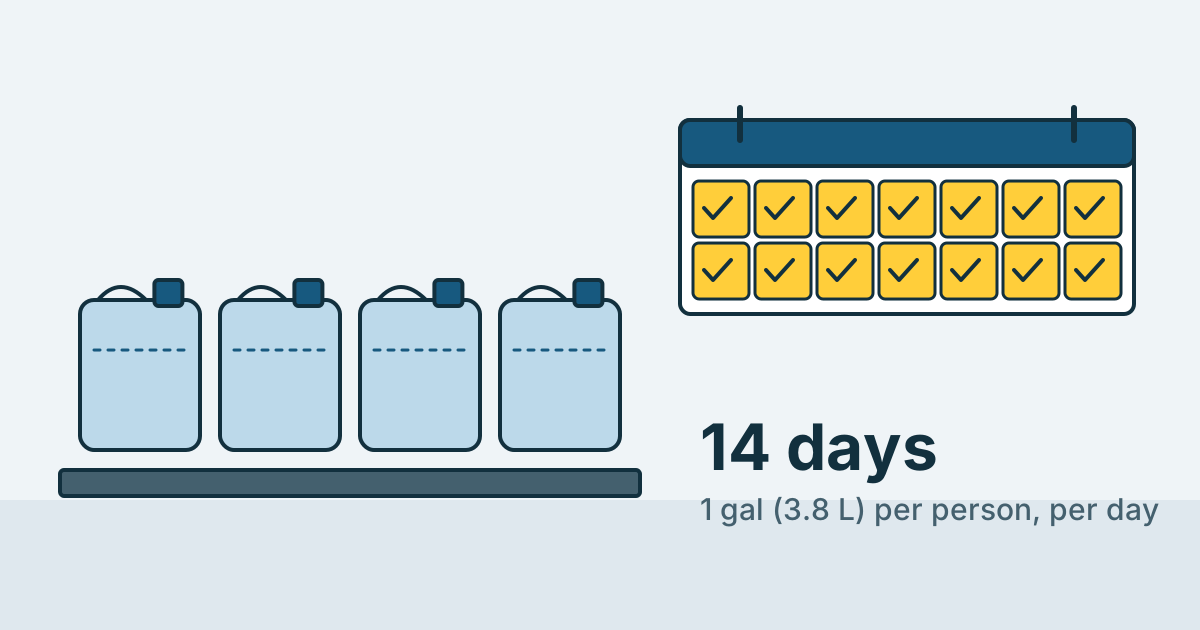
Two weeks is the longer target in official US guidance. CDC asks for at least 3 days of water and says to try for a 2-week supply if you can. The calculator above does the arithmetic for your household. Below I explain where the numbers come from, how to store that much water in an ordinary home, and what to do if two weeks feels out of reach.
The figure to plan around
| Source | Per person per day |
|---|---|
| CDC (US) | At least 1 gallon (3.8 L) |
| Canada.ca emergency kits | About 4 L (about 1 gallon) |
| PreparedBC | 4 L, for drinking and sanitation |
| Health Canada | 2 L to drink, plus 2 L for cooking and cleaning |
The US and Canadian figures land in the same place: roughly one gallon, or four litres, per person per day. That is what the calculator uses. It covers drinking and basic hygiene, not showers or laundry.
The two-week totals
For a 14-day supply:
| Household | US gallons (CDC) | Litres (Canada.ca) |
|---|---|---|
| 1 person | 14 gal (53 L) | 56 L (14.8 gal) |
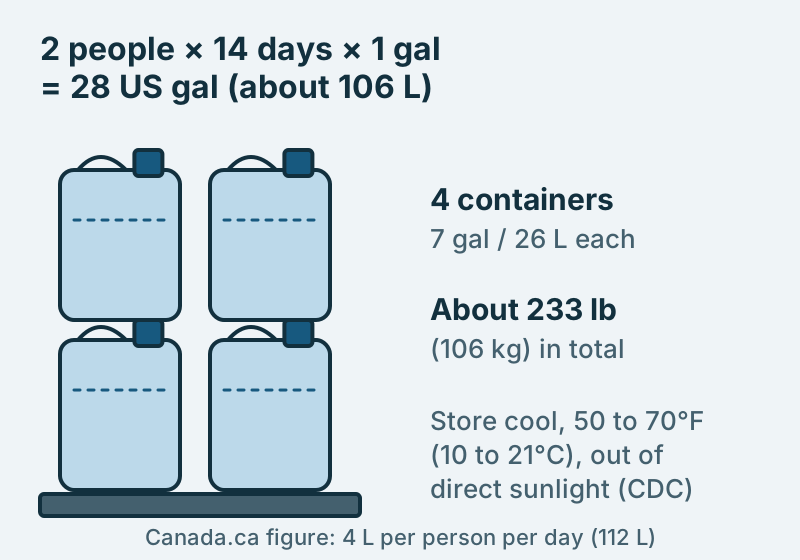
| 2 people | 28 gal (106 L) | 112 L (29.6 gal) |
| 4 people | 56 gal (212 L) | 224 L (59.2 gal) |
The Canadian column is a little higher because 4 L is slightly more than a US gallon. Either is a sound target.
Who needs more
CDC suggests storing more than the basic amount for pregnant women, people who are sick, pets and hot climates. PreparedBC says hot temperatures can double water needs. Tick the hot weather box in the calculator to see what doubling looks like. If you live somewhere with hot summers, it is worth planning around the doubled number for that season.
Pets. Canada.ca gives averages of about 4 L (about 1 gallon) a day for a dog and 1 L (about 1 quart) a day for a cat. PreparedBC gives a weight-based rule of about 30 mL per kg of body weight per day, so a large dog may need more than the average. I wrote a whole post on prepping with pets.
Storing two weeks of water at home
Water is heavy. A litre weighs about 1 kg, and a US gallon about 8.3 lb. Two weeks for two people is over 200 lb (about 100 kg). A few practical points from CDC:
- Use food-grade containers. CDC says FDA-approved food-grade water containers are best. If you cannot get them, use durable, unbreakable containers, not glass.
- Clean them first. Wash with soap, rinse, and sanitize with 1 teaspoon of unscented liquid household bleach in 1 quart (4 cups, about 1 L) of water, as CDC describes. My water storage guide has the full steps.
- Keep it cool and dark. CDC suggests 50°F to 70°F (10°C to 21°C), away from direct sunlight.
- Replace it. If you filled the containers yourself, replace the water every 6 months.
Size matters too. A 7 gal (26 L) container is about as heavy as most people can move, at nearly 60 lb (26 kg). Smaller bottles are easier to carry if you need to leave. Canada.ca suggests including small bottles that are easy to carry in your kit.
Building up to two weeks without a big spend
Two weeks of water all at once can be a lot of money and space. You do not have to do it in one go.
- Start with 3 days. That is the minimum in both CDC and Canada.ca guidance. For one person it is 3 gallons, or 12 L.
- Add a container each month until you reach 7 days, then 14.
- Know your backup. A filter rated for bacteria and protozoa, or unscented bleach, means you can treat water if your stored supply runs low. Only use official figures for treatment. My guide on treating water has them, from CDC, FDA and Health Canada.
Health Canada also suggests replacing emergency supplies every year or by the date on the label, which is a good prompt to check your water and food together.
If your tap water is affected
Stored water is for when the taps stop or the water is not safe. If your area is under a boil-water or do-not-use advisory, follow the local instructions exactly, since they are specific to what is wrong with your supply. CDC suggests checking with your state, local or tribal health department for advice on boiling or treating water in your area. In Canada, your local or provincial health authority issues these advisories.
Next steps
- Use the plan builder to see water alongside food, light and sanitation for your household.
- Read how much water to store for the full comparison of official figures.
- Print the 14-day checklist if two weeks is your goal.
Questions people ask
How much water does one person need for two weeks?
At 1 US gallon (3.8 L) per person per day, the CDC figure, one person needs 14 gallons (about 53 L) for two weeks. At the Canada.ca figure of about 4 L per person per day, it is 56 L (about 14.8 US gallons).
Does the official amount include water for cooking and washing?
The 1 gallon or 4 L figure covers drinking and basic sanitation. Health Canada splits it into 2 L for drinking plus 2 L for cooking and cleaning per person per day.
Do I need more water in hot weather?
Yes. PreparedBC says hot temperatures can double water needs, and CDC suggests storing more for hot climates, pregnant women, people who are sick, and pets.
How often should I replace stored water?
CDC says to replace water you filled yourself every 6 months. Store it somewhere cool, ideally 50°F to 70°F (10°C to 21°C), and out of direct sunlight.
How much water does a dog or cat need in an emergency?
Canada.ca suggests about 4 L (about 1 US gallon) a day for an average dog and 1 L (about 1 quart) a day for an average cat.
Where to buy
Some links earn me a commission at no cost to you. How this works
Water storage container, 7 gal / 26 L
Reliance Aqua-Tainer 7 Gallon Rigid Water Container
A rigid 7 gal (26 L) container sold for drinking water storage, so one jug covers several person-days.
Check prices and optionsat Amazon.comCheck prices and optionsat Amazon.ca
Water filter rated for bacteria and protozoa
Sawyer Products SP129 Squeeze Water Filtration System
Sawyer rates this filter at 0.1 absolute micron and states that bacteria, protozoa and cysts cannot pass through it.
Check prices and optionsat Amazon.comCheck prices and optionsat Amazon.ca
Water filter rated for bacteria and protozoa
LifeStraw Personal Water Filter
A straw-style filter that needs no power, sold by LifeStraw for hiking, travel and emergency preparedness.
Check prices and optionsat Amazon.comCheck prices and optionsat Amazon.ca
Water filter rated for bacteria and protozoa
GRAYL GeoPress 24 oz Water Purifier Bottle
GRAYL states it removes viruses, bacteria and protozoan cysts and is independently tested to NSF/ANSI protocols 42 and 53.
Check prices and optionsat GRAYLCheck prices and optionsat GRAYL
Potable Aqua Chlorine Dioxide Water Purification Tablets, 30 Count
A small chemical backup to a filter that stores easily; follow the dose and contact time on the label.
Check prices and optionsat Amazon.comCheck prices and optionsat Amazon.ca
Aquatabs 334 mg Water Treatment Tablets, 30-Pack
The Amazon.ca listing cites NSF/ANSI/CAN 60, and each tablet is sold for treating 20 L, so it suits larger containers; follow the label.
Check prices and optionsat Amazon.comCheck prices and optionsat Amazon.ca
Where these numbers come from (6 sources)
- CDC: How to Create an Emergency Water Supply https://www.cdc.gov/water-emergency/about/how-to-create-and-store-an-emergency-water-supply.html
- Canada.ca: Emergency kits https://www.canada.ca/en/services/policing/emergencies/preparedness/get-prepared/emergency-kits.html
- Health Canada: Food and drinking water safety in an emergency https://www.canada.ca/en/health-canada/services/food-drinking-water-safe-emergency.html
- PreparedBC: Build an emergency kit and grab-and-go bag https://www2.gov.bc.ca/gov/content/safety/emergency-management/preparedbc/build-an-emergency-kit-and-grab-and-go-bag
- Canada.ca: Pets and service animals in emergencies https://www.canada.ca/en/services/policing/emergencies/preparedness/get-prepared/emergency-planning-resources/animals.html
- CDC: What to Do to Protect Yourself During a Power Outage https://www.cdc.gov/natural-disasters/response/what-to-do-protect-yourself-during-a-power-outage.html