Most winter storm advice assumes a house: a garage, a basement, a woodpile, a driveway to shovel. If you rent an apartment, your situation is different. You have less storage, you share walls and hallways, and the heating may be controlled by someone else. The good news is that a few small changes go a long way. Here is how I would prepare, using guidance from Canada.ca and CDC.
Before the storm: small-space supplies
Canada.ca says the goal is to have enough supplies at home to last until conditions improve. In an apartment, think compact and stackable.
- Water. CDC asks for at least 1 US gallon (3.8 L) per person per day for 3 days. Canada.ca’s figure is about 4 L. For two people for three days, that is 6 gallons, or 24 L, which fits in a closet. My water calculator works out larger amounts.
- Food that needs no cooking. If your stove is electric, it stops with the power. See what food lasts without a fridge.
- Warmth. A sleeping bag or heavy blanket for each person, plus hats, gloves and a warm base layer. These double as everyday gear, so they earn their space.
- Light. Flashlights or headlamps and spare batteries. CDC suggests battery-powered flashlights or lanterns rather than candles.
- Charging. Charge phones and power banks when a storm is forecast.
- A carbon monoxide alarm. More on this below.
Under-bed boxes, the top shelf of a closet and the space behind the couch all work for storage. Keep water off the floor in case of leaks, and away from heaters.
Talk to your building early
A short conversation before winter can save a lot of worry later. Ask your landlord or building manager:
- What happens to heat and hot water if the power goes out?
- Is there a backup generator for elevators, hallway lights or the boiler?
- Where are the stairwells and exits, and are they lit without power?
- How will they contact tenants in an outage?
If someone in your home uses powered medical equipment or cannot manage stairs, tell the building manager now, and see my medical device power plan.
If the heat goes out: one warm room
CDC’s advice is to keep as much heat inside your home as possible. In an apartment, that usually means picking one room and making it the warm room.
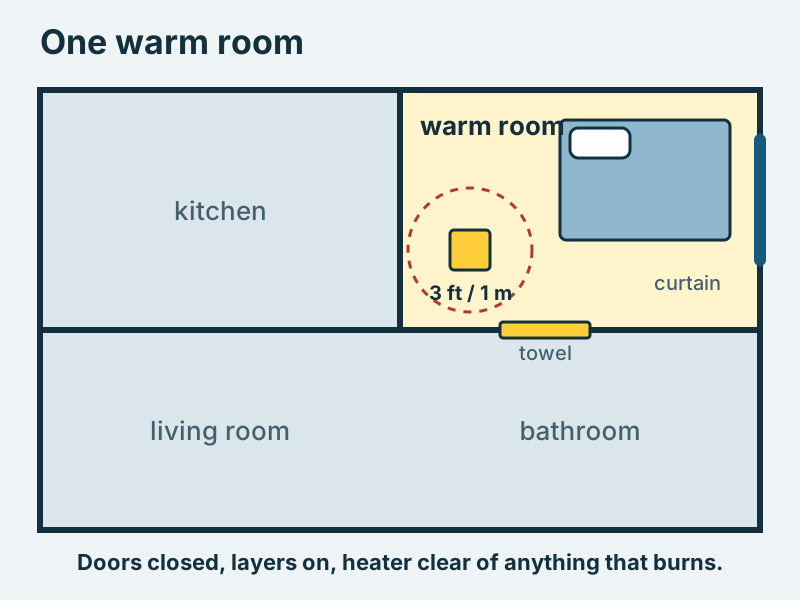
- Choose a room with as few outside walls and windows as you can. In many apartments that is a bedroom.
- Close the doors to the other rooms. A rolled towel along the bottom of the door can cut draughts.
- Draw curtains or hang a blanket over the window at night.
- Layer up with hats, gloves and dry socks, and change out of anything damp.
If you have a working space heater and power, CDC says to keep it at least 3 feet (1 m) from drapes, furniture, bedding and anything else that can burn. Plug it straight into the wall, check the cord is not frayed, and follow the maker’s instructions.
The balcony rule
This is the most important part of this post for apartment dwellers.
Carbon monoxide warning. Generators, camp stoves, barbecues, charcoal, and kerosene or propane burners give off carbon monoxide, which you cannot see or smell and which can kill within minutes. Never use them indoors, or in a garage, basement, shed, tent or covered porch, even with doors and windows open. Outdoors, keep them at least 20 feet (6 m) from doors, windows and vents.
A balcony is right outside your windows and door, and often under the balcony above. It cannot meet the 20 feet (6 m) distance, and the exhaust can drift into your unit or your neighbours’. So in an apartment, a portable generator, a barbecue or a camp stove has no safe place to run. Canada.ca also says to install certified carbon monoxide alarms with battery backup in hallways and outside sleeping areas, and CDC recommends a battery-operated detector. Test yours before the storm.
Two more rules from CDC that matter in winter:
- Never use a gas range or oven to heat your home.
- Never run a car in a parking garage or any enclosed space, even to warm up or charge a phone.
If the alarm sounds or anyone feels dizzy, sick or confused, get everyone out into fresh air and call 911.
Pipes and water
Canada.ca suggests running a trickle of water to help keep pipes from freezing. In an apartment, ask your building manager first, since they may already have a plan. If a pipe does freeze or burst, tell them right away. My cold-weather pipes guide has more.
Neighbours
Apartment living has one big advantage in a storm: people are close by. Canada.ca suggests checking on older relatives and neighbours before a storm to make sure they have enough supplies, and helping anyone who needs it during the storm if conditions allow. CDC says to check on older friends and neighbours often to make sure their homes are heated properly. My guide to building a neighbour network gives a simple way to organise it.
When to go
If you cannot keep your home warm enough, leave for a friend’s home, a family member’s or a community warming centre. CDC says to go to a friend’s home or a community shelter if it is too hot or too cold. Listen for local announcements about warming centres, and follow official instructions.
More winter reading
- The full winter storm checklist, including frostbite and hypothermia signs.
- Lighting in an outage, for safe light without candles.
- Home fire safety, including alarms and escape plans.
Interactive checklist
Apartment winter storm checklist
Tick what you have done. Nothing is saved.
0 of 13 done
All done. Keep this page open, or print the guide it links to.
Video: Prevent Carbon Monoxide Poisoning
From the official Centers for Disease Control and Prevention (CDC) YouTube channel.
Playing it loads the video from YouTube (youtube-nocookie.com), which may set cookies. Nothing loads until you press play. You can also watch it on YouTube.
Questions people ask
Can I run a generator or barbecue on my apartment balcony?
No. CDC and Canada.ca say generators must be outdoors at least 20 feet (6 m) from doors, windows, vents and buildings. A balcony sits right against your windows and doors, so it cannot meet that distance. Never use a barbecue or camp stove indoors either.
How do I stay warm in an apartment if the heat goes out?
Gather everyone in one room, close the doors to other rooms, and layer clothing and blankets. CDC says to keep as much heat inside your home as possible. If it gets too cold, go to a friend's home or a warming centre.
How far should a space heater be from furniture?
CDC says at least 3 feet (about 1 m) from drapes, furniture, bedding and other things that can burn.
Do I need a carbon monoxide alarm in an apartment?
Yes. CDC recommends a battery-operated CO detector, and Canada.ca recommends certified alarms with battery backup in hallways and outside sleeping areas. Carbon monoxide can come from your unit or a neighbour's.
How much water should I keep in a small apartment?
CDC asks for at least 1 US gallon (3.8 L) per person per day for 3 days, and 2 weeks if possible. Canada.ca's figure is about 4 L per person per day.
Where to buy
Some links earn me a commission at no cost to you. How this works
Flashlight, battery or hand-crank
Black Diamond Spot 400 Headlamp
A AAA-powered dimmable headlamp that keeps both hands free and uses common batteries.
Check prices and optionsat Amazon.comCheck prices and optionsat Amazon.ca
Spare batteries for your flashlights and radio
Energizer Ultimate Lithium AA Batteries, 4 Pack
Energizer states AA Ultimate Lithium cells last up to 25 years in storage and work from -40°F to 140°F (-40°C to 60°C), which suits stored kits.
Check prices and optionsat Amazon.comCheck prices and optionsat Amazon.ca
Phone power bank
Anker Power Bank, 20,000mAh, Built-In USB-C Cable
A 20,000 mAh pack holds several phone charges and has its own cable, so one less thing to find in the dark.
Check prices and optionsat Amazon.comCheck prices and optionsat Amazon.ca
Battery-operated carbon monoxide alarm
Kidde KN-COB-B-LP Nighthawk Carbon Monoxide Alarm, Battery Operated
Kidde lists it as UL Listed with an electrochemical sensor, and it runs on 3 AA batteries so it keeps working in a power outage.
Check prices and optionsat Amazon.comCanadian link coming soon
Battery-operated carbon monoxide alarm
Kidde C3010 Worry-Free Carbon Monoxide Alarm, 10-Year Sealed Battery
Kidde lists its Canadian C3010-CA as CSA Listed with an electrochemical sensor and a sealed lithium battery, so it keeps working in an outage; check the listing shows the CSA mark before buying.
US link coming soonCheck prices and optionsat Amazon.ca
Water storage container, 7 gal / 26 L
Reliance Aqua-Tainer 7 Gallon Rigid Water Container
A rigid 7 gal (26 L) container sold for drinking water storage, so one jug covers several person-days.
Check prices and optionsat Amazon.comCheck prices and optionsat Amazon.ca
Where these numbers come from (6 sources)
- Canada.ca: Winter storms, how to prepare https://www.canada.ca/en/services/policing/emergencies/preparedness/get-prepared/hazards-emergencies/winter-storms/how-prepare.html
- CDC: Stay Safe During and After a Winter Storm https://www.cdc.gov/winter-weather/safety/stay-safe-during-after-a-winter-storm-safety.html
- CDC: What to Do to Protect Yourself During a Power Outage https://www.cdc.gov/natural-disasters/response/what-to-do-protect-yourself-during-a-power-outage.html
- CDC: Prevent Carbon Monoxide Poisoning (PSA) https://www.cdc.gov/natural-disasters/psa-toolkit/prevent-carbon-monoxide-poisoning.html
- Canada.ca: Power outages, how to prepare https://www.canada.ca/en/services/policing/emergencies/preparedness/get-prepared/hazards-emergencies/power-outages/how-prepare.html
- CDC: How to Create an Emergency Water Supply https://www.cdc.gov/water-emergency/about/how-to-create-and-store-an-emergency-water-supply.html