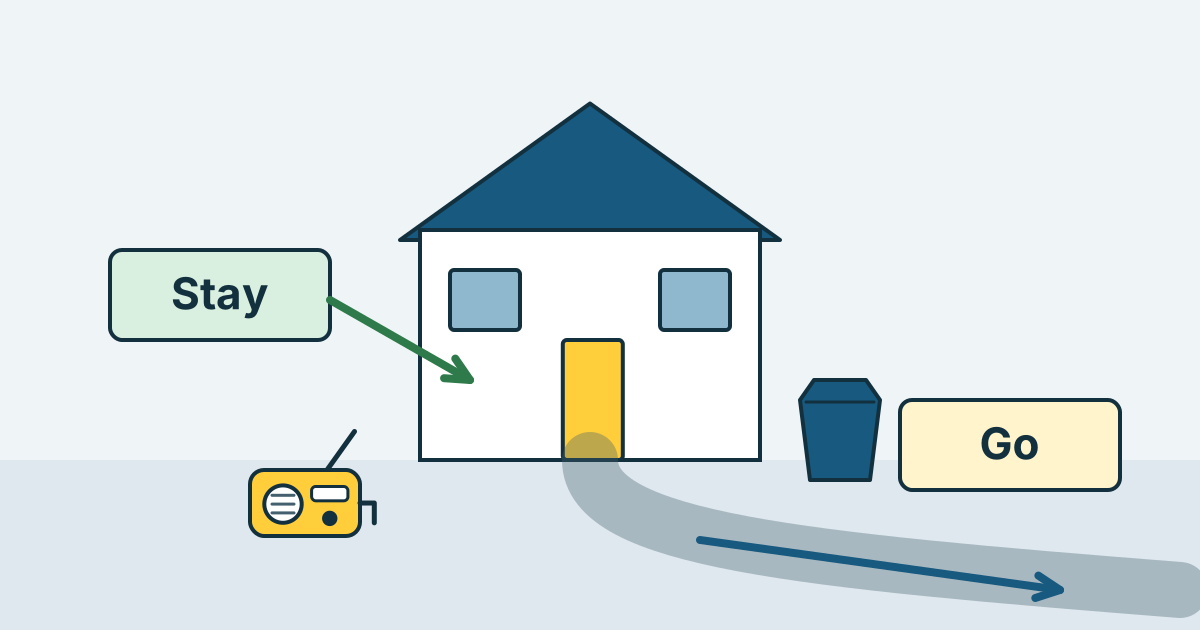
This site is about staying safely at home. But staying is not always the safe choice, and part of being prepared is knowing when to switch. The short answer: if officials tell you to leave, leave. If they tell you to stay inside, stay inside. The harder cases are the ones in between, when nobody has told you anything and conditions are slowly getting worse. This post covers both, with a quick decision helper at the end.
What “shelter in place” means
Sheltering in place is an official instruction, not just a choice to stay home. Alberta describes a shelter-in-place advisory as one issued when an outside hazard threatens life and leaving would be riskier, and describes sheltering as finding the safest nearby area and putting distance and barriers between you and the threat. Vancouver’s emergency guidance says these orders are usually for situations that last a few hours and are not safe to evacuate from. CDC, writing about chemical emergencies, says you might need to stay put for a few hours, possibly a few days.
Typical reasons include a chemical spill or gas release, severe storms, or very poor outdoor air.
How to shelter in place
CDC’s steps for a chemical emergency are a good general pattern:
- Get everyone inside, including pets. Lock the doors.
- Turn off fans, air conditioning and the furnace, and close the fireplace damper, so outside air is not pulled in.
- Go to one room you can seal off from outside air. CDC suggests a large room, with water, ideally on a higher floor.
- Seal it. Use duct tape and plastic sheeting over windows and vents, and tape around the door. If you have no plastic, towels, sheets or clothing will do.
- Take your supplies: medication, phone and charger cables.
- Stay informed by radio or a news app, follow instructions from police, fire or local officials, and let someone outside the area know you are safe.
- Wait for the all clear before going outside.
For wildfire smoke, the approach is gentler. You do not seal yourself in, you filter the air. See making a clean-air room.
What evacuation alerts and orders mean
Terms vary by place, so learn the ones your area uses. In BC, the provincial evacuee guidance uses three stages:
| Stage | What it means | What to do |
|---|---|---|
| Evacuation alert | Be ready to leave on short notice | Pack, fuel up, plan your route and where you will go |
| Evacuation order | You are at risk. Leave immediately | Go now, by the routes officials give |
| Rescind | The risk has passed | Return only once it is rescinded |
BC’s guidance is blunt about orders: choosing to remain puts yourself and others in danger. If you are ill or have mobility needs, tell the person delivering the order. My guide to what a wildfire evacuation order means covers how terms differ elsewhere.
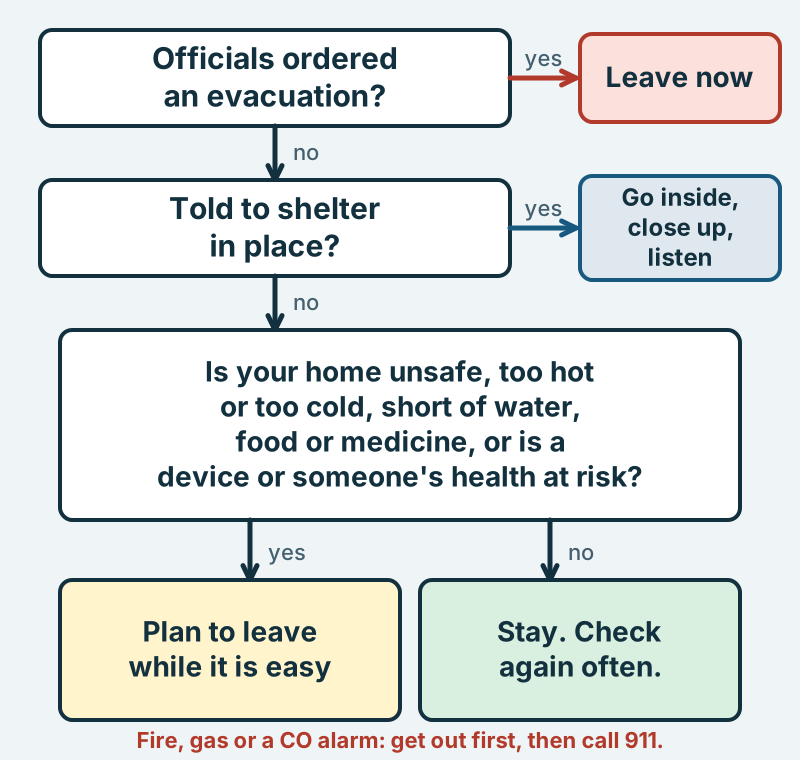
Leave right away if
Some situations do not wait for an order:
- Your home is on fire, or filling with smoke or gas.
- A carbon monoxide alarm sounds. Get everyone outside into fresh air, then call 911.
- Floodwater is rising toward your home.
Carbon monoxide warning. Generators, camp stoves, barbecues, charcoal, and kerosene or propane burners give off carbon monoxide, which you cannot see or smell and which can kill within minutes. Never use them indoors, or in a garage, basement, shed, tent or covered porch, even with doors and windows open. Outdoors, keep them at least 20 feet (6 m) from doors, windows and vents.
Plan to leave if
These are the slower signs that staying home is no longer working:
- Your home is too hot or too cold. The American Red Cross says to evacuate in that case.
- Someone depends on powered medical equipment and the power will not last. The Red Cross says to evacuate if you have medical devices that need power.
- Food, water or medicine is running out and help is not coming soon.
- Someone’s health is getting worse.
- An evacuation alert is in effect. It is easier to leave early, calmly, than late in traffic.
My guide on when to leave instead of staying goes through each of these.
Be ready for both
The same preparation covers staying and going. A few things make the switch easy:
- A go bag for each person, packed and by the door. See the go-bag checklist.
- A fuelled vehicle. Canada.ca suggests keeping your vehicle fully fuelled when wildfire is a risk, since refuelling may be hard during an evacuation.
- Somewhere to go. Family, friends, a hotel, or an official reception centre. Canada.ca notes that most evacuation shelters only accept service animals, so make a plan for pets. See prepping with pets.
- Documents and medication in one place. See protecting documents.
- A sealing kit for sheltering in place: duct tape, scissors and plastic sheeting, as CDC suggests.
- A way to get alerts that does not depend on the power: a battery or crank radio, and a charged phone.
If staying is the plan, the plan builder works out supplies for 3, 7, 14 or 30 days. If you have just lost power, start with the first hour of a power outage.
Decision helper
Should you stay or go right now?
Tick anything that is true for your home right now. This is a prompt for your own judgement. Official instructions always come first.
Questions people ask
What does shelter in place mean?
It means staying where you are, indoors, because going outside or leaving would put you in more danger. CDC describes it for chemical emergencies as staying put and sealing off your space, possibly for a few hours or longer. Alberta describes it as finding the safest nearby area and putting barriers between you and the hazard.
What is the difference between an evacuation alert and an evacuation order?
In BC, an evacuation alert means be ready to leave on short notice. An evacuation order means you are at risk and must leave the area immediately. A rescind means the risk has passed and you can return.
Should I leave during a power outage?
The American Red Cross says to evacuate if your home is too hot or too cold, or if you have medical devices that need power. Otherwise, many outages can be managed at home with supplies.
Can I stay home if there is an evacuation order?
You should not. BC's evacuee guidance says choosing to remain puts yourself and others in danger. Leave immediately using the routes officials give.
When is it safe to go back home?
When officials say so. BC says to wait for the evacuation to be rescinded before returning, and CDC says to wait for the all clear from police, fire or local officials before leaving a shelter-in-place.
Where to buy
Some links earn me a commission at no cost to you. How this works
Battery or hand-crank radio, with NOAA Weather Radio
Midland ER310 Emergency Crank Weather AM/FM Radio
Runs from multiple power sources including a hand crank, and receives NOAA weather channels with alert.
Check prices and optionsat Amazon.comCheck prices and optionsat Amazon.ca
Battery or hand-crank radio, with NOAA Weather Radio
Kaito KA500 5-Way Powered Emergency AM/FM/SW Weather Alert Radio
Has solar, hand-crank and other power options plus a flashlight and reading lamp.
Check prices and optionsat Amazon.comCheck prices and optionsat Amazon.ca
Waterproof pouch for document copies
SentrySafe Fire and Water Resistant Portable Bag with Zipper, FBWLZ0SSC
A zippered bag sold as fire and water resistant, for keeping IDs, insurance papers and a paper medication list together.
Check prices and optionsat Amazon.comCheck prices and optionsat Amazon.ca
First aid kit with bandages, antiseptic wipes and gloves
First Aid Only 299 Piece All-Purpose First Aid Kit
A soft-sided kit with a broad mix of common supplies for home use; check contents and replace used items.
Check prices and optionsat Amazon.comCheck prices and optionsat Amazon.ca
First aid kit with bandages, antiseptic wipes and gloves
Adventure Medical Kits Mountain Series Hiker Medical Kit
Sized by the maker for 2 people for 2 days and includes a guide book for when you can't get information online.
Check prices and optionsat Amazon.comCheck prices and optionsat Amazon.ca
Flashlight, battery or hand-crank
Black Diamond Spot 400 Headlamp
A AAA-powered dimmable headlamp that keeps both hands free and uses common batteries.
Check prices and optionsat Amazon.comCheck prices and optionsat Amazon.ca
Phone power bank
Anker Power Bank, 20,000mAh, Built-In USB-C Cable
A 20,000 mAh pack holds several phone charges and has its own cable, so one less thing to find in the dark.
Check prices and optionsat Amazon.comCheck prices and optionsat Amazon.ca
Where these numbers come from (7 sources)
- CDC: Stay Put and Seal Off Your Space in a Chemical Emergency https://www.cdc.gov/chemical-emergencies/response/shelter-in-place.html
- Government of Alberta: Shelter-in-place advisories https://www.alberta.ca/shelter-in-place-advisories-severe-weather-hazardous-air
- City of Vancouver: When to evacuate or take shelter in a building https://vancouver.ca/home-property-development/when-to-evacuate-or-take-shelter-in-a-building.aspx
- Province of BC: Emergency evacuee guidance https://www2.gov.bc.ca/gov/content/safety/emergency-management/preparedbc/evacuation-recovery/evacuee-guidance
- American Red Cross: Power Outage https://www.redcross.org/get-help/how-to-prepare-for-emergencies/types-of-emergencies/power-outage.html
- Canada.ca: Wildfires, how to prepare https://www.canada.ca/en/services/policing/emergencies/preparedness/get-prepared/hazards-emergencies/wildfires/how-prepare.html
- Canada.ca: Pets and service animals in emergencies https://www.canada.ca/en/services/policing/emergencies/preparedness/get-prepared/emergency-planning-resources/animals.html