Interactive checklist
Your first hour, step by step
Tick each step as you go. Nothing is saved.
0 of 13 done
All done. Keep this page open, or print the guide it links to.
The lights go out, the fridge goes quiet and the house suddenly feels very still. Most outages are short, and the first hour is not about doing everything. It is about a few simple moves that protect your food, your phone battery and your household. Here is how I break that hour down, using guidance from Canada.ca, CDC, the American Red Cross and FoodSafety.gov.
You can work through the checklist above as you go. It does not save anything, so it is fine to use on a phone in the dark.
Minutes 0 to 10: find out what kind of outage it is
Check whether it is just your home. Canada.ca’s first step is to check if the outage is only in your home. Look at your breaker panel or fuse box. If a breaker has tripped, the fix may be quick. If your neighbours are dark too, it is a wider outage.
Report it. Call or text your power company, or use its outage map if you can get online. That way they know about your street, and you may get an estimated restoration time.
Keep the fridge and freezer shut. This is the single most useful thing you can do for your food. Canada.ca says not to open them unless it is absolutely necessary.
Reach for a flashlight, not a candle. Canada.ca and the Red Cross both say to use flashlights instead of candles, because candles raise the risk of fire. If you have a headlamp, even better: your hands stay free.
Minutes 10 to 30: protect your food, your gear and your battery
Write down the time. Food decisions later depend on how long the fridge has been without power. A note on the fridge door saves guessing.
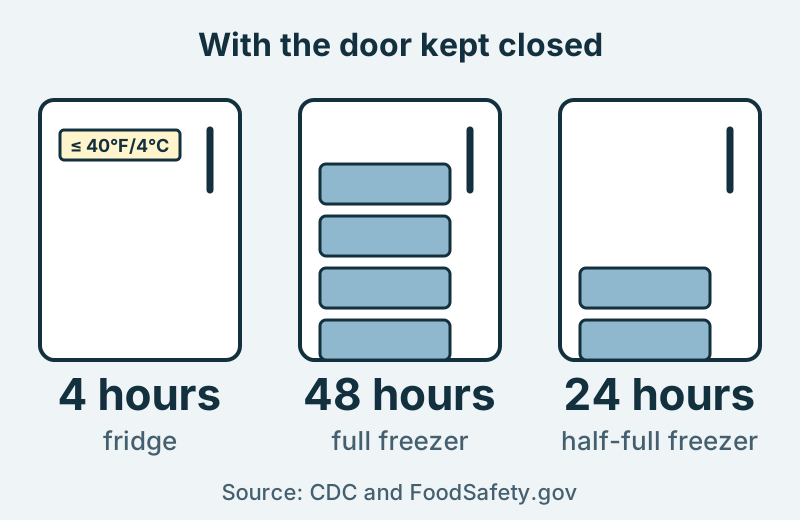
Here are the official times, from CDC and FoodSafety.gov:
| Appliance, door kept closed | Keeps food safe for about |
|---|---|
| Fridge | 4 hours |
| Full freezer | 48 hours |
| Half-full freezer | 24 hours |
If it looks like the outage will run past 4 hours, plan to move the most important cold items to a cooler with ice. My fridge and freezer guide covers what to keep and what to throw out later.
Unplug electronics and appliances. Canada.ca says to unplug tools, appliances and electronic equipment, and to turn the thermostat down, to prevent damage from a power surge when the power is restored. Leave one light switched on inside so you notice when it comes back. When it does, Canada.ca suggests waiting 10 to 15 minutes before plugging other things back in.
Put phones on power-saving mode. The FCC suggests limiting non-emergency calls and conserving battery. Texts often get through when calls do not. My phone charging guide has more, and I wrote a separate post on keeping phones charged for a week.
Minutes 30 to 60: people, information and safety
Get information from something that does not need the grid. A battery or hand-crank radio keeps working when phone networks are busy or down.
Check on people. Think about neighbours who live alone, are older, or have young children. A knock on the door is often all it takes.
Medical devices and medicine. If anyone at home relies on powered medical equipment, start your backup plan now rather than waiting. CDC also notes that when the power is out for a day or more, medicine that should be refrigerated may need to be thrown out unless the label says otherwise, so check the label and call a pharmacist if you are unsure. My medical device power plan walks through what to sort out ahead of time.
Stay away from downed lines. Canada.ca says not to touch power lines, to stay away from them and to report them. Assume any downed line is live.
Generators: the one thing not to rush
A portable generator can make a long outage much easier, but it is also the most dangerous thing in this post.
Carbon monoxide warning. Generators, camp stoves, barbecues, charcoal, and kerosene or propane burners give off carbon monoxide, which you cannot see or smell and which can kill within minutes. Never use them indoors, or in a garage, basement, shed, tent or covered porch, even with doors and windows open. Outdoors, keep them at least 20 feet (6 m) from doors, windows and vents.
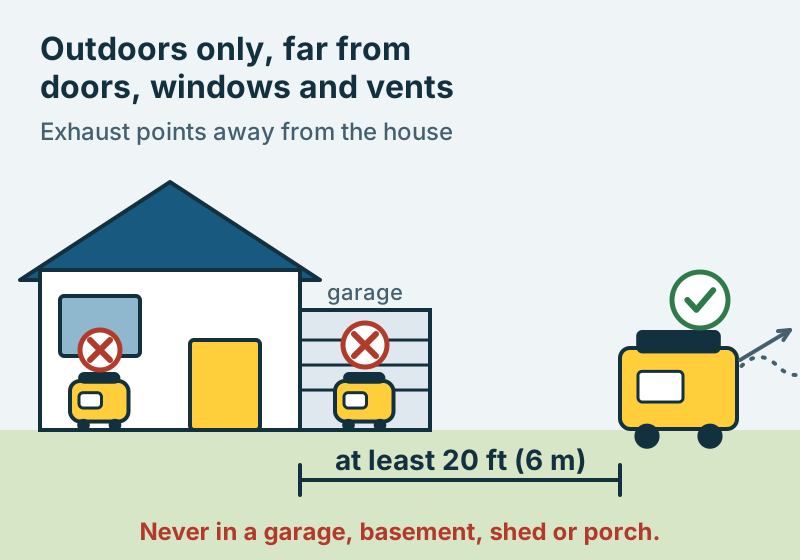
CDC’s advice is to keep the generator outside at least 20 feet away from any doors, windows or vents, to use an extension cord more than 20 feet long so it can sit at a safe distance, and to use a battery-powered or battery-backup carbon monoxide alarm inside. Canada.ca says the same 6 m (20 feet) from all homes and buildings. Never plug a generator into a wall outlet. My generator safety guide covers cords, fuel and transfer switches.
Two more things that cause carbon monoxide poisoning in outages:
- Gas ranges and ovens used for heat. CDC says never use a gas range or oven to heat a home.
- Cars running in a garage. CDC says never leave a motor running in a vehicle parked in an enclosed or partly enclosed space such as a garage, even to charge a phone.
If anyone gets a headache, feels dizzy, weak or sick to their stomach, or a carbon monoxide alarm sounds, get everyone outside into fresh air and call 911.
When the first hour turns into a long night
If the power stays off, the no power for 1 day checklist picks up from here, and the 3-day checklist after that. The Red Cross says to evacuate if your home becomes too hot or too cold, or if you have medical devices that need power. My post on sheltering in place versus leaving has a short decision helper.
If you are reading this before an outage, the best time to prepare is now. The plan builder works out what your household needs for 3, 7, 14 or 30 days, and the 72-hour list is a good first target.
Video: Use a Generator Safely
From the official Centers for Disease Control and Prevention (CDC) YouTube channel.
Playing it loads the video from YouTube (youtube-nocookie.com), which may set cookies. Nothing loads until you press play. You can also watch it on YouTube.
Questions people ask
How long will food in my fridge stay safe when the power goes out?
CDC and FoodSafety.gov say a fridge keeps food safe for up to about 4 hours if you keep the door closed. A full freezer holds a safe temperature for about 48 hours, and a half-full one for about 24 hours.
Should I unplug things during a power outage?
Yes. Canada.ca says to unplug tools, appliances and electronics to prevent damage from a power surge when the power comes back, and to leave one light on so you know when it has been restored.
Can I use my gas stove to stay warm while the power is out?
No. CDC says never to use a gas range or oven to heat a home. Canada.ca says a natural gas stove can be used to prepare food during an outage but not as a heating source.
Where should a portable generator go?
Outside only. CDC says to keep it at least 20 feet (6 m) away from doors, windows and vents, and never to run it in a home, garage or basement. Use a battery-powered or battery-backup carbon monoxide alarm indoors.
When should I leave home during a power outage?
The American Red Cross says to evacuate if your home is too hot or too cold, or if you have medical devices that need power. Always follow an evacuation order from officials.
Where to buy
Some links earn me a commission at no cost to you. How this works
Flashlight, battery or hand-crank
Black Diamond Spot 400 Headlamp
A AAA-powered dimmable headlamp that keeps both hands free and uses common batteries.
Check prices and optionsat Amazon.comCheck prices and optionsat Amazon.ca
Spare batteries for your flashlights and radio
Energizer Ultimate Lithium AA Batteries, 4 Pack
Energizer states AA Ultimate Lithium cells last up to 25 years in storage and work from -40°F to 140°F (-40°C to 60°C), which suits stored kits.
Check prices and optionsat Amazon.comCheck prices and optionsat Amazon.ca
Phone power bank
Anker Power Bank, 20,000mAh, Built-In USB-C Cable
A 20,000 mAh pack holds several phone charges and has its own cable, so one less thing to find in the dark.
Check prices and optionsat Amazon.comCheck prices and optionsat Amazon.ca
Battery or hand-crank radio, with NOAA Weather Radio
Midland ER310 Emergency Crank Weather AM/FM Radio
Runs from multiple power sources including a hand crank, and receives NOAA weather channels with alert.
Check prices and optionsat Amazon.comCheck prices and optionsat Amazon.ca
Battery or hand-crank radio, with NOAA Weather Radio
Kaito KA500 5-Way Powered Emergency AM/FM/SW Weather Alert Radio
Has solar, hand-crank and other power options plus a flashlight and reading lamp.
Check prices and optionsat Amazon.comCheck prices and optionsat Amazon.ca
Battery-operated carbon monoxide alarm
Kidde KN-COB-B-LP Nighthawk Carbon Monoxide Alarm, Battery Operated
Kidde lists it as UL Listed with an electrochemical sensor, and it runs on 3 AA batteries so it keeps working in a power outage.
Check prices and optionsat Amazon.comCanadian link coming soon
Battery-operated carbon monoxide alarm
Kidde C3010 Worry-Free Carbon Monoxide Alarm, 10-Year Sealed Battery
Kidde lists its Canadian C3010-CA as CSA Listed with an electrochemical sensor and a sealed lithium battery, so it keeps working in an outage; check the listing shows the CSA mark before buying.
US link coming soonCheck prices and optionsat Amazon.ca
Where these numbers come from (6 sources)
- Canada.ca: Power outages, how to prepare https://www.canada.ca/en/services/policing/emergencies/preparedness/get-prepared/hazards-emergencies/power-outages/how-prepare.html
- CDC: What to Do to Protect Yourself During a Power Outage https://www.cdc.gov/natural-disasters/response/what-to-do-protect-yourself-during-a-power-outage.html
- CDC: Use a Generator Safely (PSA) https://www.cdc.gov/natural-disasters/psa-toolkit/use-a-generator-safely.html
- American Red Cross: Power Outage https://www.redcross.org/get-help/how-to-prepare-for-emergencies/types-of-emergencies/power-outage.html
- FoodSafety.gov: Food Safety During a Power Outage (chart) https://www.foodsafety.gov/food-safety-charts/food-safety-during-power-outage
- FCC: Tips for Communicating in an Emergency https://www.fcc.gov/reports-research/guides/tips-communicating-emergency