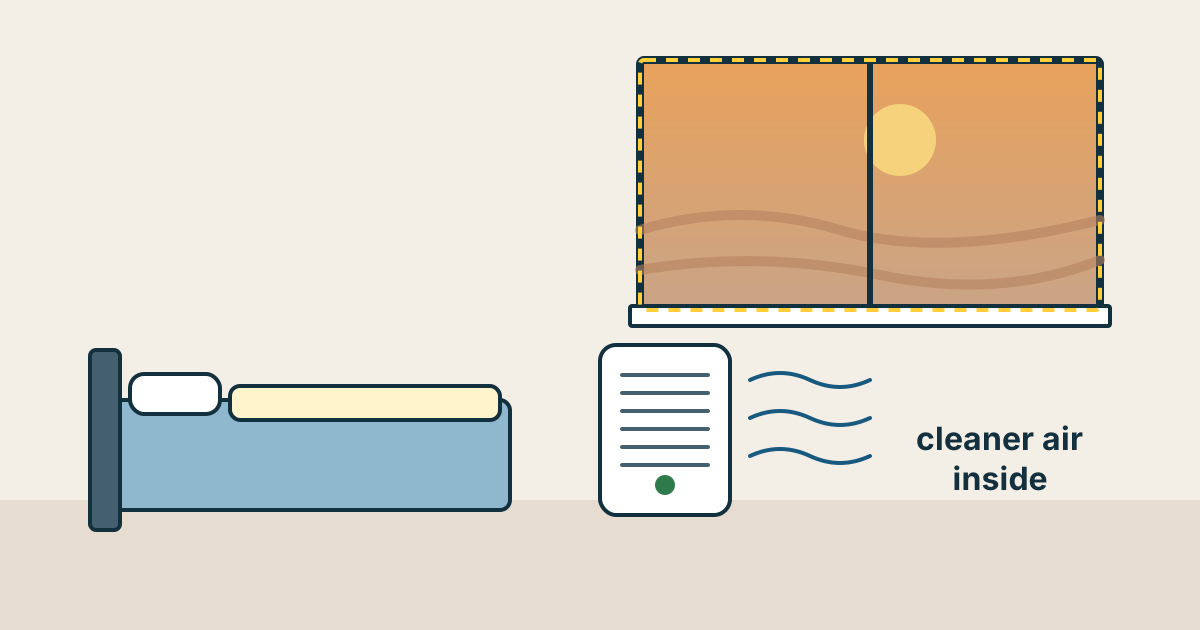
When wildfire smoke settles over a region, it can stay for days. Keeping a whole house clean is hard. Keeping one room clean is much more manageable. The US Environmental Protection Agency calls this a clean room, and Health Canada talks about cleaner air spaces. Here is how I would set one up, step by step, from EPA, Health Canada and Canada.ca guidance.
Step 1: pick the room
EPA suggests a room big enough for everyone in your household and comfortable enough to spend a lot of time in. A bedroom with an attached bathroom works well, because you can close it off for long periods. Fewer windows and outside doors means fewer places for smoke to get in.
If you have pets, they belong in the room too. Plan for their water, food and litter.
Step 2: keep smoke out
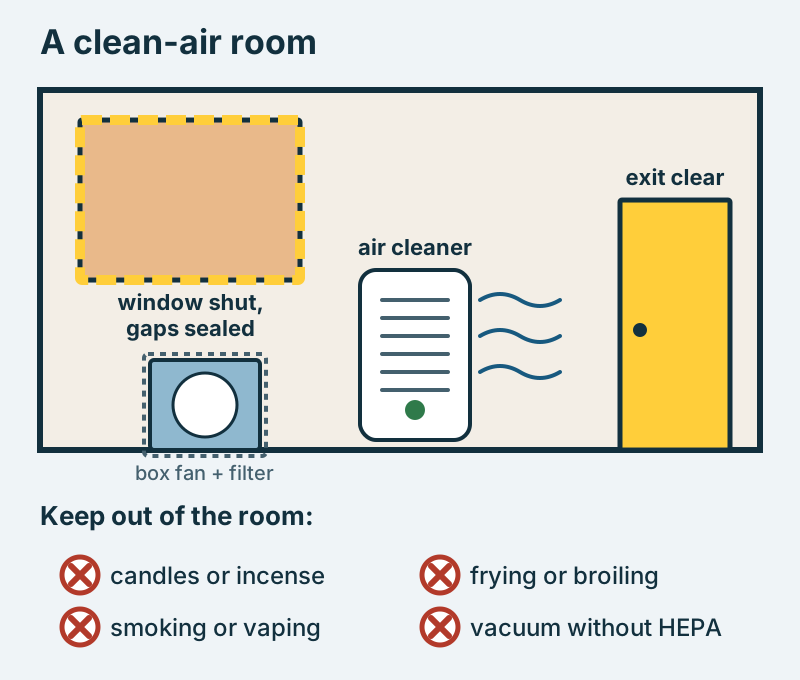
- Close the windows and doors, but keep your exit usable. EPA is clear that you still need a way out.
- Seal gaps. Canada.ca suggests properly sealing windows and doors before smoke arrives. Weatherstripping is one way to do it. Tape and plastic sheeting over a window you will not need to open is another.
- Use exhaust fans briefly. EPA notes that bathroom fans and range hoods in the room can pull smoke in from elsewhere in the house, so use them only for short periods.
Step 3: filter the air
This is where the real cleaning happens.
A portable air cleaner. EPA suggests one sized for the room, running continuously on its highest setting if you can. Pick one that does not produce ozone. Health Canada says to use a certified portable air cleaner that can filter fine particles. Canada.ca suggests considering one or more certified, properly sized air cleaners as part of getting ready, and keeping spare filters on hand.
A box fan filter, as a stopgap. If you cannot get or afford an air cleaner, EPA describes attaching a high-efficiency furnace filter to a box fan. It recommends this only when products of known performance are unavailable or unaffordable. EPA’s safety points:
- Use a newer box fan, made in 2012 or later, with a UL or ETL safety mark.
- Do not leave it running when nobody is there to watch it.
Your HVAC system. If you have forced-air heating or cooling, EPA suggests a high-efficiency filter, MERV 13 or higher, if your system can take it. Set the fan to On rather than Auto, and set the system to recirculate so it is not pulling in outside air. During heavy smoke, change filters more often than the maker suggests. Health Canada says to use the best filter your system can handle. If you are not sure what your system can take, ask a heating technician before smoke season.
Step 4: stop making smoke inside
It is easy to undo all of the above by accident. EPA’s list of things to avoid in your clean room, and ideally the whole home:
- Smoking or vaping
- Gas or wood stoves and fireplaces
- Frying or broiling food
- Candles and incense
- Aerosol sprays
- Vacuuming, unless your vacuum has a HEPA filter
EPA also suggests damp-dusting surfaces. Meals that need no cooking help a lot here, so see what food lasts without a fridge for ideas.
Step 5: spend your time there
EPA suggests spending as much time as you can in the clean room, and not exercising there. When the air outside improves, open up the room and the house to air them out, and run kitchen and bathroom fans.
When heat matters more than smoke
Smoke often comes with hot weather, and that changes the priority. Health Canada says to prioritize keeping cool, because overheating can be more dangerous. It warns that indoor temperatures can get dangerously high during extreme heat.
- If you have air conditioning, use it on recirculate.
- If you do not, and the air outside is cooler than inside, opening windows for a while may be the right call.
- Cooling centres and public spaces with air conditioning and filtered air are another option.
Health Canada lists the people most at risk from heat and smoke: adults 65 and older, pregnant people, infants and young children, people with chronic illnesses, people without air conditioning, and people who work or exercise outdoors. My extreme heat checklist covers the heat side in more detail.
Going outside
If you have to go out, Health Canada and Canada.ca say a well-fitted, NIOSH-approved N95 respirator can reduce your exposure to fine particles. It does not filter the gases in smoke. Health Canada says children under 2, and anyone who has trouble breathing in one, should not wear a respirator.
If anyone has trouble breathing, chest pain or a cough that will not settle, get medical help. In an emergency, call 911.
Keep an eye on the air and on alerts
- US: check AirNow and your state or local air agency.
- Canada: Canada.ca suggests learning the Air Quality Health Index (AQHI) and checking local readings and forecasts regularly.
Smoke usually means fire somewhere. Canada.ca suggests keeping your vehicle fuelled and your emergency kit ready to go in case you need to leave. If you get an evacuation alert or order, see what a wildfire evacuation order means and my post on sheltering in place versus leaving.
The short version
The full wildfire smoke checklist is printable. The checklist below is a quick way to see whether your room is ready.
Interactive checklist
Is your clean-air room ready?
Tick what is done. Nothing is saved.
0 of 11 done
All done. Keep this page open, or print the guide it links to.
Questions people ask
What is a clean-air room?
A room you can close off and keep cleaner than the rest of the house during smoke, usually with windows and doors shut and a portable air cleaner running. EPA suggests a room big enough for everyone, such as a bedroom with an attached bathroom.
Does a box fan with a filter work for wildfire smoke?
EPA describes a do-it-yourself box fan filter as a temporary option when you cannot get or afford a portable air cleaner. It says to use a newer box fan, 2012 or later, with a UL or ETL safety mark, and not to leave it running unattended.
What filter should I use in my furnace or HVAC during smoke?
EPA suggests a high-efficiency filter, MERV 13 or higher, if your system can take it, with the fan set to On rather than Auto and the system on recirculate. Change filters more often than usual during heavy smoke.
Should I keep windows closed during wildfire smoke if it is hot?
Health Canada says to prioritize keeping cool, because overheating can be more dangerous. If you have no air conditioning and the outside air is cooler, opening windows may help, or go to a cooling centre or a public space with filtered air.
Do cloth masks protect against wildfire smoke?
A well-fitted NIOSH-approved N95 can reduce exposure to fine smoke particles, according to Health Canada and Canada.ca. It does not filter the gases in smoke, and children under 2 should not wear one.
Where these numbers come from (3 sources)
- EPA: Create a Clean Room to Protect Indoor Air Quality During a Wildfire https://www.epa.gov/emergencies-iaq/create-clean-room-protect-indoor-air-quality-during-wildfire
- Health Canada: Wildfire smoke with extreme heat https://www.canada.ca/en/health-canada/services/publications/healthy-living/combine-wildfire-smoke-heat.html
- Canada.ca: Wildfires, how to prepare https://www.canada.ca/en/services/policing/emergencies/preparedness/get-prepared/hazards-emergencies/wildfires/how-prepare.html