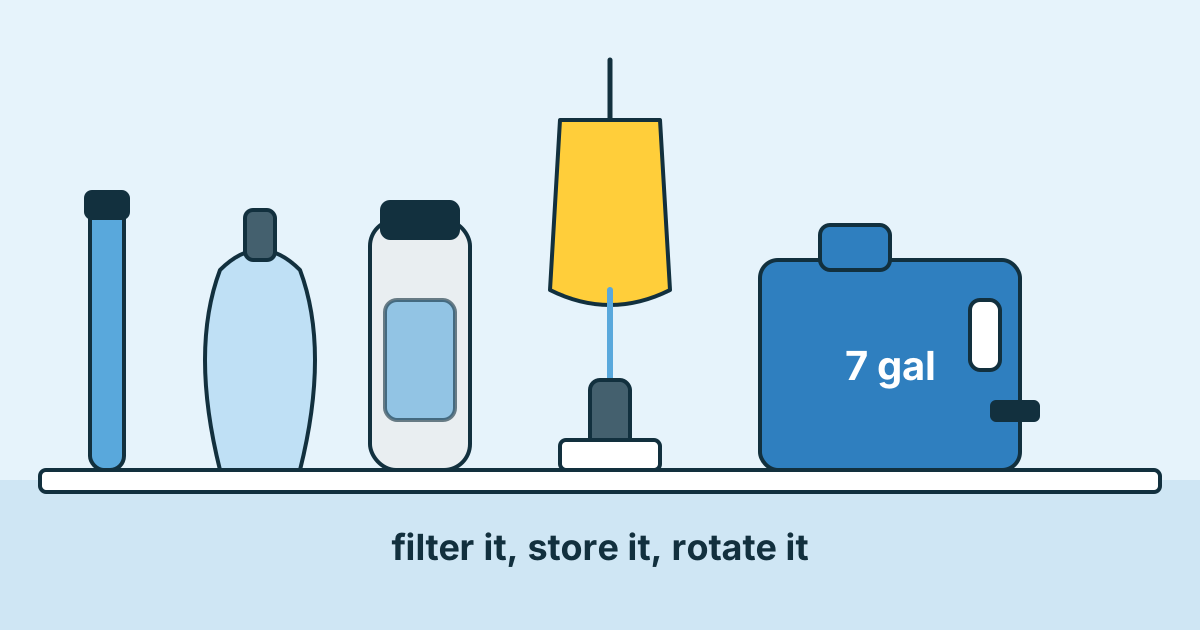
There are two sides to emergency water. Storage is water you set aside before anything happens. Treatment is making questionable water safe after something goes wrong. Most households need storage first, and a filter or purifier as a backup. Here is what the common options do, using only what the makers publish and what CDC and Health Canada say about treating water.
These are the makers’ claims as I read them on November 9, 2026, not my own test results. Check the current product page and manual before you buy.
Start with what official guidance says
CDC’s emergency water page sets the rules every filter is measured against:
- Filters will not remove viruses. After filtering, CDC says to add a chemical disinfectant such as iodine, chlorine or chlorine dioxide.
- To remove parasites such as Giardia or Cryptosporidium, a filter needs an absolute pore size of 1 micron or smaller.
- To remove bacteria, it needs an absolute pore size of 0.3 micron or smaller.
- Boiling: bring clear water to a rolling boil for 1 minute, or 3 minutes above 6,500 feet (about 2,000 m).
- Chemicals and fuel: you can’t make water with fuel, toxic chemicals or radioactive material safe by boiling or disinfecting. Use bottled water or a different source, and contact your health department.
Health Canada gives a bleach method for when boiling isn’t practical: about 2 drops (0.2 mL) of unscented 5.25% household bleach per litre of water, stirred, then left for 30 minutes. My water treatment guide has CDC’s full bleach table.
The filters, side by side
| Product | Type | What the maker says it removes | What the maker doesn’t claim or warns about | Rated life |
|---|---|---|---|---|
| LifeStraw Personal | Straw, 0.2 micron | 99.999999% of bacteria, 99.999% of parasites, 99.999% of microplastics; reduces cloudiness | No virus claim. Manual: never use on seawater or chemically contaminated water | Up to 1,000 gal (4,000 L) |
| Sawyer Squeeze (SP129) | Squeeze pouch or inline, 0.1 micron absolute | 99.99999% of bacteria, 99.9999% of protozoa, 100% of microplastics | No virus or chemical claim | No rated life on the product page |
| Sawyer Micro Squeeze (SP2129) | Squeeze, 0.1 micron absolute | Same bacteria, protozoa and microplastic figures | Sawyer says dissolved substances pass through, including fluoride, chlorine and anything in solution | Up to 100,000 gal |
| Sawyer One Gallon Gravity (SP160) | Hanging bag, 0.1 micron absolute | 99.99999% of bacteria, 99.9999% of protozoa, 100% of microplastics | No virus or chemical claim | Up to 100,000 gal |
| GRAYL GeoPress | Press bottle, purifier, 24 oz (710 mL) | 99.99% of viruses, 99.9999% of bacteria, 99.9% of protozoan cysts; carbon adsorbs some chemicals, including PFAS and VOCs, pesticides and heavy metals | Avoid salty or brackish water. Not designed for industrial disasters, high lead levels, mercury or nuclear disasters | 350 cycles, 65 gal (250 L) |
A few notes on reading this table:
- Filter vs purifier. The LifeStraw and Sawyer filters above claim bacteria and protozoa, not viruses. That matches CDC’s general point that filters won’t remove viruses, so follow a filter with a disinfectant if viruses are a concern. GRAYL markets GeoPress as a purifier and makes a virus claim. GRAYL says it’s tested to NSF/ANSI protocols 42 and 53 and meets the US EPA’s water purifier standard.
- Pore size. Both 0.2 micron (LifeStraw) and 0.1 micron (Sawyer) are below CDC’s 0.3 micron line for bacteria.
- Volume. A straw serves one person at a time. A gravity bag fills a pot for the household while you do something else. GRAYL lists 8 seconds per 24 oz press, but each press is one bottle.
- Taste and chemicals. Sawyer says tastes, colours and odours are dissolved solids that pass through its filter. GRAYL’s carbon is aimed at some of those. Neither makes water with fuel or industrial chemicals safe, which matches CDC.
Which fits your situation
This is about matching a tool to a job, not ranking brands.
- One person, a backup in a bag or car: a straw or squeeze filter is small and light. Pair it with tablets or bleach if you’re worried about viruses.
- A household during a boil-water advisory: a gravity bag can fill a pot for several people. Then follow CDC’s boiling or bleach steps, or the advisory’s own instructions.
- Unknown tap water while travelling: a purifier with a virus claim, like the GeoPress, covers more in one step.
- Water that might contain fuel or chemicals, such as floodwater: don’t drink it. Use stored or bottled water.
Storage: the part most people need first
A filter is only useful if there’s water to filter. CDC says to store at least 1 gallon (3.8 L) per person per day for 3 days, and a 2-week supply if you can. Health Canada lists 2 L per person per day for drinking, plus 2 more litres for cooking and cleaning. For two people for two weeks at CDC’s rate, that’s 28 gallons, or about 106 L. My two-week water post has a calculator.
CDC’s container rules:
- Use food-grade water storage containers. If one isn’t food-grade, it should be durable and unbreakable, not glass.
- Never reuse containers that held toxic chemicals such as bleach or pesticides.
- Sanitize first with 1 teaspoon of unscented bleach in 1 quart (4 cups) of water.
- Replace stored water every 6 months.
- Keep containers cool, 50 to 70°F (10 to 21°C), and out of direct sunlight.
Rigid jugs are a common choice. As one example, REI lists the Reliance Aqua-Tainer 7 gal. at 26.5 L, made of polyethylene, BPA free, with a spigot and reversible spigot cap, and weighing 2 lb empty. Full, a jug like that is heavy, so store it where you’ll use it. Smaller bottles are easier to carry. Health Canada suggests keeping some, because they’re easier to handle.
My storing water guide covers rotation and where to keep jugs, and how much water covers pets and special cases.
A simple setup for most homes
- Store water first, using CDC’s 1 gallon (3.8 L) per person per day as a minimum.
- Keep a filter or purifier that matches how many people you need to serve.
- Keep a disinfectant, such as unscented bleach or tablets, for the step a filter doesn’t cover.
- Write the date on stored water and set a reminder to change it every 6 months.
Build the rest of your plan
- Get water and supply amounts for your household in the plan builder.
- Pick a ready-made list from the lists page, such as the 72-hour list.
- Plan meals that use little water on my food page and with no-cook recipes.
Questions people ask
Do water filters remove viruses?
CDC says filters will not remove viruses, and recommends adding a chemical disinfectant such as chlorine, iodine or chlorine dioxide after filtering. LifeStraw and Sawyer make no virus claim for the filters covered here. GRAYL sells the GeoPress as a purifier and states it removes 99.99% of viruses.
What pore size does a filter need?
CDC says a filter needs an absolute pore size of 1 micron or smaller to remove parasites such as Giardia and Cryptosporidium, and 0.3 micron or smaller to remove bacteria. LifeStraw lists 0.2 micron for its Personal filter, and Sawyer lists 0.1 micron absolute.
Can a filter make water with fuel or chemicals safe?
CDC says you cannot make water containing fuel, toxic chemicals or radioactive materials safe by boiling or disinfecting it. Use bottled water or a different source. LifeStraw's manual says never to use its filter on seawater or chemically contaminated water.
How often should I replace stored tap water?
CDC says to replace water you've stored yourself every 6 months, and to keep containers somewhere cool, 50 to 70°F (10 to 21°C), out of direct sunlight.
How much water should I store?
CDC says at least 1 US gallon (3.8 L) per person per day for 3 days, and 2 weeks if possible. Health Canada lists 2 L per person per day for drinking, plus 2 more litres for cooking and cleaning.
Where to buy
Some links earn me a commission at no cost to you. How this works
Water filter rated for bacteria and protozoa
Sawyer Products SP129 Squeeze Water Filtration System
Sawyer rates this filter at 0.1 absolute micron and states that bacteria, protozoa and cysts cannot pass through it.
Check prices and optionsat Amazon.comCheck prices and optionsat Amazon.ca
Water filter rated for bacteria and protozoa
LifeStraw Personal Water Filter
A straw-style filter that needs no power, sold by LifeStraw for hiking, travel and emergency preparedness.
Check prices and optionsat Amazon.comCheck prices and optionsat Amazon.ca
Water filter rated for bacteria and protozoa
GRAYL GeoPress 24 oz Water Purifier Bottle
GRAYL states it removes viruses, bacteria and protozoan cysts and is independently tested to NSF/ANSI protocols 42 and 53.
Check prices and optionsat GRAYLCheck prices and optionsat GRAYL
Water filter rated for bacteria and protozoa
Sawyer SP160 One Gallon Gravity Water Filtration System
A hanging 1-gallon bag with a 0.1 micron absolute filter that Sawyer rates for up to 100,000 gallons, for filtering water for a household.
Check prices and optionsat Amazon.comCheck prices and optionsat Amazon.ca
Water storage container, 7 gal / 26 L
Reliance Aqua-Tainer 7 Gallon Rigid Water Container
A rigid 7 gal (26 L) container sold for drinking water storage, so one jug covers several person-days.
Check prices and optionsat Amazon.comCheck prices and optionsat Amazon.ca
Potable Aqua Chlorine Dioxide Water Purification Tablets, 30 Count
A small chemical backup to a filter that stores easily; follow the dose and contact time on the label.
Check prices and optionsat Amazon.comCheck prices and optionsat Amazon.ca
Aquatabs 334 mg Water Treatment Tablets, 30-Pack
The Amazon.ca listing cites NSF/ANSI/CAN 60, and each tablet is sold for treating 20 L, so it suits larger containers; follow the label.
Check prices and optionsat Amazon.comCheck prices and optionsat Amazon.ca
Where these numbers come from (10 sources)
- CDC: How to Make Water Safe in an Emergency https://www.cdc.gov/water-emergency/about/index.html
- CDC: How to Create an Emergency Water Supply https://www.cdc.gov/water-emergency/about/how-to-create-and-store-an-emergency-water-supply.html
- Health Canada: Food and drinking water safety in an emergency https://www.canada.ca/en/health-canada/services/food-drinking-water-safe-emergency.html
- LifeStraw: Personal Water Filter, filtration performance sheet (PDF) https://cdn.shopify.com/s/files/1/2631/0778/files/LifeStraw_-_Personal_Water_Filter_-_Filtration_Performance_Sheet.pdf
- LifeStraw: Personal user manual (PDF) https://cdn.shopify.com/s/files/1/2631/0778/files/LifeStraw_Personal_User_manual.pdf
- Sawyer: Squeeze Water Filter System https://www.sawyer.com/product/sawyer-squeeze-water-filter-system
- Sawyer: Micro Squeeze Water Filtration System https://sawyer.com/products/micro-squeeze-water-filtration-system
- Sawyer: One Gallon Gravity Water Filtration System https://www.sawyer.com/product/sawyer-one-gallon-gravity-water-filtration-system
- GRAYL: GeoPress Purifier https://grayl.com/products/geopress-purifier-alpine-white
- REI: Reliance Aqua-Tainer 7 gal. listing https://rei.com/product/618168/reliance-aqua-tainer-7-gal