When grocery prices rise, a strike hits the news or a post says the shelves will be empty next week, it’s natural to want to stock up. The calm way to do it is slow and boring: check what’s true, then add a little to each regular shop until you have a two-week supply you actually use. Here is how, without paying extra, wasting food or emptying shelves your neighbours need too.
This post sticks to practical steps. It doesn’t take sides on why prices are moving.
Step 1: Check the rumour before you act
A lot of “stock up now” posts are based on things that never happen. Some disruptions are real but local. Checking takes a few minutes.
The Canadian Centre for Cyber Security offers three quick checks:
- See if other outlets report it. If established news organisations are covering the same story, it’s more likely to be real. If few or none are, be cautious.
- Find the original source. Most reports name where the information came from: a company, a union, a government agency. Look at what that source actually said.
- Check the web address. Fake sites sometimes copy a real news site’s name with a missing or swapped letter.
It also suggests you pause before you hit share.
Two real examples from this fall show the difference:
- A rumour. In September, posts claimed a nationwide US truckers’ strike would start October 1. Newsweek reported that the Owner-Operator Independent Drivers Association said the talk appeared to be “limited to social media chatter.”
- A real, local disruption. In November, WCAX reported a strike at an Associated Grocers Northeast warehouse in New Hampshire that was affecting deliveries to some independent grocery stores in Vermont. The Vermont Retail and Grocers Association said there are other distribution channels for those stores.
Both were in the news. Only one was real, and it affected a region, not a country. If a disruption is real where you live, the steps below still apply, just a little faster.
Step 2: Know your target
Without a goal, it’s easy to buy too much of one thing and none of another. Official guidance gives a clear range:
- At least 72 hours. Canada.ca asks households to be ready to look after themselves for at least 72 hours.
- About two weeks. During the pandemic, FDA’s food policy lead said there was no need to buy more than a week or two of food for your family and pets, and to leave some for others. CDC suggests a 2-week water supply if possible.
Two weeks is a good working goal. It covers most storms and outages, and it fits in an ordinary home. My plan builder works out amounts for your household, and the 14-day list shows what that looks like.
Step 3: Buy gradually
Gradual buying spreads the cost and gives stores time to restock. A simple pattern:
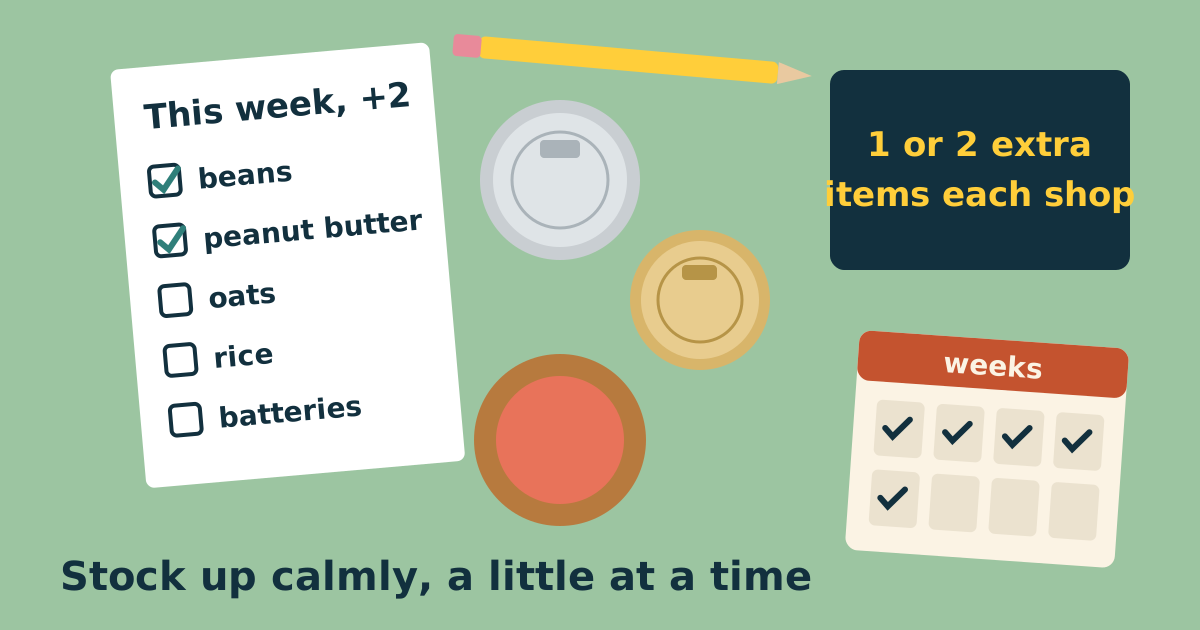
- Add one or two extra items each regular shop. For example, an extra can of beans this week and an extra jar of peanut butter next week.
- Buy what you already eat. Stored food only saves money if you eat it before it expires.
- Rotate as you go. New items go to the back, and you use the oldest first. My pantry rotation guide shows a simple shelf system.
- Watch for sales on long-keeping staples. Rice, pasta, oats, canned fish and dried beans keep well. See pantry staples that keep a year.
- Set a budget. My first $50 prep shop is one way to start small.
Small additions add up over a couple of months, without one large bill.
Step 4: Don’t forget the non-food basics
The things people often find missing in an outage aren’t food. Ready.gov’s kit list includes water, food, a radio, a flashlight, a first aid kit, a whistle, and a phone with chargers. Add these gradually too:
- Water. CDC suggests at least 1 gallon (3.8 L) per person per day.
- Medicines. Talk to your pharmacist or doctor about an extra supply. My medication planning guide explains how to ask.
- Batteries and a manual can opener.
- Pet food and supplies if you have pets.
- Hygiene supplies: soap, toilet paper, menstrual products.
What panic buying looks like, and why to skip it
Panic buying usually means buying a lot in one trip because of a headline. The downsides are practical:
- You pay more, because you buy at whatever today’s price is, not on sale.
- Food goes to waste if you buy more than you can eat before it expires.
- Storage runs out. Food kept in a hot garage or damp basement spoils faster.
- Neighbours go without if shelves empty for a day or two. Leaving some for others, as FDA put it, helps everyone get what they need.
If you notice the urge to buy everything at once, go back to step 1 and check the story, then step 2 and check your target.
Keep it going
Ready.gov says to replace expired items as needed and to rethink your needs every year, as your family changes. A once-a-year check, maybe when you change your clocks, keeps your supply useful instead of stale.
Build the rest of your plan
- Work out exact amounts for your household in the plan builder.
- See every ready-made checklist on the lists page, including the supply shortage list.
- Plan meals around what you store on my food page, with pantry recipes such as rice and beans.
Questions people ask
How much food should I stock up on?
FDA's food policy lead said during the pandemic that there was no need to buy more than a week or two of food for your family and pets, and to leave some for others. Canada.ca asks every household to be ready for at least 72 hours. Two weeks is a sensible goal to build toward.
How do I know if a shortage rumour is true?
The Canadian Centre for Cyber Security suggests checking whether other established news outlets report the same thing, looking for the original source, and checking the website address for misspellings. It also suggests pausing before you share.
Is it panic buying to buy extra when prices are rising?
Buying one or two extra of what you already eat on each regular shop is gradual stocking. Clearing a shelf in one trip, or buying more than you can store or use before it expires, tends to cost more and wastes food.
What should I buy first?
Water, then foods you already eat that keep without a fridge, any medicines you rely on (talk to your pharmacist), and basics like batteries. Ready.gov's kit list starts with water and food.
How do I keep stored food from going to waste?
Put new items at the back and use the oldest first. Ready.gov says to replace expired items as needed and to rethink your needs every year.
Where to buy
Some links earn me a commission at no cost to you. How this works
Water storage container, 7 gal / 26 L
Reliance Aqua-Tainer 7 Gallon Rigid Water Container
A rigid 7 gal (26 L) container sold for drinking water storage, so one jug covers several person-days.
Check prices and optionsat Amazon.comCheck prices and optionsat Amazon.ca
Canned beans, tuna, chicken or stew
Canned chunk chicken breast, multi-pack
Fully cooked and ready to eat from the can; USDA FSIS lists canned meat and poultry at 2 to 5 years.
Check prices and optionsat Amazon.comCheck prices and optionsat Amazon.ca
Rice, pasta or oats
Long-grain white rice, 20 lb (9 kg) bag
Plain white rice in a large bag; USDA FSIS lists rice and dried pasta at 2 years in a cool, dry place.
Check prices and optionsat Amazon.comCheck prices and optionsat Amazon.ca
Rice, pasta or oats
Old-fashioned rolled oats, large bag
Rolled oats can be soaked instead of cooked, as in the soaked oats recipe on this site.
Check prices and optionsat Amazon.comCheck prices and optionsat Amazon.ca
Rice, pasta or oats
Dried pasta, multi-pack
USDA FSIS lists dried pasta at 2 years in a cool, dry place.
Check prices and optionsat Amazon.comCheck prices and optionsat Amazon.ca
Peanut butter or another nut or seed butter
Peanut butter, large jars, multi-pack
Ready-to-eat protein that needs no cooking or fridge before opening; check for peanut allergies in your household first.
Check prices and optionsat Amazon.comCheck prices and optionsat Amazon.ca
Manual can opener
OXO Good Grips Lock & Go Can Opener
A manual opener that works without power and has locking arms that hold the can while you turn.
Check prices and optionsat Amazon.comCheck prices and optionsat Amazon.ca
Spare batteries for your flashlights and radio
Energizer Ultimate Lithium AA Batteries, 4 Pack
Energizer states AA Ultimate Lithium cells last up to 25 years in storage and work from -40°F to 140°F (-40°C to 60°C), which suits stored kits.
Check prices and optionsat Amazon.comCheck prices and optionsat Amazon.ca
Where these numbers come from (7 sources)
- FDA: Perspective on Food Safety and Availability During and Beyond COVID-19 https://www.fda.gov/food/conversations-experts-food-topics/fdas-perspective-food-safety-and-availability-during-and-beyond-covid-19
- Ready.gov: Build a Kit https://www.ready.gov/kit
- Canada.ca: Emergency kits https://www.canada.ca/en/services/policing/emergencies/preparedness/get-prepared/emergency-kits.html
- Canadian Centre for Cyber Security: Fact or fiction, quick tips to help identify fake news https://cyber.gc.ca/en/guidance/fact-or-fiction-quick-tips-help-identify-fake-news
- Newsweek: Are truckers going on strike October 1? (Sept. 21, 2026) https://www.newsweek.com/are-truckers-going-on-strike-october-1-what-diesel-prices-say-12468623
- WCAX: Major New England strike leaves grocery store shelves empty (Nov. 6, 2026) https://wcax.com/2026/11/06/major-new-england-strike-leaves-grocery-store-shelves-empty
- CDC: How to Create an Emergency Water Supply https://www.cdc.gov/water-emergency/about/how-to-create-and-store-an-emergency-water-supply.html