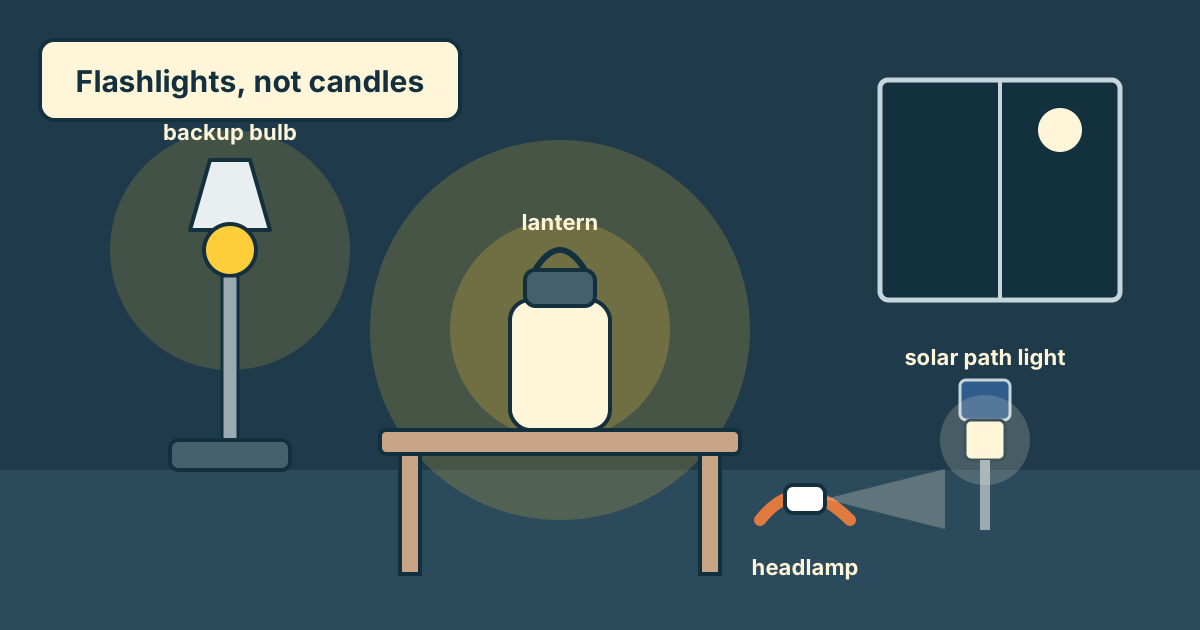
When the power goes out after dark, light is the first thing people reach for. The safest choices run on batteries or sunlight, not flame. CDC says to use battery-powered flashlights and lanterns rather than candles, gas lanterns or torches, to lower the risk of fire. The Red Cross puts it more simply: use flashlights, not candles.
There are four common types of outage lights, and each does a different job. Below is what each is good for, followed by a table of picks using only the makers’ published specs, as I read them on November 9, 2026. I haven’t tested these, and this isn’t a ranking.
Carbon monoxide warning. Never use a gas or kerosene lantern, camp stove, grill or generator indoors for light or heat. They give off carbon monoxide, which you can’t see or smell. Battery and solar lights make none.
Headlamps: light where you’re looking
A headlamp leaves both hands free for cooking, fixing a breaker, helping a child, or carrying things up stairs. That makes it a practical light for each person. Look at:
- Low mode run time. This is what gets you through several nights. Black Diamond lists 200 hours on low for the Spot 400 on AAA batteries; Petzl lists 100 hours at 7 lumens for the TIKKINA.
- Battery type. Both of these take three AAA batteries and also accept the maker’s rechargeable pack, sold separately. One battery size across all your lights makes spares simple.
- Water rating. Useful outdoors in a storm. Black Diamond lists IPX8 for the Spot 400; Petzl lists IPX4 for the TIKKINA.
Lanterns: light for the room
A lantern spreads light around a table or a room so the household can gather in one place. A solar lantern can recharge on a sunny windowsill or outdoors during the day.
- MPOWERD lists 150 lumens, up to 50 hours on low, and a 2,000 mAh battery for the Luci Pro Series. It charges by USB in 2 to 3 hours or in 14 hours of direct sun, and has a USB port that can top up a phone.
- Battery lanterns that take AA or D cells are also fine, as long as you keep spare batteries.
Solar charging is slow and depends on the weather, so charge solar lanterns fully by USB before a storm and use the sun to top up afterwards.
Battery backup bulbs: the lamp keeps working
These look like ordinary LED bulbs and screw into a standard E26 socket. A built-in battery charges while the bulb is on, and takes over when the power fails.
- GE lists 760 lumens and up to 5 hours of light for its LED+ Battery Backup A21 bulb. GE says the bulb stays on automatically when the power goes out, needs 10 hours of use to fully charge, and is for indoor use only.
- Feit lists 800 lumens and up to 3 hours of emergency light for its battery backup Intellibulb. Feit says you push the bulb’s power button to switch to battery.
These are handy in a hallway, stairwell or kitchen, where the outage would otherwise leave you in the dark at the worst moment. A few hours of light covers getting your bearings, not a multi-day outage.
Solar path lights: a free nightlight
Solar stake lights from the garden can be brought in after dark for a low glow in a bathroom or hallway, then set back outside the next morning to recharge. They need no batteries to buy, but their output is low and run time is often not listed. Treat them as nightlights alongside your real lights.
Picks by published specs
| Light | Type | Brightest setting | Longest run time (maker) | Power | Notes from the maker |
|---|---|---|---|---|---|
| Black Diamond Spot 400 | Headlamp | 400 lm | 200 h on low (AAA) | 3 AAA or BD 1500 rechargeable | IPX8; 86 g with AAA |
| Petzl TIKKINA | Headlamp | 300 lm | 100 h at 7 lm (AAA) | 3 AAA or CORE rechargeable | IPX4; 92 g |
| MPOWERD Luci Pro Series | Solar lantern | 150 lm | Up to 50 h on low | Built-in 2,000 mAh; solar or USB | IP67; USB port charges a phone |
| GE LED+ Battery Backup A21 | Backup bulb | 760 lm | Up to 5 h | Built-in battery, charges in use | Stays on automatically; indoor only |
| Feit Battery Backup Intellibulb | Backup bulb | 800 lm | Up to 3 h | Built-in battery, charges in use | Press button to switch to battery |
| Solar path lights | Stake light | Varies, check listing | Varies, check listing | Built-in cell and panel | Recharges outdoors in daylight |
A simple setup for most homes
- One headlamp or flashlight for each person, kept where they sleep.
- One lantern for the room where everyone gathers.
- A battery backup bulb or two for stairs or a hallway.
- Spare batteries in the sizes your lights take.
- A way to recharge: a power bank, a power station or solar.
Batteries and charging
Check your lights twice a year, when you change the clocks, and swap any batteries that are weak. Store spares in their packaging, in a cool, dry place, and keep them with the lights so nobody hunts in the dark. If your lights are rechargeable, charge them fully whenever a storm is in the forecast, and keep a power bank topped up so you can recharge a headlamp or lantern a second time. A battery backup bulb only charges while it’s switched on, so use it as your everyday bulb in that fixture.
If you must use candles
Health Canada says to use flameless candles whenever possible, never leave a burning candle unattended, put candles out before going to bed or leaving the room, and keep them away from anything that can burn and out of reach of children and pets. Snuff candles out rather than using water.
Related guides
- My guide to lighting in an outage has more on safe light.
- Keeping phones charged for a week covers power banks.
- If you want to recharge from the sun, see solar panels for power stations.
- Browse lights and the rest of the kit on my picks page, or start with the 72-hour list.
Questions people ask
Are candles OK in a power outage?
CDC says to use battery-powered flashlights and lanterns rather than candles, gas lanterns or torches to lower the risk of fire. The Red Cross says to use flashlights, not candles. If you must use candles, Health Canada says never leave them unattended and put them out before sleeping.
How many lights do I need?
A headlamp or flashlight for each person, so everyone has their hands free and their own light, plus a lantern for the room where you gather. Add spare batteries that match every light.
Do battery backup bulbs work in any lamp?
They're made for standard medium (E26) sockets. GE says its LED+ bulb stays on automatically when the power goes out and is for indoor use only. Feit says to press the bulb's button to switch to battery. Check the maker's instructions on switches and fixtures.
Can I use outdoor solar path lights indoors during an outage?
You can pull the stake light out of the ground and bring it in at night for a low glow, then put it back outside to recharge in daylight. Output and run time vary widely and are often not listed, so treat them as a nightlight, not a main light.
Where to buy
Some links earn me a commission at no cost to you. How this works
Flashlight, battery or hand-crank
Black Diamond Spot 400 Headlamp
A AAA-powered dimmable headlamp that keeps both hands free and uses common batteries.
Check prices and optionsat Amazon.comCheck prices and optionsat Amazon.ca
Flashlight, battery or hand-crank
Petzl TIKKINA Headlamp, 300 Lumens
Petzl lists 300 lumens max and 100 hours at 7 lumens on three AAA batteries, at 92 g.
Check prices and optionsat Amazon.comCheck prices and optionsat Amazon.ca
Battery lantern
Black Diamond Moji Lantern
A small AAA-powered lantern that lights a table or room corner without an open flame.
Check prices and optionsat Amazon.comCheck prices and optionsat Amazon.ca
Battery lantern
Goal Zero Lighthouse Core Lantern and USB Power Hub
A lantern with a USB port, so it can also top up a phone in an outage.
Check prices and optionsat Amazon.comCheck prices and optionsat Amazon.ca
Battery lantern
MPOWERD Luci Pro Series Solar Lantern
MPOWERD lists 150 lumens, up to 50 hours on low, solar or USB charging, a USB port for phones and IP67.
Check prices and optionsat Amazon.comCheck prices and optionsat Amazon.ca
GE LED+ Battery Backup A21 Bulbs, 8W, 2-Pack
GE lists 760 lumens and up to 5 hours of light from the built-in battery, and says the bulb stays on when the power goes out.
Check prices and optionsat Amazon.comCheck prices and optionsat Amazon.ca
Feit Electric Intellibulb Battery Backup LED, 60W Equivalent
Feit lists 800 lumens and up to 3 hours of emergency light after you press the bulb's button to switch to battery.
Check prices and optionsat WalmartCheck prices and optionsat Amazon.ca
Solar path lights, multi-pack
A small solar stake light can be brought in at night for a little glow; check the listing's lumen and run-time figures.
Check prices and optionsat Amazon.comCheck prices and optionsat Amazon.ca
Spare batteries for your flashlights and radio
Energizer Ultimate Lithium AA Batteries, 4 Pack
Energizer states AA Ultimate Lithium cells last up to 25 years in storage and work from -40°F to 140°F (-40°C to 60°C), which suits stored kits.
Check prices and optionsat Amazon.comCheck prices and optionsat Amazon.ca
Where these numbers come from (9 sources)
- CDC: What to Do to Protect Yourself During a Power Outage https://www.cdc.gov/natural-disasters/response/what-to-do-protect-yourself-during-a-power-outage.html
- American Red Cross: Power Outage Safety Checklist (PDF) https://www.redcross.org/content/dam/redcross/get-help/power-outage/EN_Power-Outage-Safety-Checklist.pdf
- Health Canada: Fire safety in your home https://www.canada.ca/en/health-canada/services/home-safety/fire-safety.html
- Ready.gov: Build a Kit https://www.ready.gov/kit
- Black Diamond: Spot 400 Headlamp https://blackdiamondequipment.com/products/spot-400-headlamp
- Petzl: TIKKINA https://www.petzl.com/US/en/Sport/Headlamps/TIKKINA
- MPOWERD: Luci Pro Series https://mpowerd.com/products/pro-series
- GE Lighting: LED+ Battery Backup A21 bulbs https://www.gelighting.com/led-lights/bulbs/medium-base/ge-led-battery-backup-led-light-bulbsgeneral-purpose-a21-bulbs-8-watts
- Feit Electric: Battery Backup Intellibulb https://feit.com/products/60w-equivalent-a19-dimmable-battery-backup-intellibulb-om60-927ca-batg2ledi