A portable generator can keep a fridge, a sump pump and a few lights going through a long outage. It also makes carbon monoxide, which is why every section below comes back to placement. This is general information, using official safety guidance and each maker’s own published specs as I read them on November 9, 2026. I haven’t tested these generators, and this isn’t a ranking.
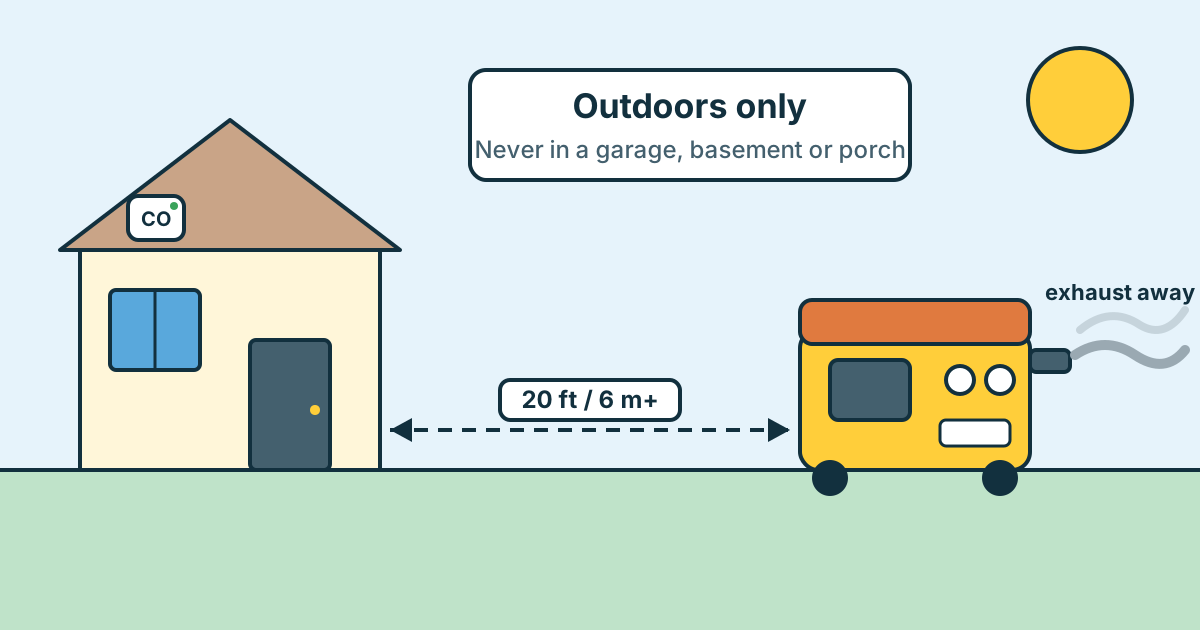
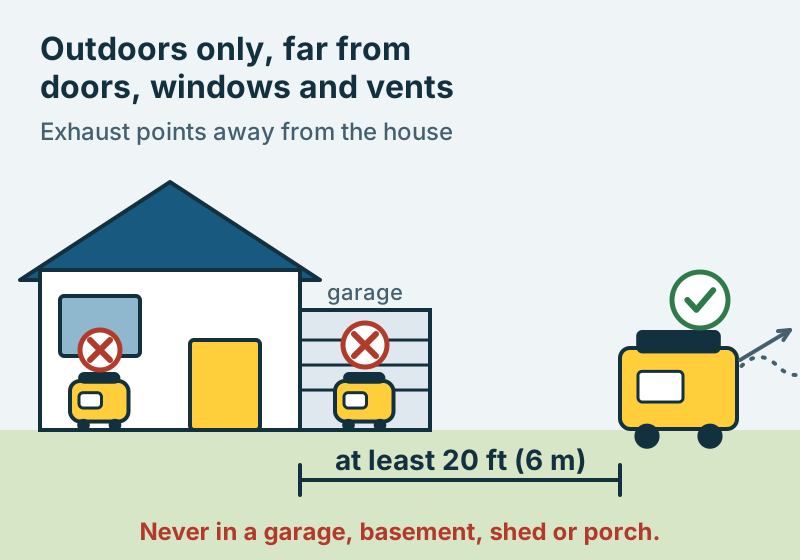
Carbon monoxide warning. A generator’s exhaust contains carbon monoxide (CO), which you can’t see or smell. CPSC says more than 80 people die each year in the US from CO poisoning caused by portable generators, and that running one indoors can kill in minutes. Never run a generator inside a home, garage, basement, crawlspace, shed or porch, even with doors and windows open. CDC says to keep it more than 20 feet (6 m) from any window, door or vent, and Canada.ca says at least 6 m (20 feet) from all buildings. Put battery-powered or battery-backup CO alarms near every sleeping area. If anyone feels dizzy, sick or weak, get to fresh air and call 911.
Inverter or conventional
Most portable generators fall into two groups.
- Inverter generators turn the engine’s power into AC electronically. In the table below they list 1,800 to 4,000 running watts, weigh roughly 47 to 100 lb (21 to 46 kg), and list noise figures from 48 to 64 dBA. WEN lists total harmonic distortion under 1.2% at full load for its DF480iX, a figure makers publish for sensitive electronics.
- Conventional (open-frame) generators in the table list 8,000 to 10,500 running watts and weigh 198 to 240 lb (90 to 109 kg). They can cover more of a home at once, including 240 V loads through the right outlet and transfer equipment.
Neither type is safer indoors. Both burn fuel and make CO.
Dual fuel and tri fuel
A dual-fuel generator runs on gasoline or propane. A tri-fuel model adds natural gas. The makers here list lower output on propane: Champion’s 201531 goes from 3,250 running watts on gasoline to 2,925 on propane, and DuroMax’s XP13000HXT from 10,500 to 10,000. Run times change too. Champion lists 10 hours on gasoline and 25 hours on a 20 lb propane tank at quarter load.
Propane cylinders also stay outdoors. CPSC says to keep propane, gasoline and kerosene outside living areas.
Size it by watts
Two numbers matter, and both are on the generator’s spec sheet:
- Running watts: what it can supply continuously.
- Starting (surge or peak) watts: the short burst for motors that kick on, like a fridge compressor or pump.
The Eugene Water & Electric Board’s sizing sheet gives a simple method: add the running watts of everything you want on at once, then add the single biggest extra starting load. Using that sheet’s typical figures:
| Appliance (EWEB typical figures) | Running watts | Extra starting watts |
|---|---|---|
| Refrigerator/freezer | 700 | 2,200 |
| Sump pump, 1/2 hp | 1,050 | 2,200 |
| Furnace fan, 1/3 hp | 700 | 1,400 |
| Four 15 W LED bulbs | 60 | none |
Running total: 700 + 1,050 + 700 + 60 = 2,510 W. Add the biggest extra starting load, 2,200 W, and you need about 4,710 W of starting capacity. The sheet calls this a guide only. Your own appliance labels are better, and an electrician can measure.
Six models and their published specs
Figures come only from each maker’s own product page. Where a page left a figure out, the table says so. Run times are at the load the maker states.
Output, fuel and CO shutoff
| Model | Fuel | Running W | Starting W | CO shutoff |
|---|---|---|---|---|
| Honda EU2200i | Gasoline | 1,800 | 2,200 | Yes, CO-MINDER |
| Champion 201531 | Gas / propane | 3,250 / 2,925 | 4,500 / 4,500 | Yes, CO Shield |
| Westinghouse iGen4500DFcv | Gas / propane | 3,700 / 3,330 | 4,500 / 4,050 | Yes |
| WEN DF480iX | Gas / propane | 4,000 / 3,600 | 4,800 / 4,320 | Yes, CO Watchdog |
| Generac GP8000E (7715) | Gas powered | 8,000 | 10,000 | Yes, COsense |
| DuroMax XP13000HXT | Gas / propane / natural gas | 10,500 / 10,000 / 9,000 | 13,000 / 12,500 / 11,250 | Yes |
Type, run time, noise and weight
| Model | Type | Run time (maker) | Noise (maker) | Weight |
|---|---|---|---|---|
| Honda EU2200i | Inverter | 8.1 h at 1/4 load | 48 dBA at 1/4 load, 57 at rated | 47.4 lb (21.5 kg) |
| Champion 201531 | Inverter | 10 h gas, 25 h propane at 1/4 load | 64 dBA at 23 ft (7 m) | 51.8 lb (23.5 kg) |
| Westinghouse iGen4500DFcv | Inverter | Up to 18 h at 25% load | “As low as” 52 dBA | 100.3 lb (45.5 kg) |
| WEN DF480iX | Inverter | Up to 7 h gas, 12 h propane (20 lb) at 1/2 load | 62 dB at 1/4 load | Not listed on WEN’s page |
| Generac GP8000E (7715) | Conventional | 10 h at 50% load* | Not listed | 198 lb (90 kg) |
| DuroMax XP13000HXT | Conventional | 8.5 h gas, 6.5 h propane at 50% | 74 dB | 240 lb (109 kg) dry |
* Generac’s spec table says 10 hours; its description on the same page says up to 11. Generac’s model name includes “49ST/CSA”. Noise figures aren’t measured the same way across makers, so compare them only loosely.
Using the example above, a 4,710 W starting need rules out the EU2200i on its own and is close to the limit of the 4,500 W inverters. The conventional models cover it with room to spare.
Transfer switches, and why backfeeding is dangerous
Never plug a generator into a wall outlet. CPSC calls this backfeeding. It says the practice can electrocute utility workers and neighbours served by the same transformer, and it bypasses your home’s circuit protection. OSHA adds that a generator tied into a building without a properly installed transfer switch can energize lines over long distances.
You have two safe options:
- Plug appliances straight into the generator with heavy-duty extension cords made for outdoor use. CPSC says each cord should be undamaged, have three prongs, and be rated above the load on it.
- Have a licensed electrician connect it to your home’s wiring. Canada.ca says a backup generator may only be connected to your home’s electrical system through an approved transfer panel and switch installed by a qualified electrician. In Ontario, the Electrical Safety Authority’s notice on portable generators says any setup must make backfeeding the utility lines impossible. Ask your electrician about permits where you live.
Fuel storage and maintenance
- Refuel cold. CPSC and OSHA both say to turn the generator off and let it cool before adding fuel. Spilled gasoline on a hot engine can ignite.
- Store fuel outside living areas. CPSC says never store generator fuel in the home. Use labelled, non-glass safety containers and keep them away from fuel-burning appliances like a garage water heater.
- Treat stored gasoline. Honda says to add stabilizer to your fuel container each time you fill it, not to use fuel with more than 10% ethanol in its generators, and that stabilizer can’t bring back stale fuel.
- Store the generator properly. Honda’s guidance depends on how long it will sit. For storage of 2 to 12 months it says to drain the carburetor; for over a year, drain the tank and carburetor. Champion says gasoline left in the carburetor can clog it if the unit isn’t used or drained within two weeks.
- Check your CO alarms. CDC says to check their batteries each spring and fall and replace the alarm per the maker’s instructions or every 5 years.
Follow your own owner’s manual for oil changes and how often to run the generator.
Is a generator the right fit?
If you mainly need a fridge, phones, lights and a CPAP, a battery station may fit better. My comparison of generators and power stations walks through the trade-offs, and my power station sizing guide does the battery math. The generator safety guide has the full safety checklist, and backup power basics covers the options side by side.
To see everything I’d keep on hand, go to my picks, or build a list for your household in the plan builder. The 14-day power outage list is a good place to start.
Questions people ask
How far from the house should a portable generator be?
CDC says more than 20 feet (6 m) from any window, door or vent, and Canada.ca says at least 6 m (20 feet) from all homes and buildings. Point the exhaust away. Never run one in a garage, basement, shed or porch, even with the doors open.
Can I plug my generator into a wall outlet to power the house?
No. CPSC calls this backfeeding and says it can electrocute utility workers and neighbours served by the same transformer. Canada.ca says a backup generator may only connect to your home's wiring through an approved transfer panel and switch installed by a qualified electrician.
What is a CO shutoff on a generator?
A sensor that turns the engine off when carbon monoxide builds up near the generator. Champion calls it CO Shield, Honda CO-MINDER, Generac COsense and WEN CO Watchdog. CPSC and Canada.ca both suggest choosing a model that has one. It does not make indoor use safe.
Inverter or conventional generator?
In the table here, the inverter models list 1,800 to 4,000 running watts and lower weights. The two conventional models list 8,000 and 10,500 running watts and weigh 198 to 240 lb (90 to 109 kg). Size by the watts you need first, then look at weight, noise and fuel.
How should I store gasoline for a generator?
CPSC says never store fuel in the home. Keep it in labelled, non-glass safety containers outside living areas, away from fuel-burning appliances. Honda says to add a fuel stabilizer each time you fill your container and to avoid fuel with more than 10% ethanol in its generators.
Where to buy
Some links earn me a commission at no cost to you. How this works
Portable generator, outdoor use only
Champion 201531 4500-Watt Dual Fuel Inverter Generator with CO Shield
Champion lists 3,250 running watts on gasoline (2,925 on propane), 64 dBA at 23 ft, and CO Shield, which shuts the engine off at unsafe CO levels.
Check prices and optionsat Home DepotCheck prices and optionsat Amazon.ca
Portable generator, outdoor use only
Westinghouse iGen4500DFcv Dual Fuel Inverter Generator with CO Sensor
Westinghouse lists 3,700 running watts on gasoline (3,330 on propane), up to 18 hours at 25% load, and automatic CO shutdown.
Check prices and optionsat Tractor SupplyCheck prices and optionsat Amazon.ca
Portable generator, outdoor use only
Honda EU2200i Inverter Generator with CO-MINDER
Honda lists 1,800 rated watts, 48 dBA at quarter load, 47.4 lb, and CO-MINDER, which shuts the generator off before CO near it reaches dangerous levels.
Check prices and optionsat Amazon.comCheck prices and optionsat Amazon.ca
Portable generator, outdoor use only
Generac GP8000E Portable Generator with COsense (7715, 49ST/CSA)
Generac lists 8,000 running and 10,000 starting watts, a 7.9 gal tank, electric start and COsense carbon monoxide protection.
Check prices and optionsat Amazon.comCheck prices and optionsat Amazon.ca
Portable generator, outdoor use only
DuroMax XP13000HXT Tri Fuel Portable Generator with CO Alert
DuroMax lists 10,500 running watts on gasoline, runs on gasoline, propane or natural gas, and lists CO sensor shutdown.
Check prices and optionsat WalmartCheck prices and optionsat Amazon.ca
Portable generator, outdoor use only
WEN DF480iX 4800-Watt Dual Fuel Inverter Generator with CO Watchdog
WEN lists 4,000 rated watts on gasoline (3,600 on propane), up to 7 hours at half load, and a CO Watchdog sensor that shuts the generator off.
Check prices and optionsat Home DepotCheck prices and optionsat Amazon.ca
Battery-operated carbon monoxide alarm
Kidde KN-COB-B-LP Nighthawk Carbon Monoxide Alarm, Battery Operated
Kidde lists it as UL Listed with an electrochemical sensor, and it runs on 3 AA batteries so it keeps working in a power outage.
Check prices and optionsat Amazon.comCanadian link coming soon
Battery-operated carbon monoxide alarm
Kidde C3010 Worry-Free Carbon Monoxide Alarm, 10-Year Sealed Battery
Kidde lists its Canadian C3010-CA as CSA Listed with an electrochemical sensor and a sealed lithium battery, so it keeps working in an outage; check the listing shows the CSA mark before buying.
US link coming soonCheck prices and optionsat Amazon.ca
Outdoor-rated extension cord, longer than 20 ft / 6 m
Outdoor-rated generator extension cord, 25 ft (7.6 m) or longer
CPSC says to use heavy-duty cords made for outdoor use, with a wattage rating above the load you plug in.
Check prices and optionsat Amazon.comCheck prices and optionsat Amazon.ca
Approved fuel can for the generator
Approved gasoline container, 5 gal (19 L)
OSHA says to keep generator fuel in approved, marked containers, stored outside living areas.
Check prices and optionsat Amazon.comCheck prices and optionsat Amazon.ca
Where these numbers come from (15 sources)
- CPSC: What to Know About Generators and Carbon Monoxide (PDF) https://www.cpsc.gov/s3fs-public/468-WhattoKnowGenerators_2022.pdf
- CPSC: Portable Generator Safety Alert (PDF) https://www.cpsc.gov/s3fs-public/5123_SafetyAlert_PortableGenerators_102021.pdf
- CDC: Carbon Monoxide Poisoning Basics https://www.cdc.gov/carbon-monoxide/about/index.html
- Canada.ca: Power outages, how to prepare https://www.canada.ca/en/services/policing/emergencies/preparedness/get-prepared/hazards-emergencies/power-outages/how-prepare.html
- OSHA: Using Portable Generators Safely (PDF) https://www.osha.gov/Publications/OSHA3286.pdf
- Electrical Safety Authority (Ontario): Flash Notice 25-15-FL, portable generators (PDF) https://esasafe.com/assets/files/esasafe/pdf/Electrical_Safety_Products/Flash_Notices/25-15-FL.pdf
- EWEB: Generator sizing considerations (PDF) https://www.eweb.org/documents/emergency-preparedness/generator-sizing-considerations.pdf
- Honda: Avoiding fuel-related problems with EU generators https://direct.powerequipment.honda.com/generators/eu-generator-fuel-recommendations
- Champion: Generator and inverter storage https://help.championpowerequipment.com/article/ar1mn3zfvm-generator-and-inverter-storage
- Champion: 201531 4500W Dual Fuel Inverter https://www.championpowerequipment.com/product/201531-4500w-dual-fuel-inverter/
- Westinghouse: iGen4500DFcv with CO sensor https://ope.westinghouse.com/products/igen4500dfcv-inverter-generator-dual-fuel-with-co-sensor
- Honda: EU2200i https://powerequipment.honda.com/Generators/models/eu2200i
- Generac: 8000W portable generator with COsense, 49ST/CSA (7715) https://www.generac.com/residential-products/portable-generators/8000-Portable-Generator-Electric-Start-with-COsense-49ST-CSA-7715/
- DuroMax: XP13000HXT tri fuel generator with CO Alert https://duromaxpower.com/products/duromax-xp13000hxt-13000-watt-500cc-tri-fuel-gas-propane-natural-gas-portable-generator-with-co-alert
- WEN: DF480iX dual fuel inverter generator https://wenproducts.com/products/wen-df480ix-quiet-and-lightweight-4800-watt-dual-fuel-rv-ready-electric-start-portable-inverter-generator-with-fuel-shut-off-and-co-watchdog