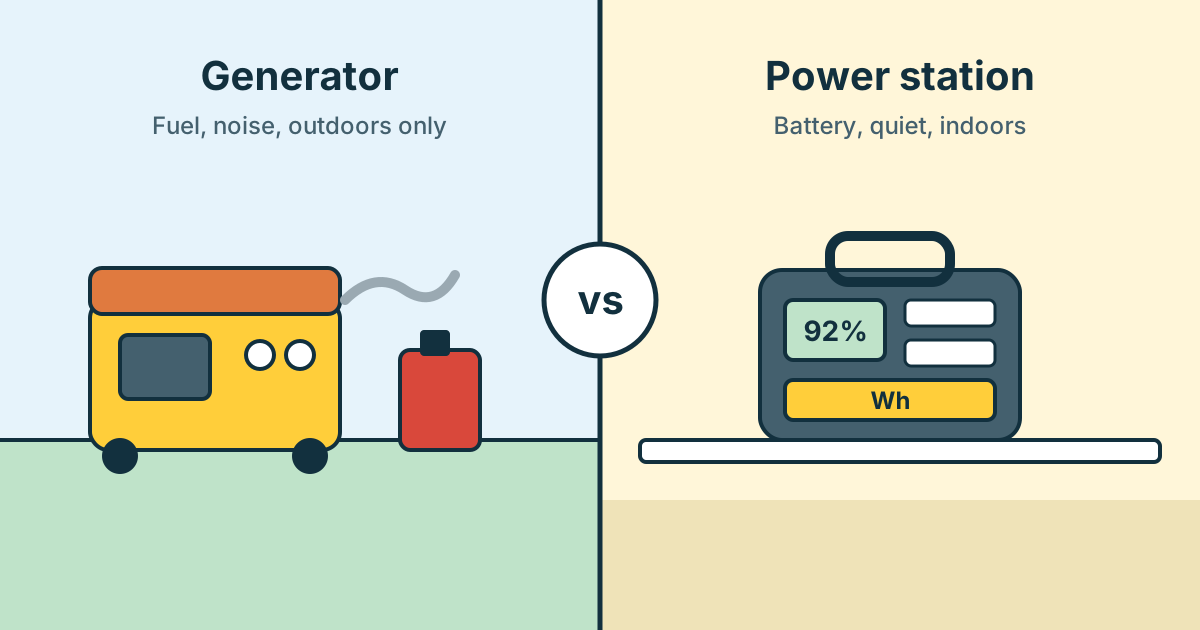
If you want power through an outage, you’ll quickly land on two choices: a fuel-burning portable generator or a battery power station. They solve different problems. A generator makes power for as long as you feed it fuel. A station stores a fixed amount of energy and gives it back quietly, indoors. Here’s how they compare on the things that matter at home, using official safety guidance and makers’ published specs. This is general information, not a recommendation for your situation.
Carbon monoxide warning. Generators burn fuel and give off carbon monoxide, which you can’t see or smell and which can kill within minutes. Never run one inside a home, garage, basement, shed or porch, even with doors open. CDC says to keep it more than 20 feet (6 m) from windows, doors and vents, and to have battery or battery-backup CO alarms inside. Battery power stations make no exhaust.
The short version
| Portable generator | Battery power station | |
|---|---|---|
| Where it runs | Outdoors only, 20 ft (6 m) or more from openings | Indoors or out |
| Carbon monoxide | Yes | None |
| How long it lasts | As long as you add fuel | Until the battery is empty, then recharge |
| Power at once | Small inverters list about 1,800 W; large models over 10,000 W | Models I’ve compared list 1,000 to 2,200 W |
| Noise | Engine; makers list 48 to 74 dB(A) | Fans only |
| Fuel to store | Gasoline, propane or both | None; recharge from wall, car or solar |
| Upkeep | Oil, fuel stabilizer, carburetor care | Keep it charged |
Indoor use and safety
This is the biggest difference. Canada.ca says battery- or solar-powered portable generators don’t produce carbon monoxide and can be used anywhere. A fuel generator must sit outdoors, which means extension cords through a door or a transfer switch, and someone going outside to refuel in a storm. CPSC says to turn a generator off and let it cool before refuelling.
If you live in an apartment or condo, or have nowhere safe to put a generator 20 feet (6 m) from openings, a power station is often the only practical option.
How much power, for how long
Here’s one generator and two stations, all from the makers’ own pages:
| Model | Output | Energy | Weight |
|---|---|---|---|
| Honda EU2200i generator | 1,800 W rated, 2,200 W max | 0.95 gal (3.6 L) tank: 8.1 h at 1/4 load, 3.2 h at rated load | 47.4 lb (21.5 kg) |
| EcoFlow DELTA 3 Plus station | 1,800 W | 1,024 Wh | 27.6 lb (12.5 kg) |
| Jackery Explorer 2000 v2 station | 2,200 W | 2,042 Wh | about 39.5 lb (17.9 kg) |
Output is similar. The difference is time. The Honda keeps going if you refill the tank. The stations hold a fixed amount: roughly, hours = watt-hours ÷ watts. A 1,000 W sump pump running nonstop would empty the 2,042 Wh station in about 2 hours, before conversion losses. A 60 W CPAP would run for many hours.
Stations refill from a wall outlet, a car, or solar panels. EcoFlow lists two solar inputs of up to 500 W each for the DELTA 3 Plus, and Jackery lists up to 400 W of DC input for the Explorer 2000 v2. Real solar output depends on sun and season, so in a long winter outage solar alone may not keep up. My guide to solar panels for power stations covers how to size them.
Noise
A station has no engine, so the sound comes from its cooling fans, which the station pages I read don’t rate. Generator makers do publish figures, though they don’t all measure the same way. Honda lists 48 dBA at quarter load and 57 dBA at rated load for the EU2200i. Champion lists 64 dBA at 23 feet (7 m) for its 201531. Larger conventional generators list more: DuroMax lists 74 dB for its 13,000 W model. Check your local rules and think about neighbours if you’ll run it overnight.
Fuel and storage
A generator means storing fuel safely. CPSC says never to store generator fuel in the home, and to use labelled, non-glass safety containers outside living areas. Honda says gasoline should be treated with stabilizer and shouldn’t contain more than 10% ethanol for its generators, and that the carburetor should be drained if the unit will sit for a couple of months or more. Dual-fuel models like Champion’s 201531 also run on a 20 lb propane cylinder, which Champion lists at 25 hours at quarter load.
A station needs no fuel. You do need to keep it charged, because it only helps if it’s full when the power goes out.
Cost, without prices
I don’t show prices because they change. Compare the whole setup:
- Generator: the unit, fuel containers, outdoor-rated cords, oil, stabilizer, and an electrician-installed transfer switch if you want to power house circuits. Fuel is an ongoing cost.
- Power station: the unit, plus solar panels if you want to recharge without grid power, and the electricity to charge it.
Write down what you’d actually run, for how many hours, then price both setups the same day.
Which fits your home
These are patterns, not judgements on any brand:
- Apartment, condo, or no safe outdoor spot: a power station. A generator isn’t safe there.
- Medical device, like a CPAP: a power station sized to your device, plus a plan with your supplier. My medical device power plan covers the rest.
- Fridge and freezer through a multi-day outage: a generator, or a large station with solar, depending on your fridge’s daily use.
- Sump pump or well pump in long storms: usually a generator, because pumps use a lot of energy. Check the pump’s starting draw.
- Both: some households keep a station for quiet indoor power at night and a generator outdoors during the day.
Next steps
- Size a generator and compare six models’ specs in my portable generator guide.
- Size a station for a fridge, CPAP or sump pump with my power station guide.
- Read the generator safety guide before you buy.
- See backup power basics and the products I’ve gathered on my picks page.
Questions people ask
Can I use a power station indoors?
A battery power station has no engine and makes no exhaust. Canada.ca says battery- or solar-powered portable generators do not produce carbon monoxide and can be used anywhere. Follow the maker's manual on charging, ventilation and keeping it dry.
Can a power station replace a generator?
For short outages and small loads like a fridge for part of the day, a CPAP, phones and lights, often yes. For several days of a sump pump, well pump or electric heat, the stored energy runs out. A 2,042 Wh station holds about what a 1,000 W load uses in 2 hours.
Which is quieter?
A power station has no engine, so the sound comes from cooling fans. Generator makers publish noise figures; Honda lists 48 dBA at quarter load for the EU2200i and Champion lists 64 dBA at 23 feet for its 201531.
What does each cost to run?
A generator needs fuel, oil and stabilizer, and gasoline has to be rotated. A power station needs electricity to recharge, from a wall outlet, a car or solar panels. I don't list prices because they change; compare the full cost of what you'd need, including fuel cans or panels.
Where to buy
Some links earn me a commission at no cost to you. How this works
Jackery Explorer 1000 v2 Portable Power Station, 1070Wh
A 1070 Wh LiFePO4 unit with 1500 W AC output, sized for running small appliances through an outage with no fumes indoors.
Check prices and optionsat Amazon.comCheck prices and optionsat Amazon.ca
EcoFlow DELTA 2 Portable Power Station, 1024Wh
A 1024 Wh LiFePO4 unit with 1800 W AC output that can be expanded with an extra battery if a household needs more.
Check prices and optionsat Amazon.comCheck prices and optionsat Amazon.ca
EcoFlow RIVER 2 Portable Power Station, 256Wh
A smaller 256 Wh LiFePO4 unit for phones, lights and a modem, at lower weight and capacity than a 1000 Wh station.
Check prices and optionsat Amazon.comCheck prices and optionsat Amazon.ca
Portable generator, outdoor use only
Champion 201531 4500-Watt Dual Fuel Inverter Generator with CO Shield
Champion lists 3,250 running watts on gasoline (2,925 on propane), 64 dBA at 23 ft, and CO Shield, which shuts the engine off at unsafe CO levels.
Check prices and optionsat Home DepotCheck prices and optionsat Amazon.ca
Portable generator, outdoor use only
Westinghouse iGen4500DFcv Dual Fuel Inverter Generator with CO Sensor
Westinghouse lists 3,700 running watts on gasoline (3,330 on propane), up to 18 hours at 25% load, and automatic CO shutdown.
Check prices and optionsat Tractor SupplyCheck prices and optionsat Amazon.ca
Portable generator, outdoor use only
Honda EU2200i Inverter Generator with CO-MINDER
Honda lists 1,800 rated watts, 48 dBA at quarter load, 47.4 lb, and CO-MINDER, which shuts the generator off before CO near it reaches dangerous levels.
Check prices and optionsat Amazon.comCheck prices and optionsat Amazon.ca
Folding solar panel for a power bank or station
EcoFlow 220W Bifacial Portable Solar Panel
EcoFlow lists 220 W front and 175 W rear rating, 21.5 V open-circuit voltage, IP68 and about 15.4 lb (7.0 kg).
Check prices and optionsat Amazon.comCheck prices and optionsat Amazon.ca
Folding solar panel for a power bank or station
Jackery SolarSaga 200W Solar Panel
Jackery lists 200 W peak, 22 V open-circuit voltage, IP68 and 14.33 lb (6.5 kg), made for its Explorer stations.
Check prices and optionsat Amazon.comCheck prices and optionsat Amazon.ca
Folding solar panel for a power bank or station
BLUETTI PV200S Solar Panel, 200W
BLUETTI lists 200 W, 26.5 V open-circuit voltage, standard MC4 connectors and 19.4 lb (8.8 kg).
Check prices and optionsat Amazon.comCheck prices and optionsat Amazon.ca
Battery-operated carbon monoxide alarm
Kidde KN-COB-B-LP Nighthawk Carbon Monoxide Alarm, Battery Operated
Kidde lists it as UL Listed with an electrochemical sensor, and it runs on 3 AA batteries so it keeps working in a power outage.
Check prices and optionsat Amazon.comCanadian link coming soon
Battery-operated carbon monoxide alarm
Kidde C3010 Worry-Free Carbon Monoxide Alarm, 10-Year Sealed Battery
Kidde lists its Canadian C3010-CA as CSA Listed with an electrochemical sensor and a sealed lithium battery, so it keeps working in an outage; check the listing shows the CSA mark before buying.
US link coming soonCheck prices and optionsat Amazon.ca
Where these numbers come from (10 sources)
- Canada.ca: Power outages, how to prepare https://www.canada.ca/en/services/policing/emergencies/preparedness/get-prepared/hazards-emergencies/power-outages/how-prepare.html
- CPSC: What to Know About Generators and Carbon Monoxide (PDF) https://www.cpsc.gov/s3fs-public/468-WhattoKnowGenerators_2022.pdf
- CPSC: Portable Generator Safety Alert (PDF) https://www.cpsc.gov/s3fs-public/5123_SafetyAlert_PortableGenerators_102021.pdf
- CDC: Carbon Monoxide Poisoning Basics https://www.cdc.gov/carbon-monoxide/about/index.html
- Honda: EU2200i https://powerequipment.honda.com/Generators/models/eu2200i
- Honda: Avoiding fuel-related problems with EU generators https://direct.powerequipment.honda.com/generators/eu-generator-fuel-recommendations
- Champion: 201531 4500W Dual Fuel Inverter https://www.championpowerequipment.com/product/201531-4500w-dual-fuel-inverter/
- DuroMax: XP13000HXT tri fuel generator with CO Alert https://duromaxpower.com/products/duromax-xp13000hxt-13000-watt-500cc-tri-fuel-gas-propane-natural-gas-portable-generator-with-co-alert
- EcoFlow: DELTA 3 Plus https://us.ecoflow.com/products/delta-3-plus-portable-power-station
- Jackery: Explorer 2000 v2 https://jackery.com/products/jackery-explorer-2000-v2-portable-power-station