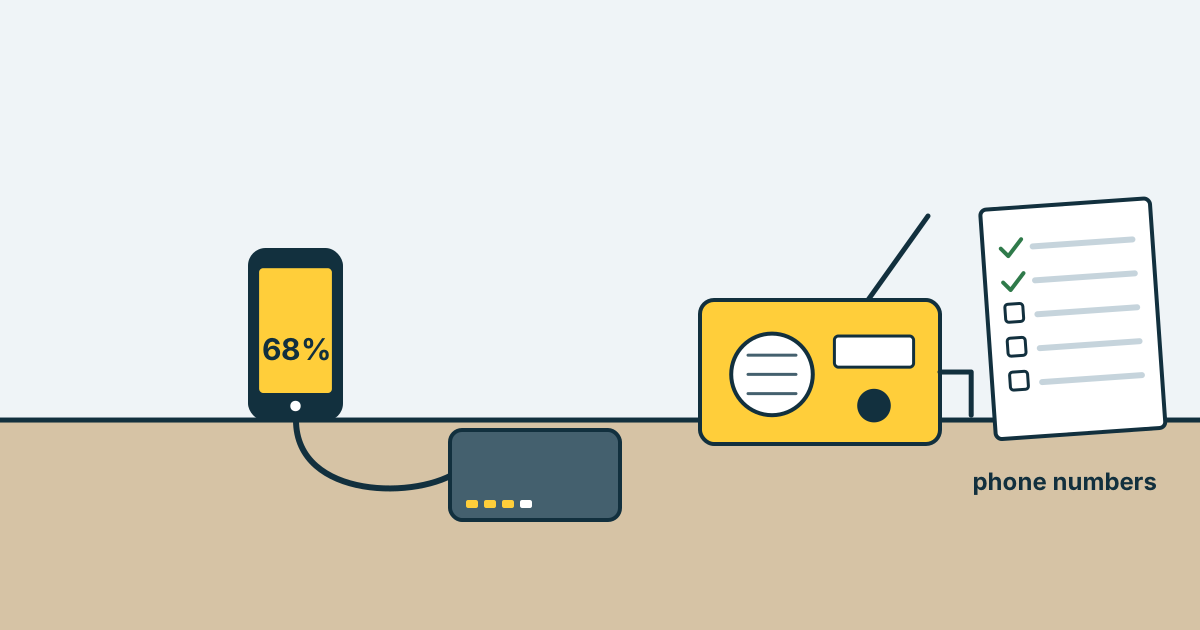
A phone is a flashlight, a radio, a map and the way you reach help. In a short outage it barely matters. Over a week, keeping it alive takes a plan. This post sets one out day by day, using FCC, Canada.ca, PreparedBC and CDC guidance. There is a checklist version at the end.
I am not going to promise how many charges a particular power bank gives, because that depends on the bank, the phone, its age and the temperature. What I can give you is the order to do things in.
Before the outage: fill everything up
Canada.ca lists chargers for mobile devices in its emergency kit, and PreparedBC lists a phone charger, power bank or inverter. The FCC suggests keeping charged batteries and car-charger adapters as backup power for your phone. When a storm is forecast:
- Charge every phone, tablet and power bank to full. Then check and top them up every month or two so they are full when you need them.
- Find your cables. A spare cable in the kit means you are not hunting in the dark.
- Put a car charger in the car.
- Write important numbers on paper: family, work, doctor, pharmacist, utility, insurer. If your phone dies, you will still have them.
- Agree on an out-of-area contact. Everyone texts that one person, so news spreads without everyone calling everyone.
Days 1 and 2: stretch the battery
The FCC suggests limiting non-emergency phone calls and conserving battery power.
- Turn on power-saving or low-power mode.
- Dim the screen and shorten the auto-lock time.
- Text instead of calling. The FCC suggests text messages when networks are busy.
- Check news at set times, for example morning, midday and evening, rather than scrolling all day.
- Use a battery or crank radio for updates. It saves the phone for messages.
- Close apps you do not need, especially video and games.
- If signal is weak and you do not need the phone for a while, airplane mode stops it searching. Turn it off to check messages at your set times.
Day 3 onward: recharge safely
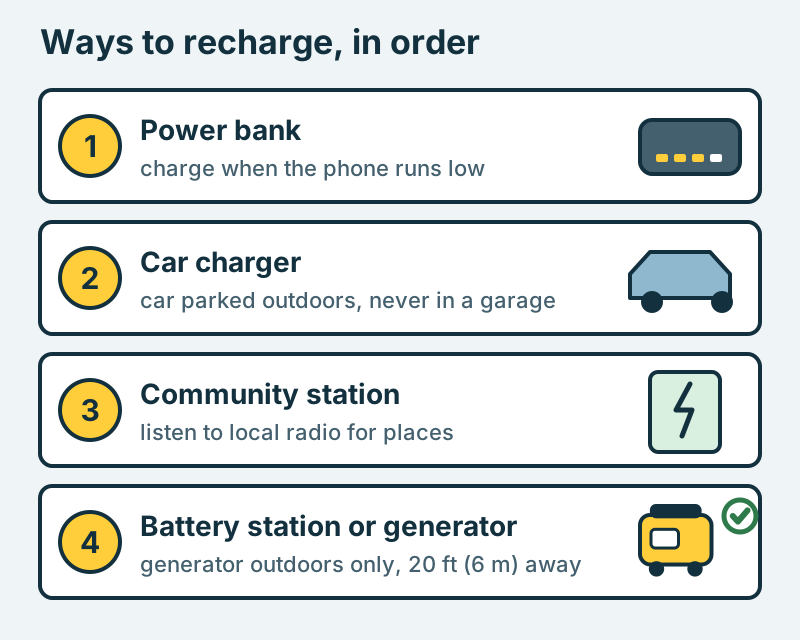
By now the power banks may be getting low. These are the main ways to refill phones, from simplest to most involved.
1. Power banks. Charge the phone from the bank when the phone gets low, not constantly. If you have a folding solar panel, use it in daylight to refill a bank.
2. Your car, parked outside. A car charger works well, but only with the car outdoors with good airflow. CDC says never to leave a motor running in a vehicle parked in an enclosed or partly enclosed space, such as a garage. That includes an attached garage with the door open.
3. Community charging stations. In longer outages, communities sometimes set up places to charge. Listen to local radio for details.
4. A battery power station or a generator. A battery station burns no fuel, so it does not give off carbon monoxide; follow the maker’s instructions. A generator is different.
Carbon monoxide warning. Generators, camp stoves, barbecues, charcoal, and kerosene or propane burners give off carbon monoxide, which you cannot see or smell and which can kill within minutes. Never use them indoors, or in a garage, basement, shed, tent or covered porch, even with doors and windows open. Outdoors, keep them at least 20 feet (6 m) from doors, windows and vents.
CDC says to use a battery-powered or battery-backup carbon monoxide alarm indoors whenever a generator is running. Canada.ca says to keep portable generators at least 6 m (20 feet) from all homes and buildings. My generator safety guide covers cords and fuel.
When the power comes back, Canada.ca suggests waiting 10 to 15 minutes before plugging other things back in, so the system can stabilise.
When the phone network is down
Even a charged phone is no use if the network is out. A few backups:
- A corded landline phone. The FCC suggests having at least one corded phone that does not depend on electricity. Cordless phones usually need power.
- A battery or crank radio for official updates.
- Your paper contact list.
- Neighbours. Someone nearby may have a working connection. See building a neighbour network.
If someone relies on a powered device
A phone running low is an inconvenience. A medical device running low is not. If anyone at home uses oxygen, a CPAP, a powered wheelchair or another device, plan its power separately and well ahead of time. My medical device power plan walks through it.
What I would buy first
If you are starting from scratch, a power bank and a spare cable cover most short outages. For a week, add a car charger, and a battery or crank radio so you are not using the phone for news. A folding solar panel helps on longer outages if you have sun. For bigger loads, my backup power basics explains the differences between power banks, battery stations and generators.
For the full routine, see charging phones in an outage, and use the plan builder to add power items to your household list.
Interactive checklist
A week of charging, planned
Tick what you have done. Nothing is saved.
0 of 12 done
All done. Keep this page open, or print the guide it links to.
Questions people ask
How can I make my phone battery last longer in an outage?
Turn on power-saving mode, lower the screen brightness, close apps you do not need, and text instead of calling. The FCC suggests limiting non-emergency calls and conserving battery power.
Is it safe to charge my phone in the car during a power outage?
Only with the car parked outdoors with good airflow. CDC says never to leave a motor running in a vehicle parked in an enclosed or partly enclosed space such as a garage, because of carbon monoxide.
Why do texts work when calls do not?
Networks can get overloaded in emergencies. The FCC suggests trying text messages when using a wireless phone, as they often get through when calls do not.
Do I still need a landline phone?
The FCC suggests having at least one corded phone that does not depend on electricity, if you have a landline. Cordless phones usually stop working when the power is out.
What chargers should be in an emergency kit?
Canada.ca lists chargers for mobile devices, and PreparedBC lists a phone charger, power bank or inverter. The FCC suggests car-charger adapters as backup power for wireless phones.
Where to buy
Some links earn me a commission at no cost to you. How this works
Phone power bank
Anker Power Bank, 20,000mAh, Built-In USB-C Cable
A 20,000 mAh pack holds several phone charges and has its own cable, so one less thing to find in the dark.
Check prices and optionsat Amazon.comCheck prices and optionsat Amazon.ca
Battery or hand-crank radio, with NOAA Weather Radio
Midland ER310 Emergency Crank Weather AM/FM Radio
Runs from multiple power sources including a hand crank, and receives NOAA weather channels with alert.
Check prices and optionsat Amazon.comCheck prices and optionsat Amazon.ca
Battery or hand-crank radio, with NOAA Weather Radio
Kaito KA500 5-Way Powered Emergency AM/FM/SW Weather Alert Radio
Has solar, hand-crank and other power options plus a flashlight and reading lamp.
Check prices and optionsat Amazon.comCheck prices and optionsat Amazon.ca
Where these numbers come from (5 sources)
- FCC: Tips for Communicating in an Emergency https://www.fcc.gov/reports-research/guides/tips-communicating-emergency
- Canada.ca: Emergency kits https://www.canada.ca/en/services/policing/emergencies/preparedness/get-prepared/emergency-kits.html
- PreparedBC: Build an emergency kit and grab-and-go bag https://www2.gov.bc.ca/gov/content/safety/emergency-management/preparedbc/build-an-emergency-kit-and-grab-and-go-bag
- CDC: What to Do to Protect Yourself During a Power Outage https://www.cdc.gov/natural-disasters/response/what-to-do-protect-yourself-during-a-power-outage.html
- Canada.ca: Power outages, how to prepare https://www.canada.ca/en/services/policing/emergencies/preparedness/get-prepared/hazards-emergencies/power-outages/how-prepare.html