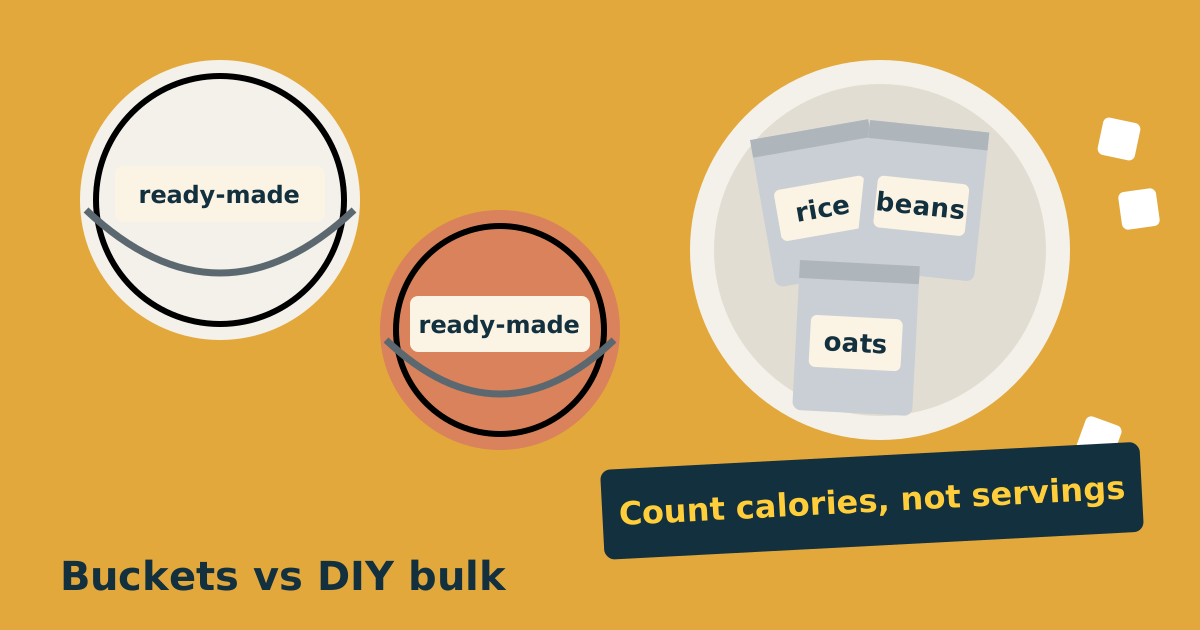
Long-term food storage comes in two forms. Ready-made buckets of freeze-dried or dehydrated meals are easy: buy, put on a shelf, done. DIY bulk means packing rice, beans and oats yourself, which often works out cheaper per calorie but takes an afternoon and a bit of care. Both can sit alongside your everyday pantry.
This is general information. Numbers below are the makers’ own, as I read them on November 9, 2026, plus a few simple calculations that I mark as mine. I haven’t tasted or tested any of these, and this isn’t a ranking.
Compare calories, not servings
Each maker sets its own serving size, so “60 servings” from one brand is not the same as 60 from another. The useful number is total calories. FDA describes 2,000 calories a day as a general guide for nutrition advice, and says individual needs vary with age, sex, size and activity. I use 2,000 below only to turn calories into rough days for one adult.
The buckets, side by side
| Product | Servings | Total calories | Calories per serving | Rough days for one adult at 2,000/day | Shelf life, maker’s wording | Weight |
|---|---|---|---|---|---|---|
| ReadyWise 60 Serving Entree Bucket | 60 | 12,720 | about 212 (my calc) | about 6 | “Up to 25 year shelf life” | 11 lb (5 kg) |
| Mountain House Classic Meal Assortment Bucket | 24 | about 6,140 (my calc from each pouch’s label) | 210 to 300 by meal | about 3 | “30-Year Taste Guarantee” | 5.52 lb (2.5 kg) |
| Augason Farms 30-Day 1-Person Kit | 194 | about 38,700 (my calc: 1,290 × 30) | about 199 (my calc) | about 19 | “Up to 25 years” | 22 lb 15.7 oz (10.42 kg) |
| Legacy 60 Serving Entree Bucket | 60 | 23,400 | 371 average | about 12 | No specific years on the page | 17 lb (7.7 kg) |
| Legacy 120 Serving Breakfast, Lunch and Dinner Bucket | 120 | 48,640 | 395 average | about 24 | “Up to 25 years” | 31 lb (14.1 kg) |
Notes from the pages:
- Augason Farms lists 1,290 calories per day, not a bucket total. Its own figure is below FDA’s 2,000 general guide, so plan to add other food, or more kits, for an adult.
- Mountain House lists calories per pouch; the bucket total is my sum. A 30-year taste guarantee is a promise about quality, not a statement about safety.
- Both Legacy buckets showed as sold out when I checked, so they’re in the table for comparison but not in my shop links. Legacy’s site sends Canadian orders to a separate Canadian retailer.
- Shelf life claims assume the maker’s storage conditions. Keep buckets somewhere cool and dry, off the floor.
Calories per dollar
Every maker above listed a price on its page, but prices change too often to print. To compare on the day you shop:
calories per dollar = total calories ÷ price
For Augason Farms, use 1,290 × 30 = 38,700 as the total. For Mountain House, add up the pouch labels. Don’t forget shipping.
What freeze-dried buckets are good for
- Grab and go. The meals come in sealed pouches you can carry.
- Little cooking. Most need only water, often hot. Check the pouch and plan the water: my two-week water guide covers how much to store.
- Variety without planning. Someone else has worked out a mix of meals.
The trade-offs: the calories per serving can be lower than you’d expect, so run the calories-per-dollar math against the DIY option.
The budget option: DIY bulk in pouches and buckets
Dry staples you already know can be packed for the long term. Check the label calories against the price, using the same math as above. The Church of Jesus Christ of Latter-day Saints’ food storage page lists these estimates for properly packaged and stored foods:
| Food | Estimated shelf life (packed and stored as below) |
|---|---|
| White rice | 30+ years |
| Dry beans | 30+ years |
| Rolled oats | 30 years |
| Pasta | 30 years |
How to pack it
- Start with dry food. The Church’s page says longer-term foods must be about 10% moisture or less. Moist foods in low-oxygen packaging risk botulism. USU Extension gives the same warning about vacuum packing.
- Use foil pouches. USU Extension says the foil layer in “Mylar” style pouches greatly reduces oxygen and moisture getting through. The Church’s page recommends laminated plastic and aluminum pouches.
- Add oxygen absorbers. USU Extension recommends food-safe absorbers from food storage suppliers for rice and dried beans. Use the size the absorber maker recommends for your pouch.
- Seal, label and date. Heat-seal the pouch and write the contents and date on it.
- Protect the pouches. A food-grade bucket with a tight lid keeps pouches from being punctured and keeps pests out.
- Store cool. The Church’s page says 75°F (24°C) or lower whenever possible.
Counting calories in DIY food
Read the Nutrition Facts label. FDA explains that the calorie figure is per serving, and a package may hold many servings. Multiply calories per serving by servings per container to get the bag’s total, then add up your bags. My guide to food by calories walks through it.
Cooking it in an outage
Rice and beans need water and fuel. Beans take a long time to cook, so plan the fuel. My cooking without power guide covers safe options.
Carbon monoxide warning. Camp stoves, grills and charcoal give off carbon monoxide, which you can’t see or smell. Use them outdoors only, never in a home, garage, tent or covered porch, and keep a battery-powered CO alarm inside.
Don’t skip the everyday pantry
Long-term buckets are a backstop. For most outages, ordinary food you already eat does the work. Health Canada suggests food that won’t spoil easily, a manual can opener, and replacing emergency food every year or sooner if the label date says so. My guides to pantry staples that keep a year, food that lasts without a fridge and pantry rotation cover that side.
Build your plan
- Work out how much food your household needs in the plan builder.
- See ready-made lists for 7 days, 14 days and 30 days.
- Browse buckets, bulk staples and storage supplies on my picks page.
Questions people ask
How many calories does an emergency food bucket give per day?
Divide the maker's total calories by the number of days you want it to cover. ReadyWise lists 12,720 calories for its 60 serving entree bucket, which is about 6 days for one adult at FDA's general guide of 2,000 calories a day. Augason Farms lists 1,290 calories a day for its 30-day kit.
Is a serving the same as a meal?
No. Each maker sets its own serving size. ReadyWise's 60 servings average about 212 calories each by my calculation from its total, while Legacy lists an average of 395 calories per serving. Compare total calories, not servings.
How long do rice and beans last in sealed pouches?
The Church of Jesus Christ of Latter-day Saints' food storage page lists white rice and dry beans at 30 years or more when properly packaged and stored at 75°F (24°C) or lower. Products must be dry, about 10% moisture or less.
Can I vacuum seal or oxygen-pack any food?
No. Only dry foods. Utah State University Extension warns that removing oxygen can help botulism bacteria grow in moist foods, and the Church's food storage page says foods for longer-term storage must be about 10% moisture or less.
How do I compare calories per dollar?
Take the total calories from the maker's page and divide by the price you see that day. Prices change often, so I don't list them. Where a maker gives only calories per day, multiply by the number of days first.
Where to buy
Some links earn me a commission at no cost to you. How this works
ReadyWise Emergency Food Supply Entree Bucket, 60 Servings
A single bucket of pre-portioned meals; the listing states a shelf life of up to 25 years, which suits food you buy once and store.
Check prices and optionsat Amazon.comCheck prices and optionsat Amazon.ca
Mountain House Classic Meal Assortment Bucket, 24 Servings
Mountain House backs its meals with a 30-year taste guarantee when stored unopened and kept out of prolonged heat above 75°F (24°C).
Check prices and optionsat Amazon.comCheck prices and optionsat Amazon.ca
Mountain House Entree Assortment Bucket, 12 Pouches
An Amazon.ca option, since Mountain House itself does not ship food outside the United States.
Check prices and optionsat Amazon.comCheck prices and optionsat Amazon.ca
Augason Farms 30-Day 1-Person Emergency Food Supply, 194 Servings
Augason Farms lists 194 servings at 1,290 calories a day for 30 days and a shelf life of up to 25 years.
Check prices and optionsat Amazon.comCheck prices and optionsat Amazon.ca
Rice, pasta or oats
Long-grain white rice, 20 lb (9 kg) bag
Plain white rice in a large bag; USDA FSIS lists rice and dried pasta at 2 years in a cool, dry place.
Check prices and optionsat Amazon.comCheck prices and optionsat Amazon.ca
Rice, pasta or oats
Old-fashioned rolled oats, large bag
Rolled oats can be soaked instead of cooked, as in the soaked oats recipe on this site.
Check prices and optionsat Amazon.comCheck prices and optionsat Amazon.ca
Rice, pasta or oats
Dried pasta, multi-pack
USDA FSIS lists dried pasta at 2 years in a cool, dry place.
Check prices and optionsat Amazon.comCheck prices and optionsat Amazon.ca
Dried beans, 20 to 25 lb (9 to 11 kg) bag
University of Missouri Extension puts dry beans in its cool, dry storage group, 32 to 50°F (0 to 10°C); they need soaking and cooking.
Check prices and optionsat Amazon.comCheck prices and optionsat Amazon.ca
1 gal mylar food storage bags with oxygen absorbers
Sold for sealing dry foods such as rice and beans; follow the seller's instructions for absorber size and heat sealing.
Check prices and optionsat Amazon.comCheck prices and optionsat Amazon.ca
5 gal (19 L) food-grade bucket with Gamma Seal screw-on lid
A screw-on lid that opens and reseals by hand, for rice, beans or oats; buy buckets sold as food-grade.
Check prices and optionsat Amazon.comCheck prices and optionsat Amazon.ca
Where these numbers come from (9 sources)
- ReadyWise: 60 Serving Entree Bucket https://readywise.com/products/60-serving-entree-bucket
- Legacy Food Storage: 120 Serving Breakfast, Lunch and Dinner Bucket https://www.legacyfoodstorage.com/products/120-serving-breakfast-lunch-and-dinner-bucket
- Legacy Food Storage: 60 Serving Entree Bucket https://www.legacyfoodstorage.com/products/60-serving-entree-bucket
- Augason Farms: 30-Day 1-Person Emergency Food Supply Kit, 194 Servings https://augasonfarms.com/products/30-day-1-person-emergency-food-supply-kit-194-servings
- Mountain House: Classic Meal Assortment Bucket https://mountainhouse.com/m/product/0080635.html
- FDA: Calories on the Nutrition Facts Label https://www.fda.gov/food/nutrition-facts-label/calories-nutrition-facts-label
- Health Canada: Food and drinking water safety in an emergency https://www.canada.ca/en/health-canada/services/food-drinking-water-safe-emergency.html
- The Church of Jesus Christ of Latter-day Saints: Longer-term food supply https://www.churchofjesuschrist.org/topics/food-storage/longer-term-food-supply?lang=eng
- Utah State University Extension: Food storage packaging https://extension.usu.edu/preserve-the-harvest/food-storage-packaging