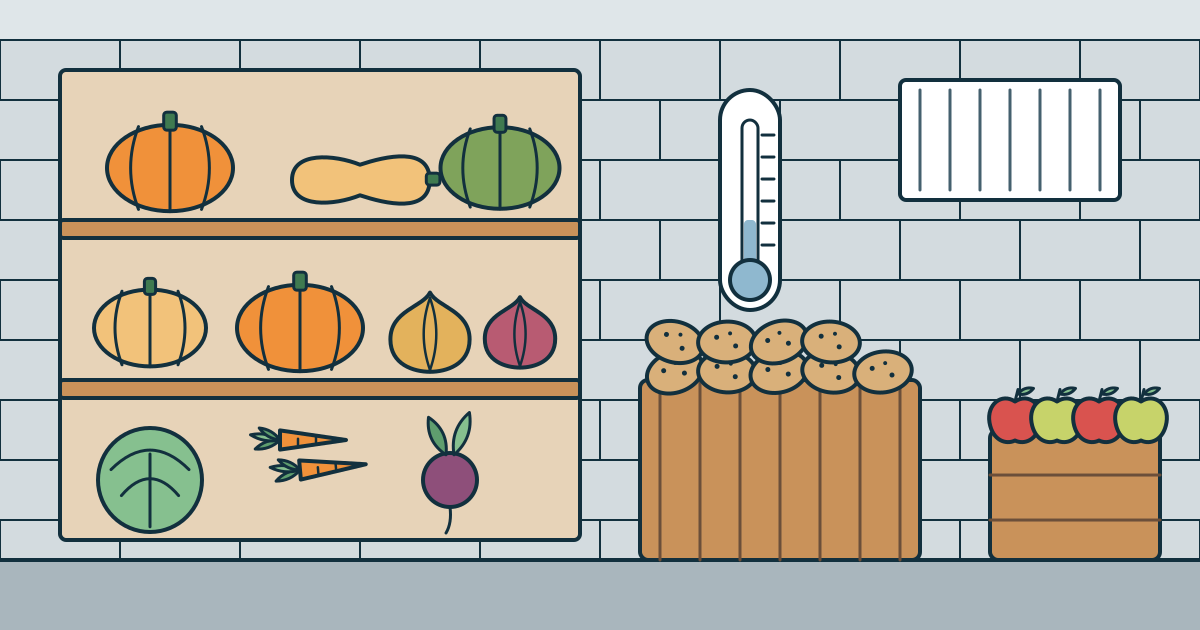
Before refrigerators, most households kept a winter’s worth of potatoes, squash, apples and root vegetables in a cool, dark room. That skill still matters. Food kept this way uses no power, so a long outage does not touch it, and it stretches a pantry of dry and canned goods with fresh food through the cold months.
You do not need a classic dug-out cellar. This guide covers what potatoes, winter squash, apples and root crops each need, and where to find those conditions in an ordinary house. The figures come from University of Missouri, Iowa State, University of Minnesota (UMN) and UConn Extension. I have not run a root cellar myself.
The rule that matters most: separate the fruit
University of Missouri Extension says not to store apples with vegetables. Apples and pears give off ethylene gas as they ripen, which shortens the storage life of vegetables, and potatoes stored near fruit may sprout early. Iowa State gives the same warning for winter squash and for potatoes.
So plan for at least two spots: one for fruit and one for vegetables. Missouri also notes that strong-smelling crops like cabbage and turnips can pass their odour to fruit and other food, so give them their own corner too.
What each crop wants
| Crop | Temperature | Humidity | Source |
|---|---|---|---|
| Apples | 32 to 40°F (0 to 4°C) | 80 to 90% | Missouri |
| Potatoes | about 40°F (4°C), dark | 90 to 95% | Iowa State |
| Carrots, beets, cabbage, parsnips, rutabaga | 32 to 40°F (0 to 4°C) | 90 to 95% | Missouri |
| Onions and garlic | 32 to 35°F (0 to 2°C) | 60 to 70% | Missouri |
| Winter squash and pumpkins | 50 to 55°F (10 to 13°C) | 60 to 75% | Missouri |
Missouri adds that late-maturing crops store better than early ones, that well-cured, undamaged produce lasts longer, and that nothing in storage should be allowed to freeze.
Potatoes
Cure first. Iowa State says to cure potatoes for two weeks at 50 to 60°F (10 to 16°C) and 85 to 90% humidity. Curing heals small cuts and bruises and thickens the skin.
Then store cold, humid and dark. Iowa State gives about 40°F (4°C), 90 to 95% humidity and no light. Light turns potatoes green, and UMN Extension says to trim green areas and not to eat potatoes with a lot of green. UMN also says potato sprouts can be toxic and should not be eaten.
Watch the temperature. Above 50°F (10°C), Iowa State says tubers may sprout within two or three months. Below 40°F they turn sugary; a few days at room temperature restores the flavour. Iowa State gives a storage life of 5 to 8 months under good conditions.
Winter squash
Cure most kinds. Iowa State says to cure winter squash at 80 to 85°F (27 to 29°C) and 80 to 85% humidity, which hardens the skin and heals scratches. Acorn squash is the exception: high heat and humidity reduce its quality and storage life, so skip curing it. UMN says not to cure Table Queen, which is an acorn type.
Store cool and dry, not cold. Iowa State gives 50 to 55°F (10 to 13°C) in a dry, well-ventilated place, away from apples, pears and other ripening fruit. UMN says pumpkins are very sensitive to temperatures below 45°F (7°C).
Know your variety. Iowa State’s storage times: acorn 5 to 8 weeks, butternut 2 to 3 months, Hubbard 5 to 6 months. Eat the short keepers first.
Apples
Missouri lists apples in the cold and moist group, 32 to 40°F (0 to 4°C) and 80 to 90% humidity, and the instruction that matters most is to keep them away from vegetables. UConn notes that apples prefer more humidity than onions and garlic.
Root crops
Missouri puts beets, cabbage, carrots, parsnips, rutabaga and turnips in the cold and very moist group, 32 to 40°F (0 to 4°C) and 90 to 95% humidity. UMN says carrots and beets store without their tops and gives about 8 months for carrots and 5 for beets.
UConn says carrots, parsnips and turnips can also stay in the garden over winter if rodents are not a problem and the site drains well, insulated with straw, hay or dry leaves once the ground cools.
Where to find these conditions at home
UConn Extension suggests looking at:
- An unheated garage, breezeway or shed, kept away from cars, lawn equipment and chemicals, and only while there is no risk of freezing.
- A cool corner of a basement. UConn says a well-ventilated basement at about 50 to 60°F (10 to 16°C) suits short-term storage of squash, pumpkins, potatoes and onions.
- An unheated room, pantry or attic for short-term storage of potatoes and onions, again only if it will not freeze.
- Outdoors, in a buried 20-gallon (about 75 L) trash can with drainage holes, which UConn says can help deter rodents. Once a pit or mound is opened, UConn says to use the produce within one or two weeks.
A cheap thermometer in each spot tells you which crops belong where. Squash usually goes in the warmer spot, potatoes and roots in the coldest damp one, and apples somewhere separate.
Keep pests out and check weekly
UConn advises:
- Sealing gaps, even very small ones, with steel wool.
- Using metal, plastic or tightly woven mesh containers with openings smaller than ¼ inch (6 mm), and only food-grade containers.
- Checking storage at least weekly for signs of rodents and drying out.
- Removing anything rotten or mouldy, and cleaning containers and the room at the end of the season.
Dry staples belong somewhere else
Rice, dried beans, oats and powdered milk do not want root cellar humidity. They keep best somewhere cool and dry, in sealed food-grade containers that keep out moisture and pests. My post on pantry staples that keep a year covers official storage times and where to keep them, and pantry rotation explains how to use the oldest first.
Putting it together
A cold room full of potatoes, squash, apples and carrots, next to a dry pantry of rice, beans and cans, can carry a household a long way through winter without any power at all. For what to grow, see 10 easy vegetables that store well and how much to plant to feed a family. For how much food your household needs in total, use the plan builder and the food section, and for meals built on pantry staples, browse the recipes, such as one-pot rice and beans.
Questions people ask
Can I store apples and potatoes together?
No. University of Missouri Extension says not to store apples with vegetables, because apples and pears give off ethylene gas that shortens vegetable storage life, and potatoes stored near fruit may sprout early.
What temperature should winter squash be stored at?
Iowa State and Missouri Extension both give 50 to 55°F (10 to 13°C), in a dry, well-ventilated place. That is warmer than potatoes or apples want.
What temperature is best for storing potatoes?
Iowa State gives about 40°F (4°C) with 90 to 95% humidity, in the dark. Above 50°F (10°C) they may sprout within two or three months, and below 40°F they turn sugary.
Do I need a real root cellar?
No. UConn Extension lists unheated garages, breezeways, sheds, cool basements and unheated rooms as workable spots, as long as the produce does not freeze and stays away from cars, lawn equipment and chemicals.
How often should I check stored produce?
UConn Extension says at least weekly, for signs of rodents and for drying out, and to remove anything rotten or mouldy.
Where to buy
Some links earn me a commission at no cost to you. How this works
5 gal (19 L) food-grade bucket with Gamma Seal screw-on lid
A screw-on lid that opens and reseals by hand, for rice, beans or oats; buy buckets sold as food-grade.
Check prices and optionsat Amazon.comCheck prices and optionsat Amazon.ca
1 gal mylar food storage bags with oxygen absorbers
Sold for sealing dry foods such as rice and beans; follow the seller's instructions for absorber size and heat sealing.
Check prices and optionsat Amazon.comCheck prices and optionsat Amazon.ca
Dried beans, 20 to 25 lb (9 to 11 kg) bag
University of Missouri Extension puts dry beans in its cool, dry storage group, 32 to 50°F (0 to 10°C); they need soaking and cooking.
Check prices and optionsat Amazon.comCheck prices and optionsat Amazon.ca
Rice, pasta or oats
Long-grain white rice, 20 lb (9 kg) bag
Plain white rice in a large bag; USDA FSIS lists rice and dried pasta at 2 years in a cool, dry place.
Check prices and optionsat Amazon.comCheck prices and optionsat Amazon.ca
Rice, pasta or oats
Old-fashioned rolled oats, large bag
Rolled oats can be soaked instead of cooked, as in the soaked oats recipe on this site.
Check prices and optionsat Amazon.comCheck prices and optionsat Amazon.ca
Rice, pasta or oats
Dried pasta, multi-pack
USDA FSIS lists dried pasta at 2 years in a cool, dry place.
Check prices and optionsat Amazon.comCheck prices and optionsat Amazon.ca
Instant nonfat dry milk, large bag or box
Mixes with water for drinking, cereal and cooking, so you have milk without a working fridge.
Check prices and optionsat Amazon.comCheck prices and optionsat Amazon.ca
Canned beans, tuna, chicken or stew
Canned chunk chicken breast, multi-pack
Fully cooked and ready to eat from the can; USDA FSIS lists canned meat and poultry at 2 to 5 years.
Check prices and optionsat Amazon.comCheck prices and optionsat Amazon.ca
Peanut butter or another nut or seed butter
Peanut butter, large jars, multi-pack
Ready-to-eat protein that needs no cooking or fridge before opening; check for peanut allergies in your household first.
Check prices and optionsat Amazon.comCheck prices and optionsat Amazon.ca
Where these numbers come from (5 sources)
- University of Missouri Extension: Home Storage of Fruits and Vegetables in Root Cellars (MP562) https://extension.missouri.edu/mp562
- Iowa State University Extension: Storing Winter Storage Vegetables https://yardandgarden.extension.iastate.edu/how-to/storing-winter-storage-vegetables
- University of Minnesota Extension: Harvesting and storing home garden vegetables https://extension.umn.edu/vegetables/harvesting-and-storing-home-garden-vegetables
- UConn Extension: Cold Storage, a Sustainable Way to Preserve the Harvest https://extension.uconn.edu/?p=4722
- University of Minnesota Extension: Growing potatoes https://extension.umn.edu/vegetables/growing-potatoes