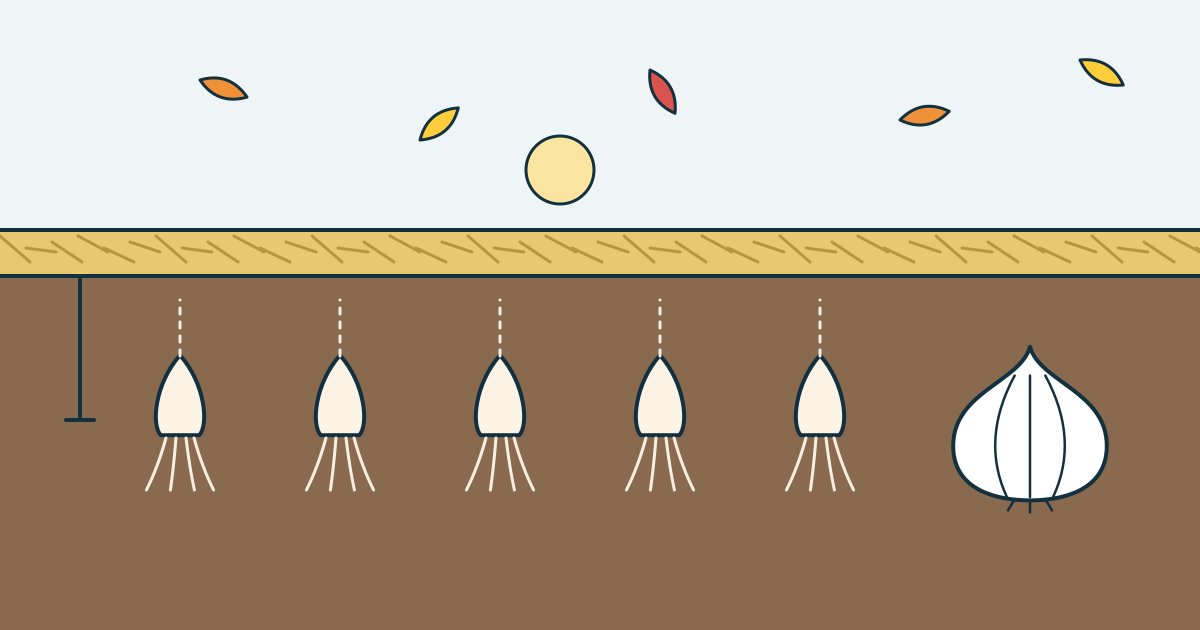
Garlic is the one common vegetable you plant as the garden is shutting down. Cloves go into the ground in fall, root before the soil freezes, sit quietly under mulch all winter, and are ready to dig the next summer. It takes little space, little work, and you can replant your own cloves every year.
Below is the method from University of Minnesota (UMN) Extension and West Coast Seeds, a seed company in Delta, BC. I have not grown garlic myself; the steps and numbers are theirs.
Hardneck or softneck?
UMN describes two main groups:
- Hardneck types, such as Rocambole, Purple Stripe and Porcelain, send up a curly flower stalk called a scape.
- Softneck types, such as Artichoke and Silverskin, usually have more cloves per bulb and are easier to braid.
UMN also notes that elephant garlic is actually a kind of leek.
UMN advises against planting grocery-store garlic, because it is mostly softneck and does not perform well in Minnesota’s climate. If you are in a cold region, buy seed garlic sold for planting from a supplier that knows your area.
Order early. Seed garlic is sold for fall planting and often by pre-order. True Leaf Market, for example, lists its hardneck bulbs as a pre-order expected to ship in October, and says it cannot ship them to Hawaii, Idaho, Washington or Puerto Rico because of agricultural restrictions. West Coast Seeds also takes seed garlic pre-orders before fall.
When to plant
UMN says to plant garlic in fall, usually one or two weeks after the first killing frost. Roots and shoots form by the first hard freeze, though shoots usually do not show until spring. West Coast Seeds gives September through November for a harvest the following July, and calls fall planting the most reliable method down to Zone 4.
To know when your first fall frost usually arrives:
- United States: NOAA’s Climate.gov has an interactive map of average spring freeze dates for weather stations. Your local extension office can usually give you the fall date too.
- Canada: Search Environment and Climate Change Canada’s Canadian Climate Normals for your nearest station.
Because garlic spends the winter in the ground, your hardiness zone matters too. In the US, look it up by ZIP code on the USDA Plant Hardiness Zone Map, which is based on the average coldest winter temperature. In Canada, use the Plant Hardiness Site. The two countries’ zone maps are not built the same way, so compare advice from your own country where you can.
How to plant
- Prepare the bed. West Coast Seeds recommends rich, well-drained soil, dug well, with plenty of compost if your soil is heavy. Try not to step on the bed.
- Split the bulbs into cloves just before planting. West Coast Seeds notes that larger cloves tend to grow larger bulbs.
- Plant pointed end up. UMN says the base of the clove should be 2 to 3 inches (5 to 8 cm) below the surface. West Coast Seeds says to set the tip 1 to 2 inches (2.5 to 5 cm) deep, deeper if rain or frost could heave the cloves out and shallower in heavy soil or under mulch.
- Space them out. West Coast Seeds gives 4 to 6 inches (10 to 15 cm) between cloves. UMN plants double rows about 6 inches (15 cm) apart.
- Mulch. UMN suggests 3 to 4 inches (8 to 10 cm) of leaf or straw mulch to protect against temperature swings in winter and early spring and to keep weeds down. In spring, pull it back once hard freezes are over, or leave it in place to hold moisture.
Spring and early summer
Shoots appear in spring. On hardneck garlic, UMN says to snap off the scapes soon after they begin to curl. Scapes are edible, so they are an early bonus harvest.
Harvest
UMN says harvest falls between late June and late July, depending on variety and climate. Start checking when the lower leaves have browned and about half or a bit more of the upper leaves are still green. Dig a test bulb or two: if the cloves fill their skins, it is time. West Coast Seeds puts the signal at roughly half to three-quarters of the leaves turning yellow, depending on variety.
Lift the bulbs carefully. West Coast Seeds warns against puncturing them.
Curing and storage
UMN says to cure whole plants, with leaves and bulbs attached, for three to four weeks in a warm, dry, airy place. Then trim the stems to ½ to 1 inch (1 to 2.5 cm) above the bulb and cut the roots close.
For storage, University of Missouri Extension lists garlic with onions at 32 to 35°F (0 to 2°C) and 60 to 70% humidity, which is cold and fairly dry. West Coast Seeds says to store bulbs somewhere cool, dry and well ventilated, and warns that refrigerating bulbs can make them sprout. UMN, on the other hand, says a home fridge is fine for long-term storage of garlic and onions. Since the sources differ, I would keep most of the crop in a cool, dry, airy spot and use the bulbs that start to sprout first.
Save your own seed garlic
UMN suggests setting aside the largest cloves from each harvest to plant again in fall. After the first purchase, garlic can be a crop you never need to buy again, which makes it a good fit for a self-reliant pantry.
Where garlic fits
Garlic is a flavour crop, not a calorie crop, but it turns plain rice, beans and lentils into meals people want to eat. Try it in pantry lentil soup or pantry chili, and browse more ideas in the recipes. For the rest of a storage garden, see 10 easy vegetables that store well. For the pantry itself, start with the plan builder and the food section.
Questions people ask
When should I plant garlic?
University of Minnesota Extension says to plant in fall, usually one or two weeks after the first killing frost. West Coast Seeds, a BC company, gives September through November for harvest the following July.
How deep do I plant garlic cloves?
Pointed end up. University of Minnesota Extension says the base of the clove should be 2 to 3 inches (5 to 8 cm) below the soil surface. West Coast Seeds says to set the tip 1 to 2 inches (2.5 to 5 cm) deep and space cloves 4 to 6 inches (10 to 15 cm) apart.
Can I plant garlic from the grocery store?
University of Minnesota Extension advises against it, because store garlic is mostly softneck types that may not suit cold climates. Seed garlic sold for planting in your region is the safer choice.
When is garlic ready to harvest?
University of Minnesota Extension says to start when the lower leaves have browned and about half or a bit more of the upper leaves are still green, usually between late June and late July. Dig a test bulb: if the cloves fill their skins, it is ready.
Should hardneck garlic scapes be removed?
University of Minnesota Extension says to remove hardneck scapes soon after they begin to curl. They are edible.
Where to buy
Some links earn me a commission at no cost to you. How this works
True Leaf Market Garlic Bulbs - Fall - Hardneck - German Red
Sold as a fall pre-order expected to ship in October, 3 bulbs per bag; True Leaf cannot ship it to Hawaii, Idaho, Washington or Puerto Rico.
Check prices and optionsat True Leaf MarketCanadian link coming soon
West Coast Seeds Seed garlic
Sold by pre-order for fall planting; check the page for this year's ordering and shipping window.
US link coming soonCheck prices and optionsat West Coast Seeds
Where these numbers come from (9 sources)
- University of Minnesota Extension: Growing garlic in home gardens https://extension.umn.edu/vegetables/growing-garlic-home-gardens
- West Coast Seeds: How to Grow Garlic https://fundraising.westcoastseeds.com/blogs/how-to-grow/grow-garlic
- University of Missouri Extension: Home Storage of Fruits and Vegetables in Root Cellars (MP562) https://extension.missouri.edu/mp562
- University of Minnesota Extension: Harvesting and storing home garden vegetables https://extension.umn.edu/vegetables/harvesting-and-storing-home-garden-vegetables
- USDA Agricultural Research Service: Plant Hardiness Zone Map https://planthardiness.ars.usda.gov/
- Canada's Plant Hardiness Site https://planthardiness.gc.ca/
- NOAA Climate.gov: Average date of last spring freeze (interactive map) https://www.climate.gov/LastFreeze
- Environment and Climate Change Canada: Canadian Climate Normals https://climate.weather.gc.ca/climate_normals/index_e.html
- True Leaf Market: Garlic Bulbs, Fall, Hardneck, German Red https://trueleafmarket.com/products/garlic-bulbs-hardneck-german-red