Pantry Chili
Two kinds of beans, tomatoes, corn and chili spices, heated in one pot on an outdoor camp stove or barbecue burner.
- Serves 4 servings
- Time 20 min
- Heat Outdoor stove
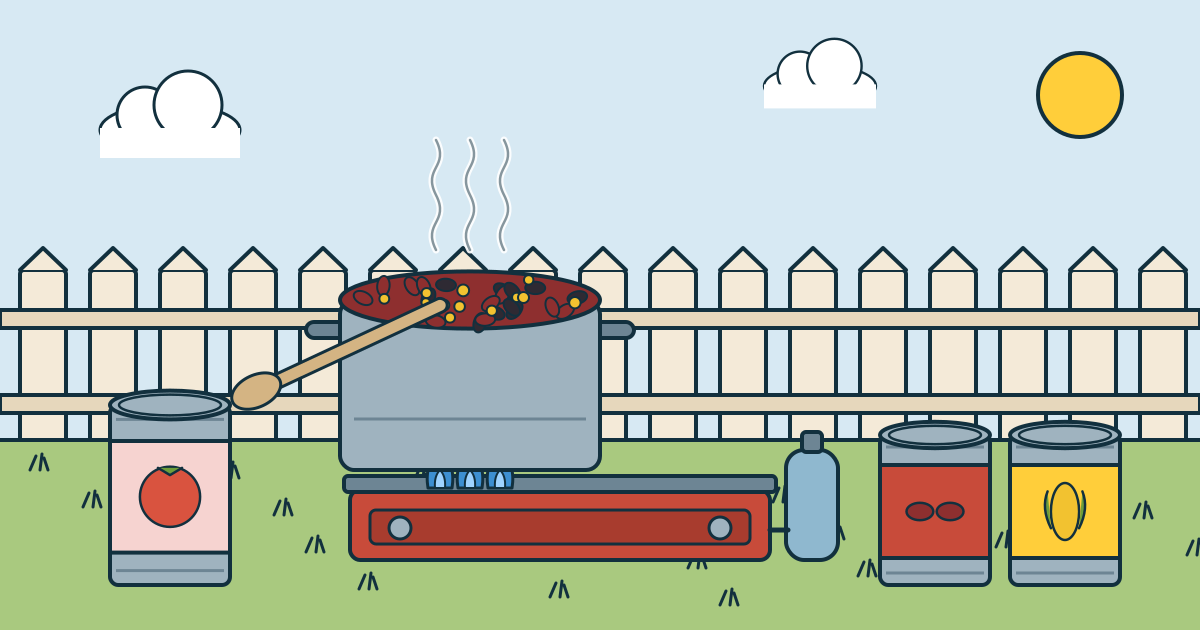
Chili appears twice in my 14-day meal ideas. This version builds it from separate cans, so you can use whatever beans you have.
Ingredients
Scaled from 4. Round cans to the nearest whole one, and add spices to taste.
- 1 can (15 oz / 425 g) kidney beans, drained
- 1 can (15 oz / 425 g) black or pinto beans, drained
- 1 can (28 oz / 796 mL) diced tomatoes, with their juice
- 1 can (15 oz / 425 g) whole kernel corn, drained
- 1 tbsp (15 mL) chili powder
- 1 tsp (5 mL) ground cumin
- 1 tsp (5 mL) onion powder
- ½ tsp (2 mL) garlic powder
- 1 can (12.5 oz / 354 g) chicken or beef, drained, optional
- salt, to taste
Equipment
- Camp stove or barbecue side burner, outdoors only
- Large pot with a lid
- Manual can opener
- Long spoon
- Oven mitt
Fuel used
One burner for about 15 minutes. Everything is already cooked in the can, so you are only heating it. A lid gets it hot faster, and if fuel runs low the chili is safe to eat cold.
Steps
- Set the stove up outdoors on a flat, stable surface, at least 20 feet (6 m) from doors, windows and vents.
- Check each can, wipe the lids and open them. Drain the beans and corn.
- Put the tomatoes and their juice in the pot. Add the beans, corn and spices and stir.
- Heat over medium, stirring now and then, until it bubbles. Turn the heat down, cover, and simmer for about 10 minutes.
- If using canned meat, stir it in and heat until the chili is steaming hot all through.
- Turn the stove off, then serve with crackers or over rice. Eat it within 2 hours unless your fridge is working.
Swaps from the pantry
- Any canned beans work. Three cans of beans and no corn is fine too.
- A jar of salsa instead of the tomatoes and spices.
- A can of ready-made chili as the base, with extra beans stirred in.
- Serve it over instant rice, or with tortilla chips.
Allergens
None of the main allergens in the base recipe. Some canned meats and chili powders contain wheat or soy, so check labels. Crackers add wheat.
Ingredients vary by brand, so read every label for your household's allergies.
Food safety
- Check every can before you open it. Do not use food from cans that are leaking, bulging or badly dented, or that have a deep dent on a seam.
- Once opened, eat it within 2 hours, or 1 hour when it is above 90°F (32°C). If your fridge is working and at or below 40°F (4°C), put leftovers in a covered container and refrigerate them. If not, throw leftovers out. See food safety when the fridge fails.
- Use safe drinking water for everything here, and especially for water that is not cooked: bottled, or boiled or treated as in treating water.
- When in doubt, throw it out. Do not taste food to test it.
Where to buy
Some links earn me a commission at no cost to you. How this works
Camp stove, outdoor use only
Coleman: Coleman Classic 2-Burner Propane Camp Stove
A two-burner propane stove for cooking through an outage; use it outdoors only, never indoors or in a garage, because it produces carbon monoxide.
Check prices and optionsat Amazon.comCheck prices and optionsat Amazon.caBattery-operated carbon monoxide alarm
Kidde: Kidde KN-COB-B-LP Nighthawk Carbon Monoxide Alarm, Battery Operated
Kidde lists it as UL Listed with an electrochemical sensor, and it runs on 3 AA batteries so it keeps working in a power outage.
Check prices and optionsat Amazon.comCanadian link coming soonBattery-operated carbon monoxide alarm
Kidde: Kidde C3010 Worry-Free Carbon Monoxide Alarm, 10-Year Sealed Battery
Kidde lists its Canadian C3010-CA as CSA Listed with an electrochemical sensor and a sealed lithium battery, so it keeps working in an outage; check the listing shows the CSA mark before buying.
US link coming soonCheck prices and optionsat Amazon.caManual can opener
OXO: OXO Good Grips Lock & Go Can Opener
A manual opener that works without power and has locking arms that hold the can while you turn.
Check prices and optionsat Amazon.comCheck prices and optionsat Amazon.ca
Sources
- USDA FSIS: Shelf-Stable Food Safety https://www.fsis.usda.gov/food-safety/safe-food-handling-and-preparation/food-safety-basics/shelf-stable-food
- Ready.gov: Food https://www.ready.gov/food
- FoodSafety.gov: Food Safety During a Power Outage (chart) https://www.foodsafety.gov/food-safety-charts/food-safety-during-power-outage
- CDC: How to Make Water Safe in an Emergency https://www.cdc.gov/water-emergency/about/index.html
Updated