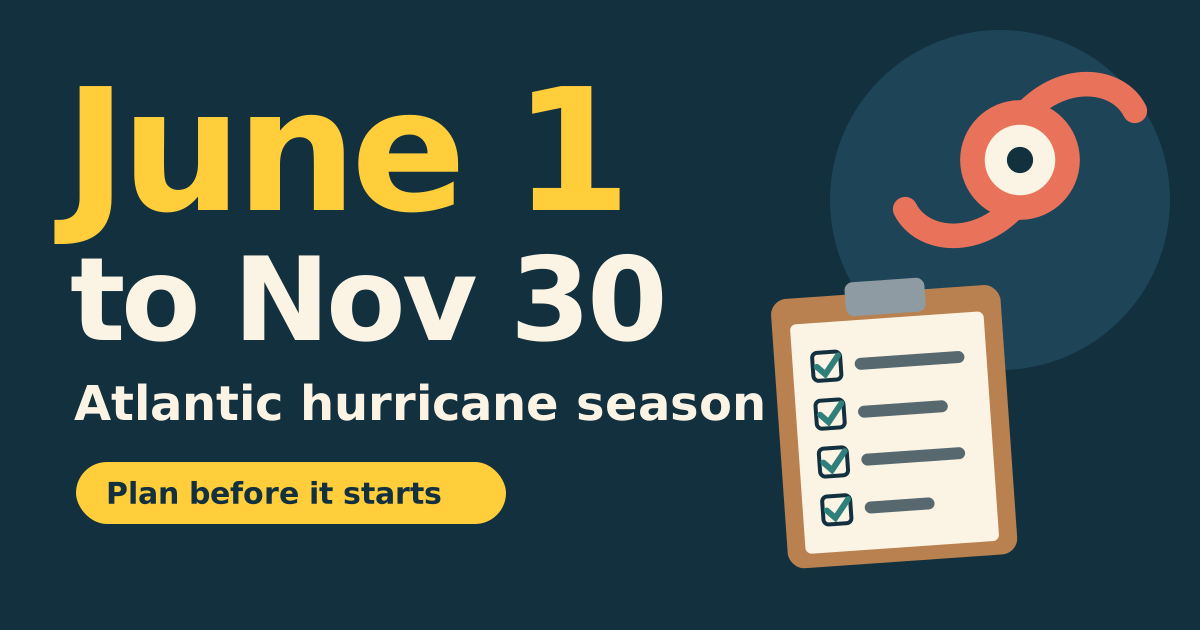
The Atlantic hurricane season runs from June 1 to November 30. That covers the US Atlantic and Gulf coasts, and the flooding from heavy rain can reach well beyond the coast. This is a seasonal checklist: as I write in November, this season is ending, so save it and start working through the first section in spring. It’s organised by timing, so you only need to look at the part you’re in.
This is general information from the National Weather Service, NOAA, the American Red Cross and CDC. Follow orders from your local officials. In an emergency, call 911.
Know the real risk: water
NOAA asks people to understand their hurricane risk from both water and wind. The National Weather Service explains why water matters so much:
- Storm surge is the abnormal rise of water generated by a storm’s winds.
- Flooding from heavy rain is the second leading cause of deaths from landfalling tropical cyclones, and it can last for several days after a storm has gone.
So even if you live away from the beach, think about flooding.
Before the season (March to May)
The NWS says to get these done before the season starts on June 1.
- Find out if you live in a hurricane evacuation area. Your county or state emergency management site has a lookup. In Florida, it’s FloridaDisaster.org/Know.
- Understand your home’s vulnerability to storm surge, flooding and wind, as the NWS puts it.
- Review your insurance. The NWS suggests checking you have enough coverage for your home and belongings. Ask your agent what is and isn’t covered, including flooding.
- Make a written plan. Decide how your household will contact each other, where you’ll go and what you’ll do.
- Check equipment, such as flashlights, generators and storm shutters.
- Sign up for local alerts. NWS sends hurricane, storm surge and extreme wind warnings by Wireless Emergency Alert with no sign-up. Your county may run a separate opt-in system, so register for it.
Build two kits
The Red Cross suggests a Go-Kit with 3 days of supplies and a Stay-at-Home Kit with 2 weeks. Florida’s emergency management agency asks for at least 7 days of food and water.
- Water: CDC says at least 1 gallon (3.8 L) per person per day
- Food that needs no cooking or fridge
- A medicine supply. CDC lists an emergency medicine supply. Talk to your pharmacist about refilling early.
- Important documents: CDC lists medical documents, wills, passports and ID. Keep copies in a waterproof bag.
- A battery or crank radio, flashlights and spare batteries
- Charged power banks
- A first aid kit
- Cash in small bills
- Pet supplies
My 7-day list and go-bag checklist cover both kits.
When a storm threatens (days out)
- Follow the National Hurricane Center forecast at nhc.noaa.gov, and your local NWS office. NOAA suggests having several ways to get forecasts and alerts.
- Top up supplies early, before the rush.
- Fill water containers and charge everything.
- Fill the car’s tank, in case you need to leave.
- Bring in outdoor furniture and anything that could blow around.
- Decide early whether you’ll stay or go. If you’re not in an evacuation zone, the Red Cross says you’ll need to decide whether to leave the area.
If you’re unsure, my stay or go post walks through it.
During the storm
The Red Cross gives three rules:
- If authorities advise or order you to evacuate, grab your kit and go right away.
- Stay away from glass windows and doors.
- Never walk, swim or drive through floodwater. CDC says cars can be swept away or may stall in just 6 inches (15 cm) of moving water.
Keep the radio on for updates, and keep phones charged for emergency calls.
After the storm
Carbon monoxide warning. Generators and other fuel-burning equipment give off carbon monoxide, which you can’t see or smell and which can kill within minutes. The NWS says never use a portable generator inside your home or garage. The Red Cross says gasoline, propane, natural gas or charcoal-burning devices should never be used inside a home, and to get to fresh air right away if anyone feels sick, dizzy or weak. Keep a battery-operated CO alarm working.
- Don’t go home until you’re told it’s safe, the Red Cross says.
- Avoid flooded roads and washed-out bridges, the NWS says.
- Don’t touch floodwater. The Red Cross says it may contain sewage, bacteria and chemicals.
- Walk around the outside of your home carefully to check for loose power lines, gas leaks and damage, as the NWS suggests.
- Check food and water safety. My fridge food safety guide and water treatment guide help.
- Photograph damage for insurance before you clean up.
My generator safety guide covers placement, cords and fuel storage.
If you live in Florida
My Florida hurricane season page covers the state’s Know Your Zone map and the AlertFlorida sign-up.
Build the rest of your plan
- Work out a week or two of supplies for your household in the plan builder.
- Print ready-made lists, such as the 7-day list and the 14-day list.
- Plan no-cook meals for after the storm on my food page and in recipes.
Questions people ask
When is Atlantic hurricane season?
The Atlantic hurricane season officially runs from June 1 to November 30. The National Weather Service suggests finishing your planning before the season begins on June 1.
What is the biggest danger in a hurricane?
Water often is. The National Weather Service describes storm surge as the abnormal rise of water generated by a storm's winds, and says flooding from heavy rain is the second leading cause of deaths from landfalling tropical cyclones. It can last for days after the storm.
Do I need to sign up for hurricane warnings on my phone?
Not for Wireless Emergency Alerts. NWS says no sign-up is needed and the service is free. NWS sends hurricane, storm surge and extreme wind warnings this way. Many counties also run opt-in alert systems, so sign up for yours too.
How many days of supplies should I keep for a hurricane?
The Red Cross suggests a Go-Kit with 3 days of supplies and a Stay-at-Home Kit with 2 weeks. Florida's emergency management agency asks for at least 7 days of food and water.
Is it safe to run a generator after a hurricane?
Only outdoors. NWS says never use a portable generator inside your home or garage. Keep it well away from doors, windows and vents, and use a battery-operated carbon monoxide alarm inside.
Where to buy
Some links earn me a commission at no cost to you. How this works
Water storage container, 7 gal / 26 L
Reliance Aqua-Tainer 7 Gallon Rigid Water Container
A rigid 7 gal (26 L) container sold for drinking water storage, so one jug covers several person-days.
Check prices and optionsat Amazon.comCheck prices and optionsat Amazon.ca
Canned beans, tuna, chicken or stew
Canned chunk chicken breast, multi-pack
Fully cooked and ready to eat from the can; USDA FSIS lists canned meat and poultry at 2 to 5 years.
Check prices and optionsat Amazon.comCheck prices and optionsat Amazon.ca
Battery or hand-crank radio, with NOAA Weather Radio
Midland ER310 Emergency Crank Weather AM/FM Radio
Runs from multiple power sources including a hand crank, and receives NOAA weather channels with alert.
Check prices and optionsat Amazon.comCheck prices and optionsat Amazon.ca
Battery or hand-crank radio, with NOAA Weather Radio
Kaito KA500 5-Way Powered Emergency AM/FM/SW Weather Alert Radio
Has solar, hand-crank and other power options plus a flashlight and reading lamp.
Check prices and optionsat Amazon.comCheck prices and optionsat Amazon.ca
Flashlight, battery or hand-crank
Black Diamond Spot 400 Headlamp
A AAA-powered dimmable headlamp that keeps both hands free and uses common batteries.
Check prices and optionsat Amazon.comCheck prices and optionsat Amazon.ca
Flashlight, battery or hand-crank
Petzl TIKKINA Headlamp, 300 Lumens
Petzl lists 300 lumens max and 100 hours at 7 lumens on three AAA batteries, at 92 g.
Check prices and optionsat Amazon.comCheck prices and optionsat Amazon.ca
Spare batteries for your flashlights and radio
Energizer Ultimate Lithium AA Batteries, 4 Pack
Energizer states AA Ultimate Lithium cells last up to 25 years in storage and work from -40°F to 140°F (-40°C to 60°C), which suits stored kits.
Check prices and optionsat Amazon.comCheck prices and optionsat Amazon.ca
Phone power bank
Anker Power Bank, 20,000mAh, Built-In USB-C Cable
A 20,000 mAh pack holds several phone charges and has its own cable, so one less thing to find in the dark.
Check prices and optionsat Amazon.comCheck prices and optionsat Amazon.ca
First aid kit with bandages, antiseptic wipes and gloves
First Aid Only 299 Piece All-Purpose First Aid Kit
A soft-sided kit with a broad mix of common supplies for home use; check contents and replace used items.
Check prices and optionsat Amazon.comCheck prices and optionsat Amazon.ca
First aid kit with bandages, antiseptic wipes and gloves
Adventure Medical Kits Mountain Series Hiker Medical Kit
Sized by the maker for 2 people for 2 days and includes a guide book for when you can't get information online.
Check prices and optionsat Amazon.comCheck prices and optionsat Amazon.ca
Waterproof pouch for document copies
SentrySafe Fire and Water Resistant Portable Bag with Zipper, FBWLZ0SSC
A zippered bag sold as fire and water resistant, for keeping IDs, insurance papers and a paper medication list together.
Check prices and optionsat Amazon.comCheck prices and optionsat Amazon.ca
Battery-operated carbon monoxide alarm
Kidde KN-COB-B-LP Nighthawk Carbon Monoxide Alarm, Battery Operated
Kidde lists it as UL Listed with an electrochemical sensor, and it runs on 3 AA batteries so it keeps working in a power outage.
Check prices and optionsat Amazon.comCanadian link coming soon
Battery-operated carbon monoxide alarm
Kidde C3010 Worry-Free Carbon Monoxide Alarm, 10-Year Sealed Battery
Kidde lists its Canadian C3010-CA as CSA Listed with an electrochemical sensor and a sealed lithium battery, so it keeps working in an outage; check the listing shows the CSA mark before buying.
US link coming soonCheck prices and optionsat Amazon.ca
Where these numbers come from (9 sources)
- National Weather Service: Hurricane safety https://www.weather.gov/safety/hurricane
- National Weather Service: Hurricane plan https://www.weather.gov/safety/hurricane-plan
- National Weather Service: After a hurricane https://www.weather.gov/safety/hurricane-after
- National Weather Service: Wireless Emergency Alerts https://www.weather.gov/wrn/wea
- NOAA: Hurricane preparedness https://www.noaa.gov/hurricane-prep
- American Red Cross: Hurricane safety https://www.redcross.org/get-help/how-to-prepare-for-emergencies/types-of-emergencies/hurricane.html
- CDC: Hurricane safety https://www.cdc.gov/hurricanes/safety/index.html
- Florida Division of Emergency Management: 2026 Hurricane Preparedness Week https://www.floridadisaster.org/news-media/news/20260504-florida-division-of-emergency-management-calls-on-floridians-to-prepare-ahead-of-hurricane-season-with-2026-florida-hurricane-preparedness-week/
- CDC: How to Create an Emergency Water Supply https://www.cdc.gov/water-emergency/about/how-to-create-and-store-an-emergency-water-supply.html